How to Diagnose Suspension-Related Ride Quality Issues Step by Step
You’ll notice suspension trouble through nose dives during braking or excessive body roll in turns, signaling worn shocks or struts. Check tires for cupping or uneven wear-scalloped patterns suggest damping failure. Perform a bounce test: push each corner down and release. If it rebounds more than twice, the shocks are failing. Inspect control arms, bushings, and ball joints for cracks or play exceeding 0.050 inches. On a test drive, feel for steering wander or alignment drift. Fluid leaks reduce damping by up to 30%, meaning replacement is necessary-further inspection reveals how deeply the wear has progressed.
Notable Insights
- Check for nose dive during braking, which may indicate worn shocks or struts reducing ride control.
- Observe tire wear patterns like cupping or feathering to identify suspension misalignment or component wear.
- Perform a bounce test at each corner; excessive rebound suggests failed shock or strut damping.
- Inspect suspension components for damage, including cracked control arms and leaking shocks or torn ball joint boots.
- Take a test drive to detect steering wander or alignment drift, signaling potential suspension geometry issues.
Spot the Signs of Suspension Trouble
What do you feel when your car nosedives hard after braking or leans sharply in turns? You’re likely experiencing worn shocks or struts, which should control spring oscillation and maintain tire contact. Uneven braking often follows, as compromised suspension allows excessive weight transfer, reducing rear tire grip. You’ll notice longer stop distances-sometimes by 10 to 15 feet at 60 mph. Steering wander occurs when loose bushings or misaligned components fail to stabilize the front end. The vehicle drifts without input, requiring constant correction. Typical fault points include degraded control arm bushings, typically lasting 70,000 miles, and strut mounts that restrict proper return. These symptoms reduce stability and increase tire scrub. Factory tolerances allow only 0.5 degrees of unintended camber shift under load-anything beyond suggests failure. You need immediate inspection. Ignoring these signs worsens safety and control, especially in emergency maneuvers or wet conditions. Upgrading to high-performance best shocks for every ride can significantly improve handling and comfort.
Check Tires: Wear Patterns That Suggest Suspension Issues
Tire wear patterns are one of the clearest indicators of underlying suspension problems. Uneven or abnormal wear often points to alignment issues or incorrect tire pressure, both influenced by suspension condition. Inspect your tires regularly-you’ll catch issues early.
| Wear Pattern | Likely Cause | Technical Insight |
|---|---|---|
| Outer edge wear | Underinflation | Bulging sidewalls reduce tread contact |
| Inner edge wear | Overinflation | Center tread lifts, increasing outer wear |
| Feathering | Toe misalignment | Tire drags sideways, creating smooth ridges |
| One-sided wear | Camber misalignment | Load imbalance over 1.5° causes rapid wear |
| Cupping (scalloped) | Worn suspension components | Bounces create 2–3 inch tread voids |
Persistent alignment issues despite correct tire pressure suggest failing control arms or bushings. Mismatched wear across axles can indicate bent struts or damaged spindles. Proper inflation (see door jamb specs) supports alignment stability. Address these clues before they affect ride safety.
Do the Bounce Test for Worn Shocks and Struts
How can you tell if your shocks or struts are failing without specialized tools? Perform the bounce test. Press down firmly on one corner of your vehicle and release. A healthy suspension should compress and rebound once, settling quickly. If the corner continues to bounce, you likely have poor shock rebound. During the test, observe strut compression-damaged struts compress too easily and fail to stabilize the vehicle. Worn shocks lose hydraulic fluid, reducing damping efficiency. Factory specs typically allow only 1–2 oscillations before stabilization. Excessive movement indicates internal wear. Each bounce after the first shows weakened control. This test checks damping performance, not structural damage. Failed rebound control affects tire contact and handling. Do this test at all four corners. Consistent over-bouncing means it’s time to replace your shocks or struts. Proper tool storage helps maintain the condition of your wrench organizers, ensuring you have the right tools available when servicing suspension components.
Look for Damaged Suspension Parts Causing Rough Ride
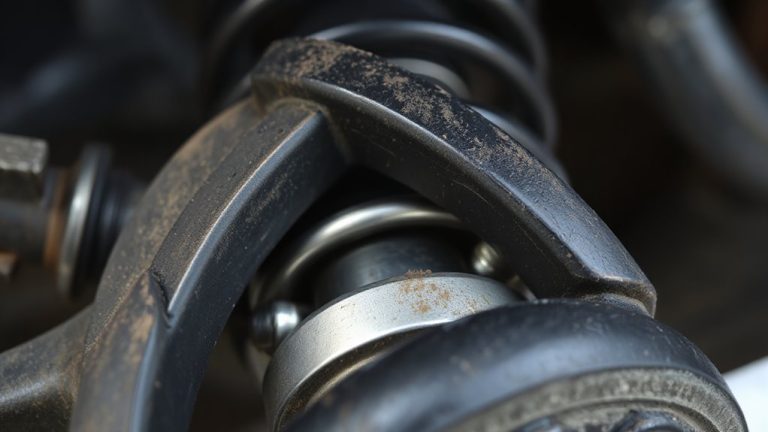
You’ve just tested your shocks and struts for damping performance-now it’s time to inspect for visible damage that could be worsening your ride quality. Start by examining the control arms for cracks, bends, or misalignment. Damaged control arms disrupt wheel geometry, leading to uneven tire wear and instability. Check bushings where the arms attach; collapsed or split rubber means compromised isolation. Next, inspect ball joints-these pivot points connect control arms to steering knuckles. Look for torn boots or play in the joint: more than 0.050 inches of movement indicates failure. Worn ball joints cause clunking and wandering steering. Use a pry bar to test for looseness while the wheel is off the ground. Any slop means replacement is needed. Both ball joints and control arms must be secured with proper torque-typically 65–75 ft-lbs for control arm bolts. Upgrading your RC car’s power source can significantly affect handling, so consider using high-performance LiPo batteries for RC cars to ensure consistent power delivery during testing and repairs.
Feel for Problems on a Diagnostic Test Drive
What if the clues to your suspension problems aren’t visible under the car but felt behind the wheel? A diagnostic test drive reveals issues like steering wander and alignment drift that static inspections miss. Drive on a level, straight road first, then shift to uneven surfaces. Pay attention to how the vehicle responds to inputs and road variations.
| Sensation | Likely Cause | What to Note |
|---|---|---|
| Steering wander | Worn tie rods or ball joints | Excessive free play in steering wheel |
| Alignment drift | Misaligned suspension angles | Vehicle pulls without steering input |
| Nose dive on braking | Worn shocks or struts | Front dips sharply, reducing control |
Stay alert for delayed response or uneven resistance. Steering wander often points to front-end wear. Alignment drift suggests geometry changes from damaged components. These sensations confirm dynamic failures not seen during a visual check.
Know When to See a Mechanic for Suspension Repairs
Why wait until the ride turns rougher than a gravel road? When you notice persistent alignment problems, like uneven tire wear or a drifting steering feel, it’s time to see a mechanic. These symptoms often point to worn control arms or damaged tie rods, which require precise realignment-typically within ±0.5 degrees of factory specs. Fluid leaks around shocks or struts signal failing hydraulic components. A single damp shock can degrade damping efficiency by up to 30%, reducing stability. If your car nose-dives sharply during braking or bounces excessively over bumps, internal seal failure is likely. Mechanics use pressure tests and lift inspections to confirm leaks and measure suspension travel variance. Delaying repair risks further damage to mounting points or accelerated tire wear. Trust calibrated diagnostics over guesswork. Early professional intervention guarantees safety, prolongs component life, and maintains ride quality within OEM tolerances. Don’t DIY every fix-some jobs need precision tools and expertise.
On a final note
You now have the tools to identify suspension issues accurately. Check for uneven tire wear-especially cupping or scalloping-as it often signals worn shocks or misaligned components. Perform the bounce test: press down on each corner; if the car bounces more than once, the dampers are likely failing. Inspect control arms, bushings, and struts for cracks or leaks. During a test drive, note pulling, nosediving, or instability in corners. These symptoms indicate degraded performance. Address problems promptly. Ignoring them risks tire life, braking efficiency, and control. For complex diagnostics-like measuring strut travel or alignment angles-professional equipment is essential. Timely repairs restore ride quality and safety.