How to Select the Ideal Coilover System for Track-Focused Street Cars
You need coilovers with 16–32 clicks of adjustable damping to fine-tune compression and rebound for both track response and street comfort. Choose a system with 1.5 to 3 inches of ride height adjustment to optimize center of gravity and weight transfer. Use monotube shocks with 46mm dampers and remote reservoirs for consistent heat management and fade-free performance. Opt for spring rates between 600–800 lb/in to balance grip and compliance on mixed surfaces. Durable components like PTFE seals, hardened piston rods, and anodized mounts guarantee longevity under daily and track stress. Further refinements in tuning await your next steps.
Notable Insights
- Choose coilovers with 16–32 clicks of adjustable damping to fine-tune compression and rebound for track and street balance.
- Select a spring rate between 600–800 lb/in to control body roll while maintaining grip on varied road surfaces.
- Prioritize monotube designs with remote reservoirs for superior heat dissipation during sustained track use.
- Ensure ride height adjustability of 1.5 to 3 inches to optimize handling without compromising ride comfort.
- Invest in durable components like hardened piston rods and PTFE-coated seals for longevity under combined street and track stress.
Match Your Driving Style to the Right Coilovers
How well do your coilovers match the way you actually drive? If you’re pushing hard on twisty roads or tracking your car, stock suspension won’t cut it. Performance demands proper coilover preload and shock valving tuned to your inputs. Preload adjusts spring tension, affecting how quickly the wheel responds to bumps-too much causes harshness, too little leads to bottoming. Most aftermarket coilovers let you fine-tune this with a threaded collar. Shock valving controls how fast oil flows through the damper; high-speed valving manages impacts, low-speed handles body roll. Match stiffer valving to aggressive driving; softer settings suit street comfort. Fully adjustable coilovers offer independent compression and rebound control, often with 16–32-click ranges. Fixed valving systems rely on factory presets-less flexible, but reliable. Always align settings with your weight, spring rate (measured in lb/in), and driving intensity.
Prioritize Ride Height and Damping Adjustability
Why settle for a static stance when your driving demands adaptability? You need ride height precision to dial in the ideal center of gravity for both street comfort and cornering stability. Quality coilovers offer 1.5 to 3 inches of adjustment, letting you fine-tune fender gap without sacrificing suspension travel. Pair that with an extensive damping control range-ideally 16 to 32 clicks of rebound adjustment-so you can respond to varying loads, road surfaces, and track conditions. Independent compression and rebound tuning allow you to control body roll and wheel contact under heavy braking or fast direction changes. Monotube designs deliver consistent damping response due to superior heat dissipation. You’re not just lowering your car-you’re calibrating performance. With precise ride height control and broad damping adjustability, your setup stays optimized year-round, whether cruising or attacking back roads. For daily-driven performance vehicles, selecting top coilovers for daily driving ensures a balance of comfort and responsiveness without compromising long-term reliability.
Invest in Durable Components for Daily and Track Use
Every component in your coilover system must withstand the daily grind and the extreme demands of track use. Prioritizing build quality guarantees coilover longevity and unmatched track durability. You need materials that resist wear, corrosion, and fatigue over time. Below is a comparison of critical components and their performance impact:
| Component | Benefit |
|---|---|
| Hardened piston rod | Resists bending and pitting under high loads |
| Stainless steel reservoir | Prevents rust and maintains pressure stability |
| PTFE-coated seals | Reduce friction and extend service life |
| Anodized aluminum mounts | Lightweight, corrosion-resistant, and strong |
You face constant vibration, heat, and stress-your coilovers must handle it all. High-grade internals maintain damping consistency. Quality construction directly translates to reliability. Choose durable parts to support both daily driving and aggressive track sessions without compromise. Performance isn’t just about adjustability-it’s about lasting power.
Size Dampers and Reservoirs for Sustained Performance
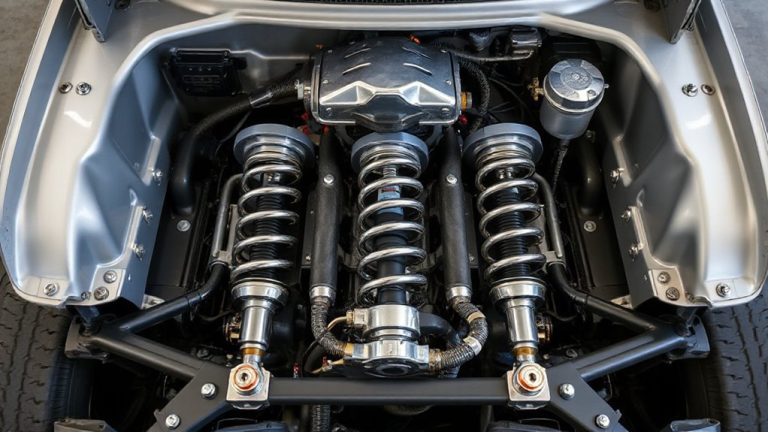
Your coilover system’s damping performance hinges on properly sized dampers and reservoirs, especially under sustained load. You need adequate fluid capacity to maintain consistent damping force during repeated compression and rebound. Larger damper bodies, like 36mm or 46mm pistons, provide more surface area for oil displacement and reduce heat buildup. Remote reservoirs increase fluid capacity by up to 50%, improving thermal management during track use. As temperatures rise, insufficient fluid capacity leads to aeration and fade, degrading response. Nitrogen-charged reservoirs minimize fluid cavitation, maintaining damping consistency. Efficient thermal management relies on aluminum construction and finned housings, which dissipate heat faster. For sustained high-speed cornering or back-to-back sessions, reservoir size and external cooling surfaces are critical. Prioritize systems with twin-tube or piggyback reservoirs designed for heat dispersion. These features preserve damping integrity, ensuring you get repeatable performance lap after lap.
Balance Stiffness and Compliance for Real-World Driving
While chasing maximum stiffness might seem like the path to better handling, a properly tuned coilover system balances firmness with compliance to deliver usable performance on real roads. You need spring rates that control body motion without crashing over bumps. Too stiff, and you lose traction; too soft, and you roll excessively. Match these with appropriate shock valving to manage energy absorption. Proper valving guarantees quick damping response without harshness. For street-driven track cars, aim for progressive spring rates and adjustable damping.
| Spring Rate (lb/in) | Best For |
|---|---|
| 400–600 | Daily-driven street cars |
| 600–800 | Mixed street/track use |
| 800–1000 | Track-focused with rough roads |
| 1000+ | Pure track, smooth surfaces only |
Choose wisely-your tires and suspension travel depend on it.
On a final note
You need coilovers that match your driving demands. Dual-adjustable dampers let you fine-tune rebound and compression, typically offering 20–32 clicks of adjustment for precise control. Use 6061-T6 aluminum bodies for lightweight durability. Remote reservoirs reduce fade by increasing oil capacity by up to 40%. Spring rates between 8–16 kg/mm balance track stiffness with street compliance. Proper valving maintains consistent damping, like a thermostat regulating temperature.