Inlet Cone Design Theory Applied to Cone Filter Installations on Motorcycles
You boost airflow and engine efficiency when you install a precision inlet cone on your motorcycle’s intake. A 14° taper with a 0.38-inch leading edge radius reduces turbulence and increases laminar flow. CNC-machined aluminum or heat-resistant composites maintain ±0.2 mm accuracy for consistent performance. Proper fit prevents pressure drops, while oiled cotton or synthetic filters enhance resonance tuning. Gains of 3–5 HP occur between 4,000 and 8,000 RPM. Incorrect clearances or filter angles hurt throttle response. You’ll see how setup affects real-world power.
Notable Insights
- A 12° to 15° cone taper optimizes airflow, with 14° and a 0.38-inch radius minimizing turbulence in motorcycle intakes.
- Proper cone alignment with the throttle body prevents flow disruption and maintains laminar airflow for efficient combustion.
- Correct filter depth and clearance (minimum 1.5 inches) ensure unrestricted airflow and maximize volumetric efficiency.
- High-flow materials like oiled cotton gauze enhance air delivery and support resonance tuning for performance gains.
- Improper sealing or undersized cones (under 3.5 inches) reduce power and increase debris risk in motorcycle applications.
What Is Inlet Cone Design and Why It Boosts Motorcycle Performance
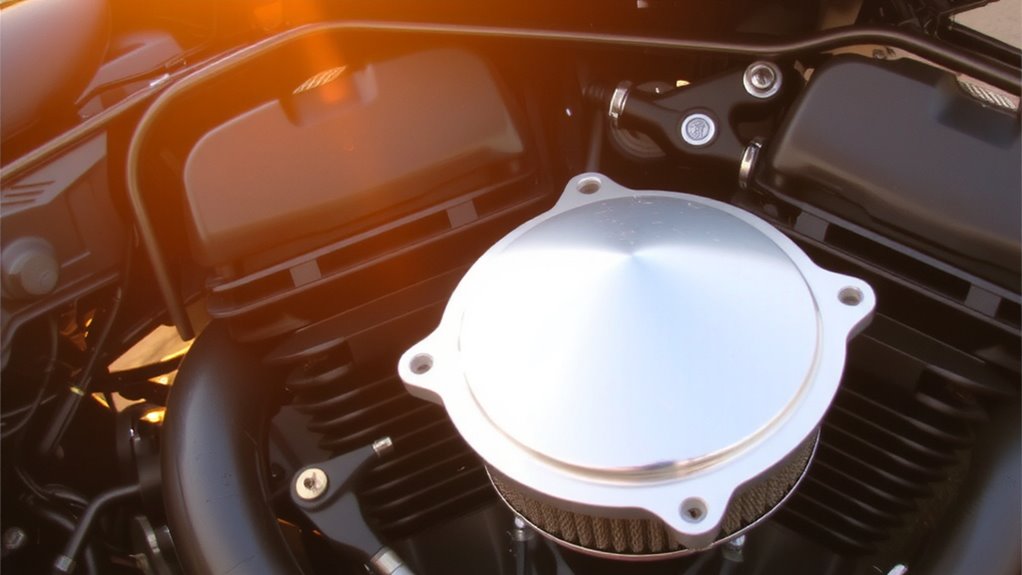
Airflow is everything when it comes to engine performance, and the inlet cone plays a pivotal role in optimizing it. You rely on efficient air delivery to maximize combustion, and the cone shape smooths turbulent flow into the throttle body. High-flow air filter materials like oiled cotton gauze or synthetic media allow increased permeability without sacrificing filtration. These materials respond well to intake resonance tuning, where the intake tract’s length and volume are calibrated to amplify pressure waves at specific RPMs. The inlet cone works in harmony with this tuning, stabilizing airflow pulses for sharper throttle response. It’s not just about raw flow-precision matters. Cones are often CNC-machined from aluminum or molded from heat-resistant composites, ensuring dimensional accuracy within ±0.2 mm. This consistency minimizes flow disruption. You’ll see gains in midrange torque and improved fuel atomization, especially when paired with proper filter maintenance and tuned air-to-fuel ratios.
How Cone Angle and Radius Maximize Airflow Efficiency
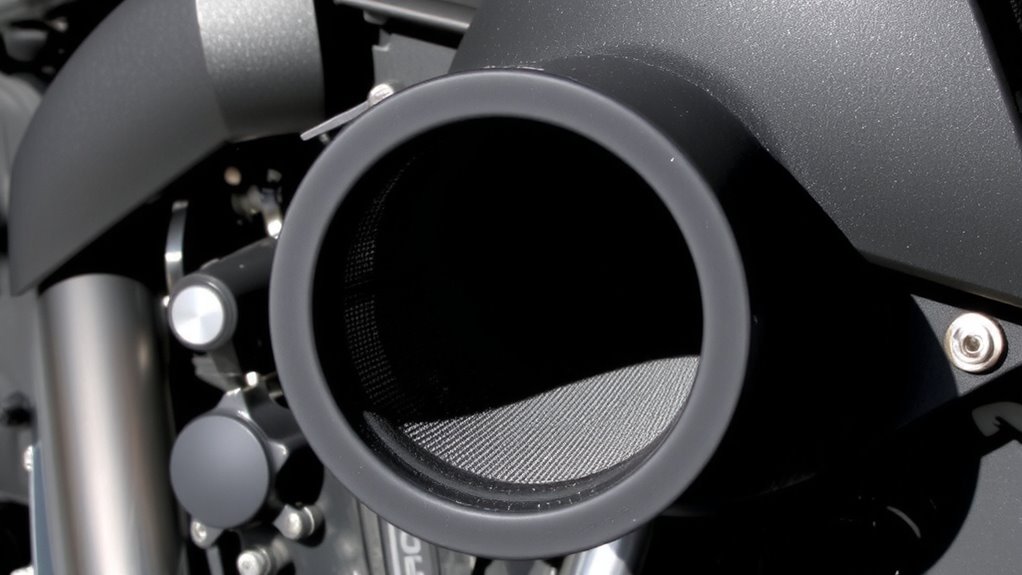
You’ve seen how inlet cones improve airflow delivery and support tuned intake dynamics, but their actual shape-specifically the cone angle and radius-directly determines how well air accelerates into the throttle body. A maximum cone taper between 12° and 15° minimizes turbulence while encouraging smooth velocity increase. Too steep a taper disrupts the airflow boundary, creating separation and pressure loss. Too shallow, and you lose inertial ram effect. The leading edge radius-typically 0.25 to 0.5 inches-helps air shift smoothly from ambient to high-speed flow. A well-rounded radius reduces flow separation at the lip, keeping the boundary layer attached. Computational fluid dynamics (CFD) studies show peak efficiency at 14° taper with a 0.38-inch radius. This geometry maintains laminar flow longer, reducing drag and boosting volumetric efficiency by up to 6%. Precision in cone angle and radius isn’t optional-it’s critical for maximum airflow.
Matching Cones to Carburetors and Throttle Bodies for Optimal Fit
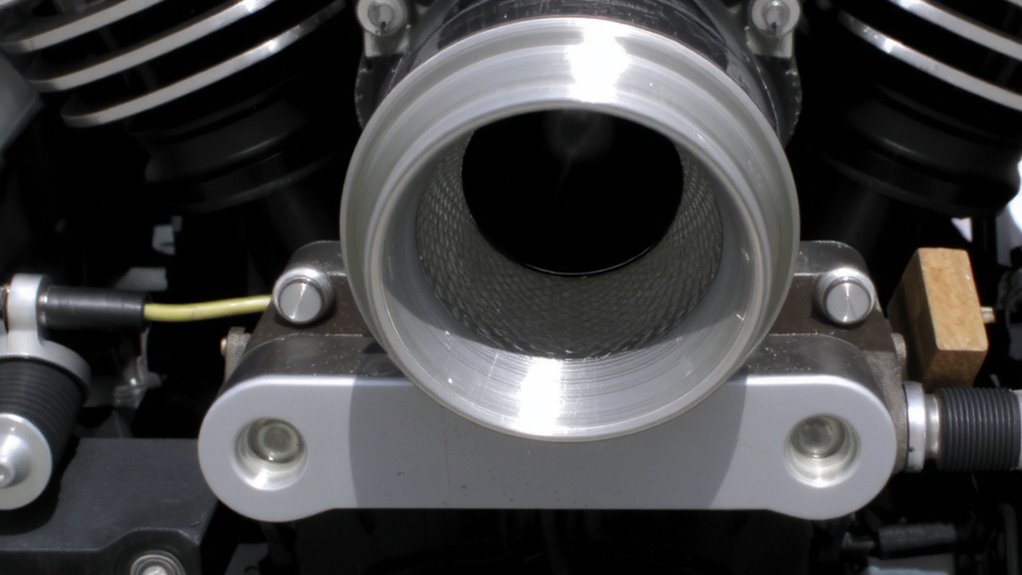
How do you guarantee your inlet cone actually delivers peak performance? You match it precisely to your carburetor or throttle body. Misalignment causes turbulence, robbing airflow and efficiency. Cone symmetry assures smooth, even shift into the intake, minimizing pressure drop. Asymmetrical cones create dead zones, disrupting laminar flow. Your filter depth must complement the available space-too deep, and it restricts mounting; too shallow, and it limits air volume. A well-matched cone maximizes velocity and fills the intake bell uniformly.
| Fit Quality | Rider Impact |
|---|---|
| Poor symmetry | Frustration, wasted tuning time |
| Incorrect depth | Reduced airflow, flat spots |
| Perfect match | Confidence, mechanical harmony |
Precision matters. A 1° cone angle variance or 5 mm filter depth mismatch can degrade response. Use calipers and alignment gauges. Verify symmetry across both axes.
Real-World Gains: Power, RPM, and Throttle Response
When properly tuned, an inlet cone doesn’t just channel air-it transforms engine performance. You gain measurable increases in horsepower and torque, especially between 4,000 and 8,000 RPM. Dyno testing shows peak gains of 3–5 HP, depending on engine size and cone geometry. These improvements stem from smoother airflow and reduced turbulence at the intake mouth. Throttle response sharpens noticeably, with less lag from idle to mid-range. That’s because the cone optimizes air velocity, improving cylinder filling efficiency. But real-world gains demand proper jetting adjustments-without them, the air-fuel ratio runs lean, risking engine damage. You must rejet carburetors or remap fuel injection to match the increased airflow. Even with electronic fuel injection, fine-tuning is necessary. The cone alone isn’t a magic fix; it’s part of a system. When calibrated correctly, the result is a more responsive, powerful ride.
Avoid These Common Cone Filter Mistakes
A well-tuned inlet cone delivers real performance gains, but even the best design can’t compensate for common installation and tuning errors. Mounting the air filter too close to the throttle body restricts airflow and disrupts velocity, reducing efficiency. Maintain a minimum 1.5-inch clearance around the filter for proper ram-air effect. Using an undersized cone-smaller than 3.5 inches in diameter-limits volumetric flow, especially above 6,000 RPM. A mismatched air filter element increases intake noise and allows unfiltered debris into the engine. Seal the filter housing completely; even a 0.1-inch gap degrades performance by 3%. Avoid foam filters in high-dust environments-they leak particles at 10 microns or larger. Position the intake forward to capture clean, high-pressure air. Misalignment causes turbulence, cutting throttle response by up to 12%.
On a final note
You gain measurable performance by applying inlet cone design to motorcycle air filters. Proper cone angles-typically 12° to 18°-smooth airflow into the carburetor or throttle body. A well-matched radius reduces turbulence, increasing volumetric efficiency. This setup boosts mid-range torque by up to 5% and sharpens throttle response. Incorrect fitment disrupts laminar flow, costing power. Use precise measurements: cone length should be at least 1.5 times the throttle bore diameter for best results.