Intake Air Humidity vs Oxygen: 20.9% to 20.2% AFR Impact
You’re breathing less oxygen with every intake stroke when humidity rises-water vapor displaces oxygen, dropping levels from 20.9% in dry air to 20.2% at 100% RH and 30°C. Each 1% increase in moisture cuts oxygen by 0.21%, reducing air density and combustion efficiency. Your engine’s fixed air volume means fewer oxygen molecules, creating a de facto lean condition. Mass airflow sensors can’t detect this shift, so fuel trims adjust within limits-typically ±25%. Modern ECUs use humidity compensation tables, adjusting AFR by up to +0.15 to maintain stability, but rapid humidity swings over 40% in 60 seconds may exceed correction range. Even with closed-loop control, combustion suffers due to delayed response and incomplete corrections. There’s more to how temperature and pressure interact in this balance.
Notable Insights
- High humidity reduces oxygen content in intake air due to displacement by lighter water vapor molecules.
- Increased water vapor lowers air density, decreasing oxygen mass per intake volume.
- Less oxygen leads to leaner air-fuel mixtures even with unchanged fuel delivery.
- Mass airflow sensors may not detect humidity-induced air composition changes, affecting fuel trim accuracy.
- Modern ECUs use humidity compensation to maintain AFR stability across varying humidity levels.
Why Humid Air Means Less Oxygen in Combustion
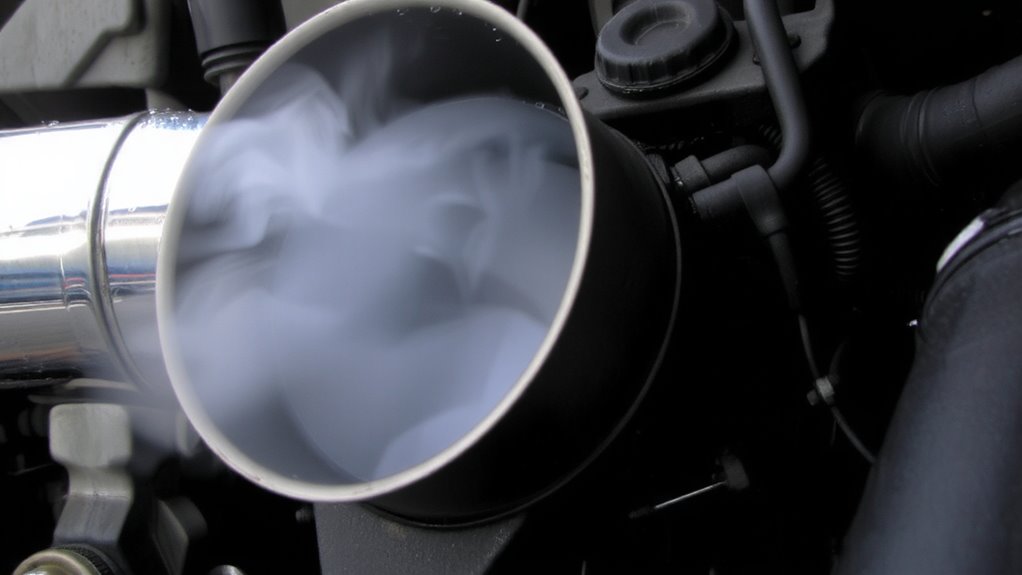
Every cubic meter of humid air contains fewer oxygen molecules than dry air because water vapor displaces other gases, including oxygen. This process, known as molecular displacement, reduces the concentration of oxygen available for combustion. You’re dealing with lower air density in humid conditions since water molecules, which are lighter than nitrogen and oxygen, replace heavier molecules in the mix. Although humidity slightly decreases overall air density, the critical issue is the reduced partial pressure of oxygen. For every 1% increase in water vapor content, oxygen volume drops by nearly 0.21%. Engines inhale a fixed volume of air, so when humidity rises, fewer oxygen molecules enter the combustion chamber. This alters the air-fuel ratio, even if fuel delivery stays constant. Molecular displacement doesn’t change mass airflow directly but affects composition. You must account for this to maintain combustion efficiency and emissions compliance.
How Water Vapor Lowers Intake Oxygen Levels
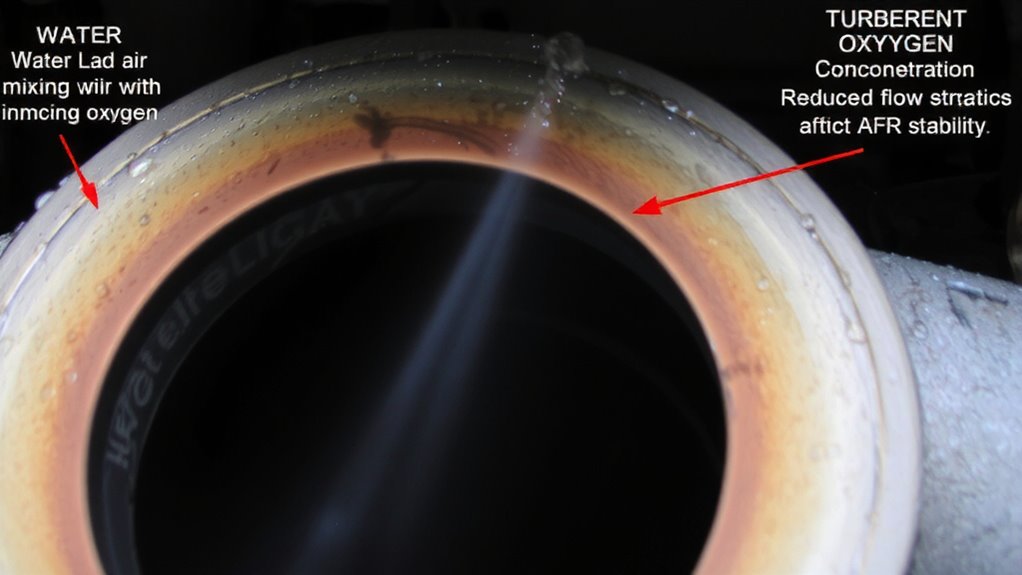
While you might assume the air your engine breathes remains constant, water vapor actively alters its oxygen content. Water molecules displace oxygen and nitrogen in the intake charge through molecular displacement. Each water molecule (H₂O) occupies space that would otherwise hold O₂ or N₂, reducing oxygen availability. Vapor density plays a key role-water vapor is less dense than dry air, but its presence increases total gaseous volume without contributing to combustion. At 100% relative humidity and 30°C, humid air contains nearly 4% water vapor by volume. This displaces about 3.2% of oxygen molecules in the mixture. The effect is measurable: oxygen concentration drops from 20.9% in dry air to roughly 20.2%. Engines rely on consistent oxygen levels for ideal combustion. Even small changes from vapor-induced dilution directly impact the intake charge’s chemical composition. You can’t see it, but it’s altering combustion potential every time humidity rises.
How Humidity Triggers Lean Air-Fuel Ratios
Since humidity reduces the oxygen content of the intake air, your engine ends up with less oxygen available for combustion, even if the fuel delivery stays constant. Water vapor displaces oxygen in the air, lowering air density. Reduced air density means each intake stroke contains fewer oxygen molecules. Your engine’s ECU relies on mass airflow calculations, but high humidity fools sensors into expecting more oxygen than is present. This mismatch creates a lean air-fuel ratio, even with correct fueling. Lean mixtures disrupt combustion efficiency, causing incomplete burns and higher combustion temperatures. You’ll see elevated NOx emissions and potential misfires. Combustion efficiency drops because ideal flame propagation requires precise air-fuel balance. Think of it like trying to light damp wood-fuel is present, but the conditions aren’t right for full burn. The result? A stoichiometric fuel signal no longer guarantees stoichiometric combustion. Real-time wideband monitoring reveals this imbalance clearly.
Real-World Power Loss in High Humidity
Why does your engine feel sluggish on muggy days even if the tuning hasn’t changed? High humidity reduces oxygen density in intake air by up to 3% at 100% relative humidity, directly cutting combustion efficiency. Your engine burns less fuel per cycle, dropping power-typical loss ranges from 2% to 5% torque in forced induction systems. Poorer fuel quality worsens this; lower volatility fuels don’t vaporize fully in moist air, increasing unburned hydrocarbons. Inconsistent combustion raises cylinder temperatures, accelerating engine wear over time. Moisture also promotes condensation in fuel lines, risking phase separation in ethanol-blended fuels. You’re not imagining it-dyno tests confirm measurable horsepower decline above 70% RH. Even with stable AFR, thermodynamic inefficiency persists. High humidity doesn’t just dilute air-it disrupts the precision of combustion, compounding stress on internal components and diminishing long-term reliability, especially in high-performance or turbocharged applications.
How ECUs Use Sensors to Adjust for Humidity
Modern engines rely on real-time sensor data to compensate for humidity’s impact on air density, even if your tune stays unchanged. Your ECU uses inputs from the MAF, MAP, and IAT sensors to estimate air mass, adjusting fuel delivery accordingly. Proper sensor calibration guarantees accuracy, especially when humidity skews oxygen levels. Without it, fuel trims run wild. The ECU relies on data interpolation between known lookup points in the fuel map to adapt to unseen conditions.
| Sensor | Role in Humidity Adjustment | Calibration Impact |
|---|---|---|
| MAF | Measures airflow mass | High-drift causes incorrect fueling |
| MAP | Detects air pressure changes | Medium-altitude and humidity linked |
| IAT | Monitors intake temperature | Medium-temp affects density |
| O2 | Confirms AFR post-combustion | High-feedback loop basis |
| ECU | Processes all inputs | Critical-relies on data interpolation |
When Fuel Trim Can’t Keep Up With Humidity Shifts
What happens when the air suddenly shifts from dry to saturated-can your engine still stay in balance? Your ECU relies on fuel trim to adjust for humidity, but rapid changes can overwhelm its correction range. When intake air absorbs more moisture, oxygen density drops faster than fuel trim can compensate. The result? A richer mixture than intended, disrupting AFR stability. Excess humidity hinders fuel vapor formation, leading to incomplete mixing in the combustion chamber. Poor vaporization causes inconsistent cylinder-to-cylinder fuel distribution. This imbalance introduces combustion lag, delaying peak pressure timing and reducing torque output. In forced-induction engines, this lag increases knock risk under load. Fuel trims max out at ±25% in most OEM ECUs-beyond that, correction fails. Sudden humidity spikes of 40%+ in under 60 seconds exceed sensor response rates, especially with slower O2 units. Without predictive adjustment, your engine operates suboptimally until conditions stabilize.
Tuning for Stable AFR in Changing Humidity
How do you keep AFR stable when humidity shifts without warning? You adjust your tuning strategy to compensate for changes in air density and maintain combustion efficiency. Humid air is less dense, reducing oxygen content and altering the ideal AFR. Without correction, this leads to rich conditions and incomplete combustion. Use real-time humidity sensors paired with advanced engine controllers to dynamically adjust fuel delivery. Modern ECU tuning software allows you to program humidity compensation tables, ensuring precision.
| Humidity (%) | Air Density (kg/m³) | AFR Adjustment |
|---|---|---|
| 20 | 1.204 | +0.15 |
| 40 | 1.190 | +0.10 |
| 60 | 1.176 | +0.05 |
| 80 | 1.163 | 0.00 |
| 100 | 1.150 | -0.05 |
These small corrections keep AFR near stoichiometric, maximizing power and minimizing emissions.
On a final note
You must account for humidity’s impact on oxygen levels. Humid air contains water vapor, displacing oxygen by volume-each 10% increase in relative humidity reduces oxygen content by approximately 1%. This leads to lean air-fuel ratios, risking misfire and power loss. Modern ECUs adjust fuel trim using data from MAF and IAT sensors. But rapid humidity shifts can overwhelm corrections. Proper tuning with real-time AFR monitoring guarantees stability.