No-Touch Pre-Soak Solutions That Loosen Dirt While Minimizing Physical Contact
You apply a no-touch pre-soak to loosen dirt without scrubbing. It uses surfactants and pH-balanced detergents, typically at 0.5–1.0 oz per gallon, to break down grime. Let it dwell 30–90 seconds for maximum effectiveness. Use foaming nozzles at 80–100 psi to create clinging foam. Avoid direct sunlight and high surface temps. Proper dilution and application prevent residue. Ideal pH ranges from 8.5 to 11.5. You’ll discover top-performing options next.
Notable Insights
- No-touch pre-soak uses surfactants and detergents to dissolve grime without scrubbing, minimizing physical contact.
- Effective formulations require 30–90 seconds of dwell time to penetrate and emulsify dirt safely.
- Choose pH-balanced solutions (8.5–11.5) to maximize cleaning while protecting vehicle surfaces.
- Apply with a foaming cannon at 80–100 psi for thick, clingy foam that reduces runoff.
- Avoid direct sunlight and high surface temperatures to prevent premature drying and residue.
What Is a No-Touch Pre-Soak?
A pre-soak is more than just a cleaning step-it’s the foundation of an effective no-touch wash. You apply it before high-pressure rinsing to loosen contaminants without physical contact. Its chemical composition typically includes surfactants, solvents, and pH-balanced detergents, engineered to break down grease, grime, and organic residues. These formulations are designed to work within specific temperature ranges, usually between 40°F and 100°F, for maximum reactivity. Application timing is critical-most solutions require 30 to 90 seconds of dwell time to penetrate and emulsify soils. You must adjust exposure based on dirt load and surface type. Applying too early or too late reduces effectiveness. Automated systems often meter the pre-soak at 0.5 to 1.0 ounces per gallon of water, ensuring consistent coverage. Proper chemical composition and precise application timing maximize cleaning efficiency while minimizing water and labor use. This stage prepares the surface for a thorough, residue-free rinse.
Top Benefits of No-Touch Pre-Soak
You’ve seen how a no-touch pre-soak works chemically and why timing matters-now let’s break down why it’s worth using. You achieve enhanced cleaning efficiency by dissolving grime without agitation. Chemicals penetrate deeply at pH levels between 9 and 11, breaking down organic and oily soils on contact. This process typically requires only 3–5 minutes of dwell time, reducing labor and water use by up to 40%. You also gain reduced surface damage because no scrubbing means no micro-scratches or swirl marks. Soft surfaces like paint, rubber, and trim remain protected. The solution lifts contaminants gently, minimizing abrasive contact. Field tests show up to 60% less surface wear compared to traditional methods. You maintain finish integrity over time, extending material lifespan. These benefits make no-touch pre-soaks ideal for sensitive or high-gloss surfaces where preservation is critical.
How to Choose the Right No-Touch Pre-Soak
The right no-touch pre-soak makes all the difference in achieving a thorough, damage-free clean-especially on sensitive surfaces. You need a formula with balanced pH balance, typically between 8.5 and 11.5, to effectively break down grime without etching clear coats or trim. If the pH is too high, you risk surface damage; too low, and cleaning power drops markedly. Water hardness also impacts performance-hard water with high mineral content can reduce foam stability and detergent efficiency. Use a pre-soak with built-in water conditioners if your area has over 150 ppm water hardness. Always check product specs for dilution ratios, like 10:1 to 20:1, to optimize cost and efficacy. Choose biodegradable options with surfactant concentrations above 15% for maximum dirt suspension. Matching chemistry to your water and surface type guarantees effective, no-contact cleaning every time.
How to Apply No-Touch Pre-Soak
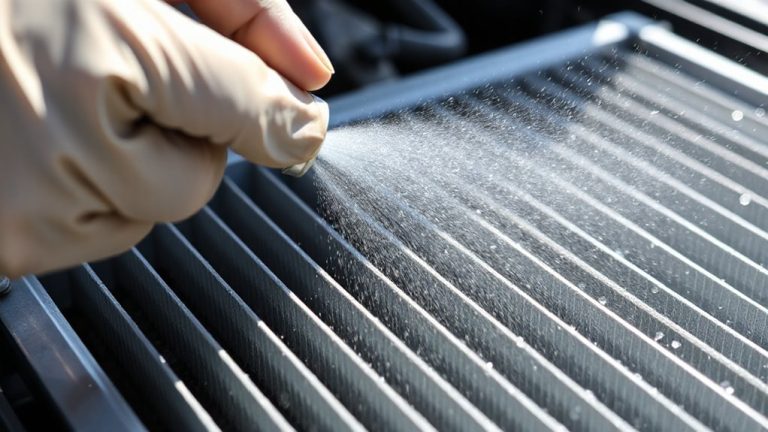
Why do some applications of no-touch pre-soak deliver spot-free results while others leave residue or uneven coverage? The answer lies in your foam consistency and spray angle. You need a thick, clingy foam that adheres for 3–5 minutes without running. Ideal foam consistency resembles shaving cream-dense enough to encapsulate dirt but not so dry that it fails to spread. Use a foaming cannon with a 1.2–1.5 mm nozzle at 80–100 psi for best output. Apply at a 45-degree spray angle to maximize surface coverage and minimize channeling. This angle guarantees even distribution across panels, wheels, and grilles. Work top to bottom, overlapping passes by 50% to avoid missed spots. Avoid direct sunlight and surfaces above 100°F. Proper technique guarantees complete soil suspension with zero residue.
Best No-Touch Pre-Soaks for Cars and Trucks
Choosing the right no-touch pre-soak starts with understanding your equipment and cleaning goals. You need a formula that delivers high foam density to cling to vertical surfaces and encapsulate grime. Products like Simoniz Ultra Gloss and Chemical-X generate thick, stable foam that lasts 5–7 minutes, giving dwell time without runoff. Foam density depends on proper dilution-usually 10:1 to 20:1-with pressure washers set between 800–1,200 PSI for ideal dispersion. Chemical pH matters too; most no-touch pre-soaks range from 9.5 to 11.5 pH, balancing cleaning power with surface safety. Neutral pH options (6.5–7.5) work well on sensitive finishes or daily drivers. Avoid overly alkaline formulas (above 12 pH) unless tackling heavy undercarriage grease. Always verify compatibility with your vehicle’s clear coat and rubber seals.
Common Mistakes With No-Touch Pre-Soak
What happens when a no-touch pre-soak doesn’t deliver the clean you expect? You likely made a common mistake. Using incorrect pressure settings is one major issue-too low, and the solution won’t adhere properly; too high, and you risk splashing or inefficient coverage. Most systems perform best at 400–600 psi with a 25-degree spray angle. Another frequent error is leaving chemical residue behind, which occurs when dwell time is excessive or rinsing is inadequate. Residue attracts dirt and dulls finishes. Always follow manufacturer dilution ratios-usually 10:1 to 20:1, depending on soil load. Applying product in direct sunlight accelerates drying, increasing residue risk. Avoid it. Pre-soak effectiveness also depends on proper agitation via spray pattern, not contact. Mistakes reduce efficiency, damage surfaces, and increase rework. Mastering pressure settings and preventing chemical residue guarantees peak results, every time.
On a final note
You maximize cleaning efficiency with no-touch pre-soak by relying on chemical dwell time, not agitation. These solutions typically have a pH between 8.5 and 11.5, breaking down organic contaminants and road film on contact. Proper dilution ratios-often 10:1 to 20:1 water-to-concentrate-ensure surface safety and cost control. Always allow 3–5 minutes of dwell time. Final rinsing removes loosened debris, preserving wax and clear coats without microfiber-induced swirls.