Resonance Frequency Matching Between Exhaust Length and Engine Firing Order
You match exhaust system resonance frequency to engine firing order by tuning header length to synchronize pressure waves with valve overlap. Exhaust pulses travel at roughly 1,100 m/s in hot gases, reflecting off pipe ends to create scavenging low-pressure zones. Firing order dictates pulse timing, so equal-length primaries guarantee waves arrive at the collector in phase. Proper synchronization boosts torque by up to 15% at target RPM. Your header’s length, diameter, and collector design must align with cam timing and engine speed-adjustments shift resonance to match power band needs. Further optimization reveals how small changes impact overall engine efficiency.
Notable Insights
- Resonance frequency in exhaust systems is tuned by header length to match engine RPM and firing order timing.
- Firing order determines exhaust pulse sequence, influencing wave reflections and scavenging efficiency at specific frequencies.
- Equal-length headers ensure pressure waves from each cylinder arrive at the collector in sync with firing intervals.
- Proper resonance matching enhances low-pressure scavenging during valve overlap, improving torque at target RPM ranges.
- Exhaust tuning must align primary tube length and collector design with firing order to optimize wave dynamics.
How Exhaust Tuning Turns Sound Waves Into Torque
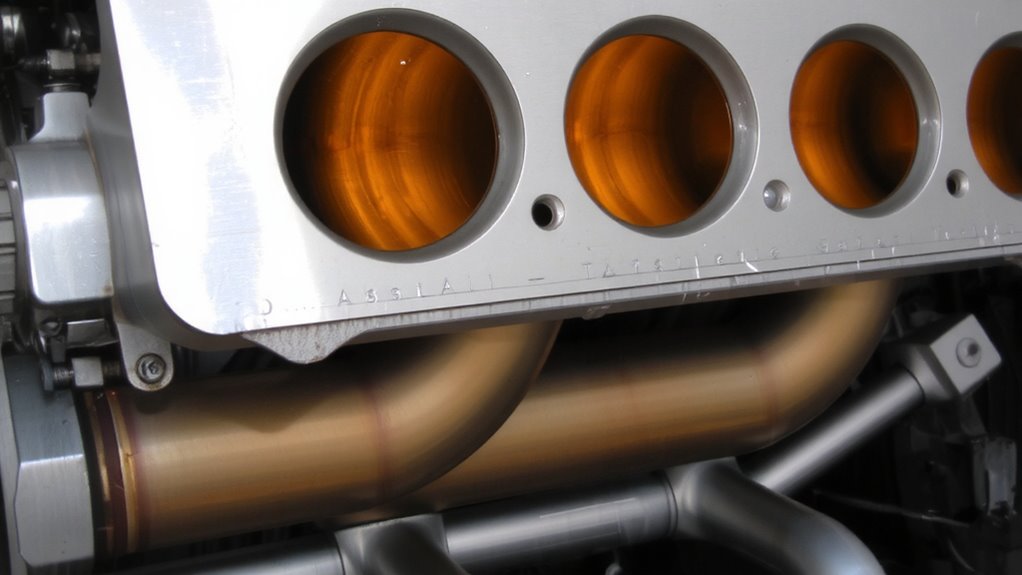
While sound waves might seem like a byproduct of engine operation, they play a critical role in generating torque through exhaust tuning. You harness pressure pulses-traveling as sound waves-in the exhaust system to improve scavenging. These waves reflect from pipe terminations or changes in diameter, returning to the cylinder during valve overlap. When timed correctly, they lower pressure in the combustion chamber, pulling out residual gases and increasing intake charge efficiency. This process enhances torque conversion by optimizing cylinder evacuation. Tuned header lengths match the engine’s rpm range to the speed of sound in hot exhaust gas (~1,100 m/s), ensuring wave timing aligns with valve events. Primary tube diameter, length, and collector design determine resonance frequency. Matching this frequency to engine speed amplifies volumetric efficiency, directly boosting torque in targeted rpm bands. High-performance V6 exhaust systems are engineered to optimize these acoustic properties for maximum power output.
Why Firing Order Controls Exhaust Pulse Timing
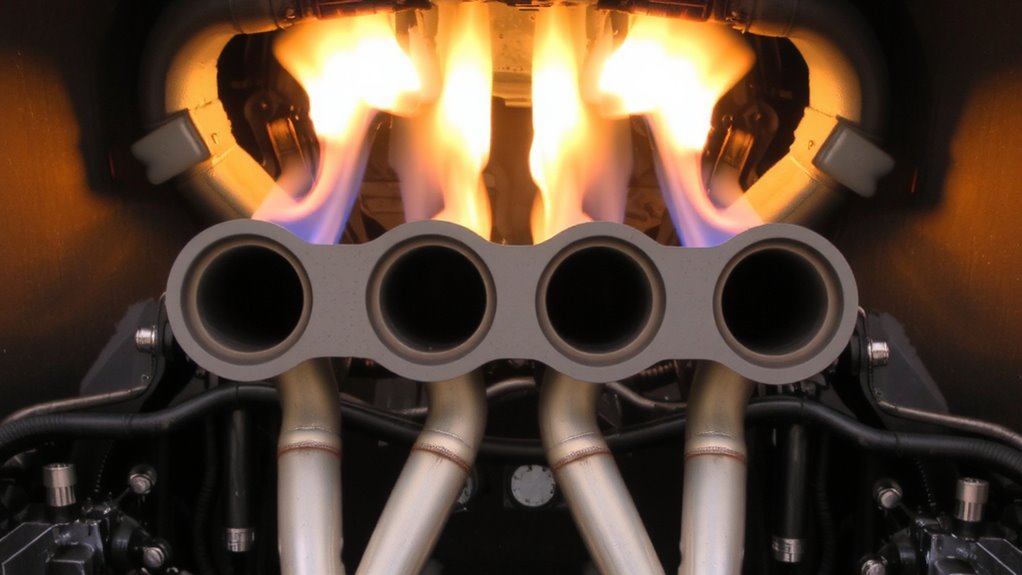
Your engine’s firing order directly sets the timing of exhaust pulses, and that timing determines how pressure waves interact in the exhaust system. Cylinder phasing dictates when each cylinder expels exhaust, spacing pulses to manage scavenging and wave dynamics. Proper sequencing prevents pulse interference and enhances low-end torque. Pressure waves rely on precise timing to reflect back to the cylinder at the right moment, improving volumetric efficiency.
| Firing Order | Cylinder Phasing (Degrees) |
|---|---|
| 1-8-4-3-6-5-7-2 | 90° uneven balance |
| 1-3-7-2-6-5-4-8 | 90° cross-plane |
| 1-8-7-3-6-5-4-2 | 90° log design |
| 1-4-2-5-3-6 | 120° inline-six |
| 1-5-3-6-2-4 | 120° optimized sweep |
You can’t tune for resonance without matching header length to this pulse timing. Cylinder phasing shapes wave timing; pressure waves respond accordingly.
How to Calculate Header Length for Peak Torque
How do you guarantee your headers deliver peak torque at the right RPM? Use the formula: header length (in inches) = (850 × (4 – exhaust duration in degrees / 180)) / RPM × 3.14. This calculates the ideal primary tube length for torque production at your target engine speed. Exhaust diameter matters-too small and flow suffers, too large and exhaust velocity drops, weakening scavenging. Match diameter to engine displacement and RPM range, typically 1.5 to 2 inches for street V8s. Material selection influences heat retention and weight; stainless steel holds heat well but costs more, while mild steel offers affordability with proper coating. Wall thickness affects durability-0.049 to 0.065 inches is standard. Precision in length and consistent tubing shape guarantee pressure waves arrive in sync with valve timing. This tuned resonance boosts cylinder filling.
Tuning Headers for Optimal Scavenging Efficiency
A well-tuned header system turns exhaust pulses into a controlled wave action that pulls spent gases from the cylinders. You harness exhaust harmonics to time pressure waves so they arrive at the collector when cylinder pressure is high. This creates low-pressure zones that improve scavenging. Primary tube diameter-typically 1.5 to 2 inches-must match engine displacement and flow rate to avoid choking or weakening pulses. Equal-length tubes guarantee pressure waves reach the collector simultaneously, reinforcing wave timing. The collector’s geometry amplifies this effect by reflecting pressure waves back into the system at precise intervals. You’re not just moving exhaust; you’re orchestrating pulses like sound waves in a tuned pipe. When harmonics align, scavenging efficiency jumps by up to 15%, boosting torque and airflow. Proper tuning balances pulse timing and wave strength without relying on RPM-specific adjustments.
How RPM and Cam Timing Change Exhaust Tuning
While engine speed and camshaft timing don’t alter the physical dimensions of your exhaust system, they directly affect how exhaust pulses behave in the header tubes. RPM effects change the frequency of exhaust pulses, shifting the pressure wave timing critical for scavenging. At higher RPM, pulses arrive more frequently, requiring shorter headers or tuned lengths that match the engine’s operating range. Cam phasing alters valve overlap, influencing when exhaust gases exit and how pulses interact in the collector. Retarding the cam delays exhaust valve opening, changing wave reflection timing and reducing low-end torque but possibly improving top-end power. Advancing cam timing boosts low-RPM efficiency by aligning scavenging waves earlier. You must balance cam phasing and header length to match your target RPM band. Proper tuning synchronizes returning negative pressure waves with valve opening events, maximizing flow. This dynamic optimization is essential for resonance frequency matching.
On a final note
You optimize torque by matching header length to engine resonance frequency. Exhaust pulses from each cylinder must arrive at the collector in sequence, timed to the firing order. A 4-into-1 header on a V8 with 180-degree crank typically uses 18–24 inch primary tubes. This length targets peak torque between 4,500–6,000 RPM. Tuning relies on speed of sound in hot gas-approximately 1,700 ft/sec. Correct length enhances scavenging, boosting volumetric efficiency by up to 8%.