The Role of Shock Absorber Valving in Tuning Ride Characteristics
Your shock absorber’s valving controls oil flow through precision orifices and shim stacks, regulating compression and rebound forces. It determines how quickly your suspension responds to bumps and recovers afterward. Street valving uses lighter compression (0.8–1.2 N/mm²) for comfort, while track setups run stiffer (3.0+ N/mm²) for stability. Rebound is typically set at 50–60% of total damping to maintain tire contact without harshness. Proper valving balances body control, traction, and ride quality-mismatched curves hurt handling. You’ll find the exact tuning trade-offs explained next.
Notable Insights
- Shock valving controls damping forces by regulating oil flow through orifices and shim stacks.
- Compression damping tunes how quickly shocks compress, affecting body roll and bump response.
- Rebound damping governs shock extension speed, maintaining tire contact and stability.
- Valving profiles differ by application-street, track, or off-road-for optimized ride and control.
- Adjustable valving allows tuning for varying conditions, while fixed valving ensures reliability.
What Shock Valving Actually Does
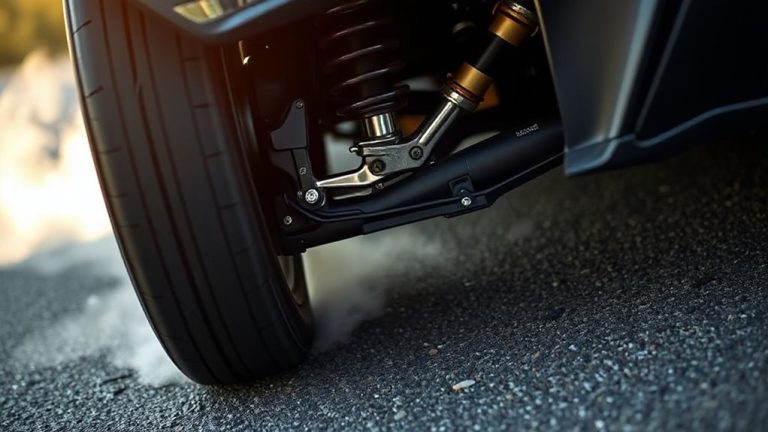
While you might think shock absorbers just keep your car from bouncing, their real job is controlling spring motion through valving-tiny hydraulic circuits that manage oil flow inside the shock body. Valving uses fluid dynamics to regulate oil movement through precisely sized orifices and stacked shim arrangements. During compression and rebound, oil flows through these circuits, creating resistance that matches your vehicle’s weight and suspension design. The efficiency of this system depends on consistent fluid behavior under pressure and temperature changes. High-performance shocks use aluminum bodies and reservoirs to improve heat dissipation, reducing fluid breakdown during sustained use. Without proper heat dissipation, oil viscosity drops, leading to fade and inconsistent damping. Valving doesn’t just resist motion-it responds to speed and load, adapting in milliseconds. Well-designed valving maintains tire contact and stability, turning raw spring energy into controlled, predictable ride behavior.
How Compression Changes Your Ride
When you hit a bump, the initial response of your suspension depends heavily on compression damping, which controls how quickly the shock compresses. Too little compression damping causes a bumpy response, letting the wheel react abruptly to uneven surfaces. This can lead to loss of contact with the road and reduced control. Increased compression damping slows shock movement, smoothing out the ride by managing energy absorption. It prevents bottoming out during a harsh impact, protecting both the vehicle and occupants. Adjusting low-speed compression affects body roll and dive under braking, while high-speed compression handles rapid impacts like potholes. Proper tuning balances comfort and performance. Valving specs typically range from 800 to 1,200 N of force at 0.1 m/s for street applications, ensuring responsive yet controlled travel. Correct setup minimizes jarring sensations without sacrificing handling precision. For optimal results, consider selecting from the best shocks for every ride, as performance-tuned models often feature advanced valving systems designed to match specific driving conditions.
Why Rebound Matters for Stability
If your suspension compresses easily but doesn’t control the return, you’re sacrificing stability. Rebound control manages how quickly the shock extends after compression, preventing uncontrolled oscillations. Without proper rebound damping, the wheel can lose contact with the road, reducing traction and steering precision. Effective rebound control guarantees the tire maintains consistent ground contact, especially over uneven surfaces. It works in tandem with compression to achieve ideal damping balance-too little rebound causes the vehicle to bob and float; too much makes it harsh and unsettled. A balanced valving setup typically allows 50–60% of total damping force on rebound, depending on application. This damping balance directly impacts pitch during braking and roll in corners. Properly tuned rebound keeps your vehicle composed, predictable, and stable-vital for both safety and performance.
Valving for Street, Track, and Off-Road
Because your driving environment dictates suspension demands, valving must align with real-world conditions-street, track, or off-road each require distinct damping profiles. Street valving profiles prioritize comfort, using light low-speed compression damping (0.8–1.2 N/mm²) and moderate rebound (1.5–2.0 N/mm²) to absorb bumps smoothly. Track setups demand high tuning precision, relying on aggressive high-speed damping (3.0+ N/mm²) to control body roll and maintain tire contact under hard cornering. Off-road valving uses digressive profiles, soft at low speeds for compliance (0.5 N/mm²) but ramping quickly (up to 4.0 N/mm²) to resist bottoming during jumps or dips. Each application balances load transfer, stability, and wheel control. You’ll need matched front/rear valving curves to preserve handling balance. Proper tuning precision guarantees shocks respond correctly-neither too stiff nor too loose-so your suspension works efficiently across terrain types. For reliable performance and durability, choosing from top shock absorber brands is essential when building a tuned suspension system.
Adjustable or Fixed: Which Is Right?
How do you decide between adjustable and fixed valving when both promise superior ride control? Your choice depends on needs, tuning knowledge, and driving environment. Fixed valving uses a set valve design optimized for specific conditions. It’s reliable, with predictable fluid dynamics and minimal maintenance. Adjustable valving lets you change rebound and compression settings, altering fluid dynamics on demand. This flexibility suits drivers who switch between street, track, and off-road use. However, it requires understanding valve design and proper calibration.
| Feature | Fixed Valving | Adjustable Valving |
|---|---|---|
| Tuning Access | None | External knobs/screws |
| Fluid Dynamics | Consistent | Variable via adjustment |
| Valve Design | Optimized for one use | Multi-mode capability |
5 Costly Valving Mistakes to Avoid
While fine-tuning your suspension, overlooking valving compatibility can lead to poor ride quality and accelerated component wear. Mismatched valving causes inconsistent damping forces, reducing control and comfort. You risk valve clogging when debris enters the system-especially if using low-quality fluid or skipping filter maintenance. Clogged valves disrupt oil flow, resulting in harsh shifts and delayed response. Seal degradation occurs with incompatible fluids or excessive heat, usually above 300°F, leading to leaks and loss of damping pressure. Use only manufacturer-specified oils with proper viscosity, typically ISO VG 10 to 22. Inspect seals every 15,000 miles or 200 hours of use. Never mix valving from different manufacturers-tolerances vary within ±0.0002 inches. Improper stack alignment reduces flow efficiency by up to 40%. Prevent failures with routine disassembly, cleaning, and correct reassembly torque-usually 8–12 in-lb. Upgrading to high-performance shocks for Jeep Wrangler can significantly improve damping control and ride consistency when properly matched to valve specifications.
On a final note
You control ride quality through precise valving adjustments. Compression damping manages how fast the shock compresses, typically measured in lb/in/sec; too stiff causes harshness, too soft induces bottoming. Rebound damping controls spring return, usually rated in milliseconds per stroke; improper settings lead to float or instability. Match valving to your use-street, track, or off-road-for ideal wheel control. Fixed valving offers reliability; adjustable provides tuning range.