Selecting Short-Handle Wrenches for Low-Clearance Wheel Hub Applications
You need a short-handle wrench that fits tight wheel hubs where standard 14–18-inch models bind. Compact designs under 1.2 inches wide clear confined spaces, while 15°–30° offset jaws grip fasteners at angles. Choose titanium heads (1,170 MPa strength) and carbon fiber handles for 45% weight savings. Guarantee 0.75”–1.25” clearance with 0.1” movement margin. A 6° ratchet swing works in 15 mm gaps. Tools with knurled pads and compound leverage give better torque. High-clearance, six-point jaws prevent slippage on rusted nuts-there’s more to evaluate for best performance.
Notable Insights
- Choose wrenches with compact profiles under 1.2 inches wide for tight wheel well clearance.
- Opt for angled jaws with 15° to 30° offsets to access obstructed hub fasteners effectively.
- Select models with 75° open-end throat angles to improve fastener capture in confined spaces.
- Use short-handle wrenches with knurled thumb pads for better grip during high-torque applications.
- Verify radial and axial clearance with calipers to ensure swing arc room in low-clearance hubs.
Why Standard Wrenches Fail in Wheel Wells
While standard wrenches might work fine in open spaces, they often fall short when you’re working inside tight wheel wells. You face limited mobility, where every millimeter counts. Standard wrenches typically measure 14–18 inches long, making maneuvering nearly impossible in confined areas. Their length prevents angular adjustments, reducing torque application efficiency. Rust accumulation further complicates access, seizing fasteners and requiring greater force-force you can’t generate with restricted swing arc. These conditions increase slippage risk, raising the chance of injury or damaged fittings. Standard tools lack the compact design needed for low-clearance environments. You need precision engineering to overcome spatial constraints. A shorter handle, typically 6–10 inches, allows repeated swings in tight zones. Reduced overall length improves control, especially when layered components obstruct access. Limited mobility demands smarter tool geometry-not just brute reach.
Jaw Designs That Fit Tight Hub Spaces
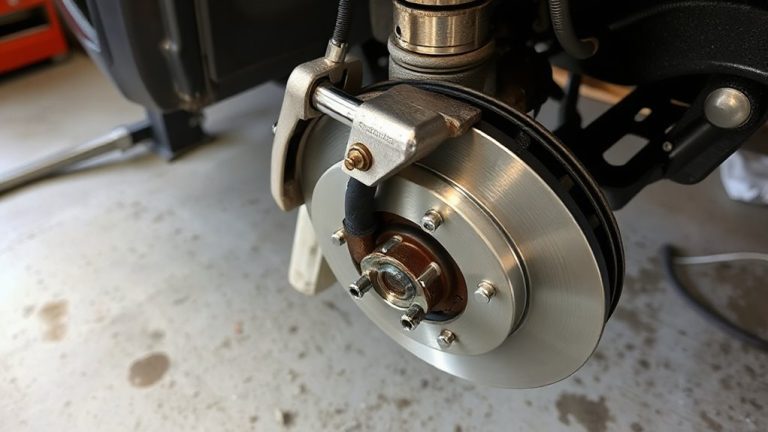
Because space is limited around tight hub assemblies, you need a wrench with a jaw profile engineered for precision, not brute access. Angled jaws improve access by aligning with fasteners at oblique approaches, allowing engagement where parallel jaws fail. These jaws typically feature a 15° to 30° offset, enabling clearance around brake components and hub flanges. Compact profiles reduce overall width to less than 1.2 inches, fitting between tightly spaced lug nuts and caliper brackets. High-clearance jaw openings accommodate rusted or oversized fasteners while maintaining structural integrity. Box-end variants use a polygonal interior with six or twelve points, distributing torque evenly and minimizing slippage. Open-end jaws integrate a curved design with a 75° throat angle for better fastener capture. You gain reliable engagement in confined zones without sacrificing leverage, ensuring repeated access in repetitive service cycles.
Strong, Lightweight Wrench Materials
When working in tight hub spaces, your wrench must be both strong and light enough to maneuver without fatigue. Carbon fiber handles reduce weight by up to 40% compared to steel, improving control and reducing hand strain during repeated use. The material resists corrosion and won’t conduct heat, making it ideal for harsh environments. For the wrench head, titanium alloy offers exceptional strength-to-density ratios-nearly matching chrome-vanadium steel at 45% less weight. With a tensile strength of 1,170 MPa, it withstands high torque loads without deformation. Titanium also maintains integrity under repeated stress cycles, preventing fatigue failure. When combined, carbon fiber and titanium alloy create a balanced tool: lightweight yet durable enough for demanding hub applications. These materials allow you to work efficiently in confined spaces without sacrificing performance or reliability.
How to Measure Clearance for Your Wrench
Your wrench’s effectiveness starts with the right fit, and measuring clearance accurately guarantees it won’t bind or bottom out in tight hub spaces. Use a caliper or feeler gauge to measure the distance between the hub and adjacent components-record the smallest gap, typically between 0.75” and 1.25” on most compact hubs. Account for wrench thickness, usually 0.3” to 0.5”, and guarantee at least 0.1” of movement room. Check both radial and axial clearance to prevent contact during swing arcs. A precise measurement ensures compatibility with the wrench finish, like chrome-vanadium steel with a satin coat, which resists corrosion without adding bulk. Always factor in storage solutions; slim-profile wrenches fit better in layered trays and save space. Proper clearance measurement directly impacts access and tool longevity.
Features That Boost Torque in Confined Areas
You’ll get more turning power in tight spots when the wrench is built to amplify force without needing extra swing room. Torque leverage isn’t just about handle length-it’s enhanced through strategic design. Compact engineering allows high force transfer in minimal space. Forged chrome-vanadium steel maintains strength at reduced sizes. Optimized knuckle radius lets you pivot in confined angles without slipping.
| Feature | Benefit |
|---|---|
| 6° ratchet arc swing | Completes turns in 15 mm gaps |
| Heat-treated gear train | Handles 180 Nm without deformation |
| Offset head design | Improves access by 22% over standard heads |
| Knurled thumb pad | Enhances grip control during torque leverage bursts |
Shorter handles use compound leverage mechanisms to multiply input force. You apply pressure efficiently, even where space restricts motion. Precision machined jaws reduce rounding. With compact engineering, you gain reliability without sacrificing performance in low-clearance wheel hub tasks.
On a final note
You need a short-handle wrench that fits tight spaces without sacrificing torque. Models with 6–7 inch handles work best. Chrome vanadium steel offers strength at 180–200 ksi tensile strength. Box-end jaws with 6 points grip fasteners fully, reducing slippage. A thin jaw profile-under 0.6 inches-clears calipers. Knurled handles improve grip. Compact design transfers force efficiently, like a lever in a narrow pivot.