Surface Contamination Assessment for EVs
Your EV’s sensors lose accuracy when dirt, salt, or moisture builds up on critical surfaces. A 0.5mm layer of mud can delay radar response by 40%. Contamination on LiDAR, cameras, or ultrasonic sensors disrupts ADAS functions like adaptive cruise and emergency braking. Moisture and grime create electrical interference and optical distortion. Factory seals and hydrophobic coatings help, but regular cleaning with isopropyl alcohol is essential. Calibration shifts from dirty sensors increase collision risk over time-knowing where and how grime accumulates reveals how to protect system integrity.
Notable Insights
- Assess sensor surfaces regularly for grime, salt, or moisture that impair LiDAR, radar, and camera performance.
- Inspect common contamination zones like bumpers, windshield gaps, and sensor housings for debris buildup.
- Evaluate environmental exposure, including road salt, dust, and weather effects on contamination levels.
- Use soft microfiber and 70% isopropyl alcohol to clean sensors without damaging coatings or seals.
- Monitor hydrophobic coating degradation and consider recalibration after cleaning factory-sensitive systems.
Why Dirty EV Sensors Are a Safety Risk
While your EV may look clean on the outside, even minor grime on sensors can compromise safety. Contaminants like road salt, dust, or water films distort sensor inputs, disrupting sensor calibration. Proper calibration guarantees accuracy in lidar, radar, and camera systems-critical for ADAS functions like automatic braking. A 0.5mm film of mud on a radar housing can scatter signals, causing up to 40% detection lag. Electrical interference worsens the issue; grime retains moisture, creating conductive paths that generate noise in low-voltage signal lines. This interference mimics false triggers or suppresses valid alerts. Calibration routines rely on clean, unobstructed sensors to align data across systems. When contamination skews input, the vehicle’s processor misinterprets surroundings. Over time, uncorrected sensor drift increases collision risk. Regular inspection and cleaning prevent degradation in real-world performance. Safety isn’t just about hardware-clean sensors guarantee systems function as engineered.
Top Areas for Surface Contamination on EVs
Since contaminants often accumulate in hard-to-see spots, knowing where to look is half the battle. You’ll find grime builds up most on sensor housings, especially around LiDAR units and camera lenses. These areas are prone to thermal drift, where temperature fluctuations warp readings over time. Ultrasonic sensors, typically embedded in bumpers, collect dirt and ice, causing signal interference. Even small debris like road salt or dust can scatter radar waves, reducing detection range by up to 40%. The gap between the windshield and roof rail houses rain sensors and GPS antennas-common sites for residue that disrupts data flow. Contamination here skews navigation and adaptive cruise control. Infrared cameras near side mirrors fog or smear, distorting night vision. Regular inspection of these zones maintains accuracy. Preventive cleaning cuts failure rates. Keep optics clear-your EV’s decisions depend on it.
How Weather Speeds Up Sensor Dirt
Weather plays a direct role in how quickly sensor surfaces degrade in performance. You face increased sensor degradation during rain, snow, or high humidity, as moisture bonds contaminants to housing lenses. Environmental exposure to road salt, dust, and grime accelerates film buildup, especially on LiDAR and camera housings. Temperatures below freezing can trap debris through ice adhesion, creating uneven optical distortion. In hot climates, UV radiation and thermal cycling weaken hydrophobic coatings, reducing their self-cleaning ability. Rain doesn’t clean sensors as you might think-mineral-laden water leaves scaling deposits that scatter light. Wind-driven particulates, like sand or brake dust, micro-abrade surfaces, reducing transparency by up to 15% over time. These factors compound rapidly during seasonal shifts. Your EV’s sensor performance hinges on how well these units resist environmental exposure. Even minor surface contamination affects detection range and accuracy-critical for ADAS reliability.
How to Clean EV Sensors Safely and Effectively
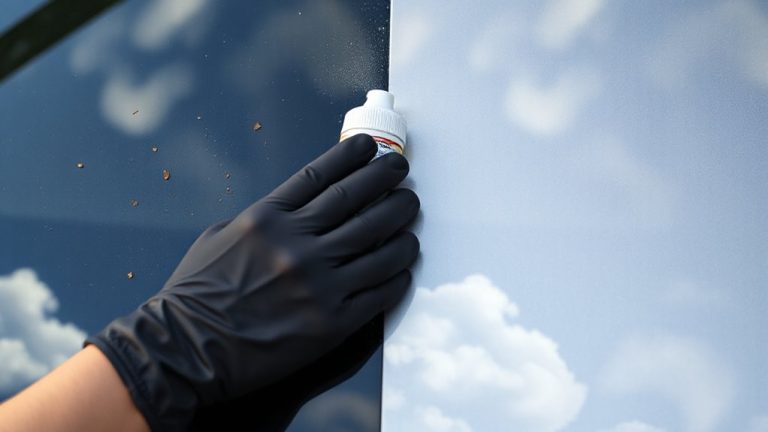
Sensor grime buildup demands immediate attention to maintain ideal performance. You must clean sensors regularly to guarantee accurate readings and reliable operation. Use a soft microfiber cloth and isopropyl alcohol solution (70% concentration) to gently wipe surfaces without scratching. Avoid abrasive materials or high-pressure water, which can damage lens coatings or housing seals. Cleaning frequency depends on driving conditions-every two weeks in urban or dusty environments, monthly in cleaner areas. Always power down the system before cleaning to prevent electrical faults. After cleaning, allow sensors to dry completely before reactivation. Improper maintenance disrupts sensor calibration, leading to misaligned object detection. Factory-calibrated sensors require professional recalibration if disturbed. Think of it like eyeglasses: smudges blur vision, affecting how the car “sees.” Following precise cleaning procedures guarantees peak functionality, safety, and longevity of your EV’s advanced driver-assistance systems.
EV Design Features That Fight Grime
You’ve cleaned your sensors properly-now let’s talk about how your EV fights grime on its own. Aerodynamic shaping reduces airflow turbulence, minimizing dust and debris accumulation. Smooth contours and sloped surfaces help water sheet off efficiently, lowering contamination risk. Many EVs use seamless integration, eliminating gaps where grime can collect. Flush-mounted door handles and hidden charging ports reduce surface disruptions. Sensor apertures feature hydrophobic and oleophobic coatings, repelling water and oils. Some models include active airflow channels that direct contaminants away from critical zones. Underbody panels are sealed to limit exposure to road spray. Surface materials are engineered with low surface energy, making grime less likely to adhere. These design choices aren’t just cosmetic-they directly enhance sensor reliability. Aerodynamic shaping isn’t only for efficiency; it reduces particle deposition rates by up to 30%. Seamless integration limits moisture traps, improving long-term cleanliness. Your EV’s form is functional, designed to stay cleaner longer.
On a final note
You must maintain clean EV sensors to guarantee peak performance. Contaminants like mud, salt, and grime disrupt signal accuracy. For example, LiDAR units operate at 905 nm wavelength and require clear surfaces. Dirt layers thicker than 0.1 mm can scatter up to 30% of emitted light. Ultrasonic sensors lose range when blocked by ice. Use isopropyl alcohol and microfiber cloths. Follow OEM-recommended intervals.