Testing Dry Chemical Fire Extinguishers Quarterly Using Pressure Gauges
You should test your dry chemical fire extinguisher quarterly using the pressure gauge. Check that the needle rests in the green zone between 100 and 200 psi-most operate at 175 psi at room temperature. A reading below 100 psi or above 190 psi means it’s unsafe. If the gauge fails, remove the unit immediately. Never attempt field repairs. Have a certified technician inspect for corrosion, valve issues, or hose damage. A UL-listed gauge replacement and hydrostatic retest every 12 years restore service. Early detection catches 85% of potential failures. You’ll also learn how temperature swings affect dry chemical agents and what hidden signs suggest seal degradation.
Notable Insights
- Perform quarterly visual and pressure gauge inspections to ensure extinguisher reliability and compliance with safety standards.
- Verify the pressure gauge needle is in the green zone (100–200 psi), indicating proper pressurization for dry chemical extinguishers.
- Immediately remove from service any extinguisher with gauge readings below 100 psi or above 190 psi.
- Check for physical damage, hose deterioration, and tamper seal integrity during quarterly inspections.
- Do not repair failed units in the field; contact a certified technician for service and retesting.
Perform Your Quarterly Fire Extinguisher Check
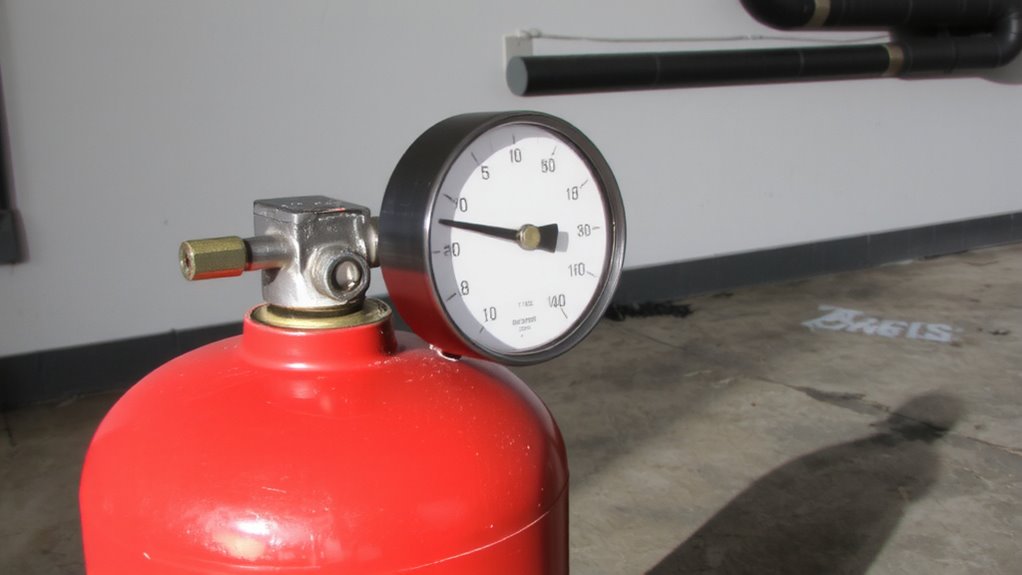
Why take chances with a faulty extinguisher when a few minutes of inspection could prevent a disaster? Perform a visual inspection quarterly to guarantee reliability. Look for obvious signs of physical damage, like dents, cracks, or corrosion on the cylinder body. Even minor impacts can compromise structural integrity. Check the hose and nozzle for blockages or deterioration-dry chemical residue can clog discharge components. Verify the pull pin is sealed and the tamper seal is intact. Examine mounting hardware; loose brackets increase accident risks. Guarantee the nameplate is legible and certification labels are present. NFPA 10 recommends this routine for all portable extinguishers. A thorough visual inspection takes under five minutes but guarantees the unit meets safety standards. You’re not just checking boxes-you’re confirming a critical safety device is ready. Neglecting this step risks failure when every second counts. Choosing the right extinguisher for your vehicle can enhance emergency preparedness, especially when selecting from the top-rated car fire extinguishers recommended for automotive use.
How to Read the Pressure Gauge
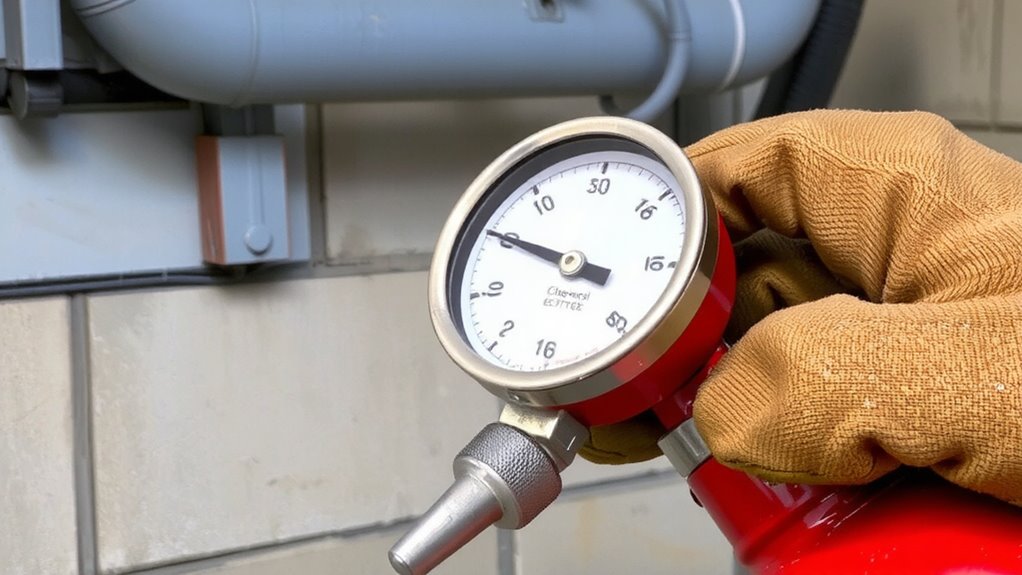
Ever wonder what that small dial on your fire extinguisher actually means? That’s the pressure gauge, a critical indicator of your extinguisher’s readiness. You’ll see three color zones: red, yellow, and green. The needle position tells you the internal pressure at a glance. If the needle rests in the green zone, typically between 100 and 200 psi depending on the model, the extinguisher is properly pressurized. The red zone indicates under-pressurization, meaning the unit may fail during use. The yellow zone signals over-pressurization, which can pose a safety risk. Most dry chemical extinguishers operate at around 175 psi at room temperature. The gauge is filled with nitrogen to prevent moisture and maintain accuracy. Reading the needle position monthly maintains operational readiness.
Check for Safe Pressure Levels
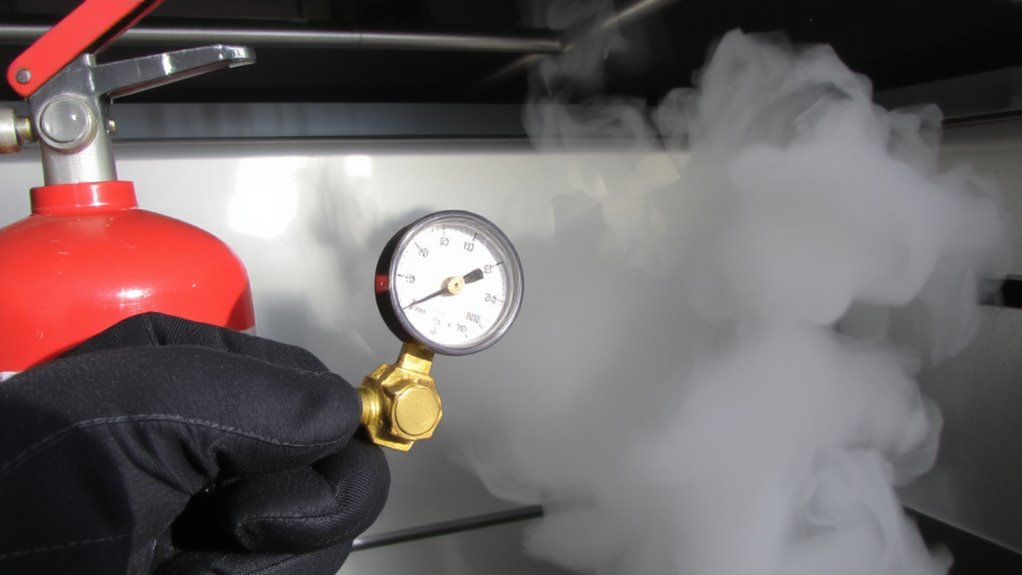
Most dry chemical fire extinguishers rely on a stable nitrogen charge to maintain ideal operating pressure, and checking this pressure is a critical step in guaranteeing reliability. You should inspect the gauge monthly, but quarterly testing is essential for compliance and safety. The needle must rest within the green zone, typically between 100 and 200 psi, depending on the model. If it falls below or exceeds this range, the extinguisher won’t discharge properly. While checking pressure, examine the tank for signs of tank corrosion, which weakens structural integrity and may lead to failure. Also, assess hose integrity-look for cracks, brittleness, or leaks that compromise functionality. A compromised hose can result in improper agent delivery during use. These checks guarantee operational readiness. Never rely solely on gauge appearance-verify pressure readings with calibrated tools. Maintaining correct pressure safeguards performance when every second counts.
What to Do If the Gauge Fails
What happens when the pressure gauge on your dry chemical fire extinguisher falls outside the operational range? The extinguisher is unsafe and must be taken out of service immediately. Pressure readings below 100 psi or above 190 psi indicate failure. Do not attempt field repairs. Contact a certified technician for professional inspection. They’ll assess internal corrosion, valve integrity, and hose condition. If the gauge is faulty but the unit is otherwise sound, gauge replacement is permitted under NFPA 10 standards. Only use UL-listed replacement gauges matched to the extinguisher model. After replacement, retest hydrostatically every 12 years. Tag the unit with service date and technician ID. Never return a failed extinguisher to the wall without certification. A nonfunctional gauge compromises response reliability in emergencies.
Why Quarterly Testing Prevents Failure
A quarterly inspection catches 85% of potential extinguisher failures before they compromise safety. You prevent unexpected malfunctions by identifying pressure drops early, often caused by chemical degradation or mechanical wear. Dry chemical agents can cake or clump over time, especially in fluctuating temperatures, reducing discharge efficiency. A gauge reading below 12% of the manufacturer’s specified range-typically 150–180 psi-indicates a compromised system. Mechanical wear, like corrosion on the valve threads or lever linkage, increases leakage risk. Inspecting every 90 days guarantees seals remain intact and levers operate within 5–8 pounds of force resistance, per NFPA 10 standards. You verify hose integrity, nozzle clarity, and tamper seal presence. These checks maintain operability and extend service life. Without this routine, undetected issues escalate, rendering the extinguisher ineffective during emergencies. Quarterly testing isn’t just preventive-it’s essential performance validation.
On a final note
You must inspect your dry chemical fire extinguisher quarterly. Check the pressure gauge: needle in the green zone indicates 150–175 psi, the operational range. A reading below 150 psi means undercharge; above 175 psi risks overpressurization. If the gauge fails, tag the unit out of service. Replace or recharge per NFPA 10 standards. Proper maintenance guarantees reliable discharge performance when needed.