Tuning ECU Fuel Trims for Aftermarket High-Pressure Fuel Pumps
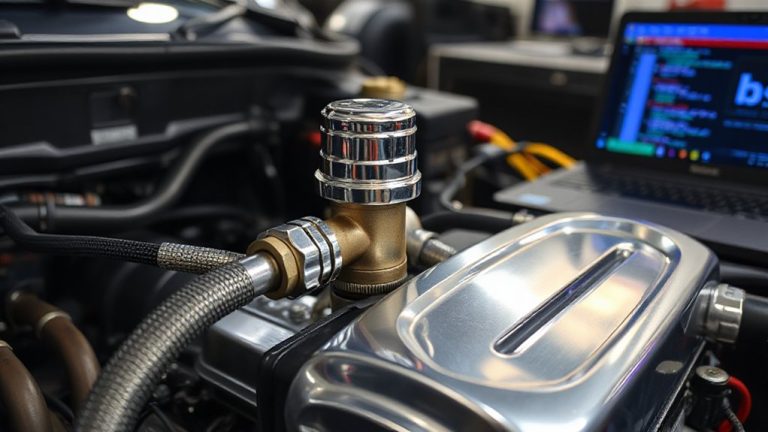
You need to adjust your ECU’s fuel trims when installing a high-pressure aftermarket pump because stock closed-loop ranges can’t compensate for excessive flow. Larger pumps overwhelm the system, causing trims to max out. Monitor short-term trims (real-time) and long-term trims (averaged); sustained values beyond ±10% indicate problems. Set base fuel pressure between 45–75 psi per your setup using a digital gauge. Incorrect pressure leads to flooding or lean conditions under load. Adjust fuel maps: scale injectors to 108%, set latency to 0.65 ms, and max flow to 270 lb/hr. Use wideband O2 data to validate AFRs of 11.8:1–12.8:1 at WOT. Exhaust leaks or faulty sensors mimic trim issues-diagnose carefully. A stable tune shows trims within ±8% across driving conditions. Further refinements depend on your fuel type and pump compatibility.
Notable Insights
- Aftermarket high-pressure pumps can exceed ECU fuel trim correction range, requiring tuning to prevent overcompensation.
- Monitor short- and long-term trims with a scan tool to detect excessive ECU adjustments beyond ±10% and ±8%, respectively.
- Diagnose lean conditions from upgraded pumps by checking long-term trims above +10% and verifying with wideband O2 sensors.
- Set correct base fuel pressure (45–75 psi) using a digital gauge to ensure stable air-fuel ratios and prevent flooding or lean spikes.
- Adjust fuel maps for injector flow, latency, and pressure changes, then validate tune with real-world AFR logging under various loads.
Understand Why Fuel Trims Fail With Bigger Pumps
With larger aftermarket fuel pumps, your engine’s ability to maintain proper air-fuel ratios often deteriorates because the ECU relies on fuel trims to correct small imbalances-not massive flow changes. You’re now supplying more fuel than the stock system expects, overwhelming the closed-loop correction range. Fuel compatibility becomes critical; ethanol blends, for example, require different stoichiometric ratios and can alter pump efficiency. Larger pumps often exceed the fuel rail’s demand, increasing line pressure beyond safe thresholds and risking fuel leaks or regulator failure. Pump cavitation occurs when inlet restrictions or excessive demand cause vapor pockets, reducing effective flow and leading to lean conditions. This is common with undersized fuel lines or clogged filters. The ECU can’t compensate for these physical flow anomalies, causing unstable idle or hesitation. You need recalibration-scaling injector flow data and adjusting fuel maps-to match the new delivery capacity and maintain control.
Monitor Short- and Long-Term Fuel Trims
How do you know if your ECU is struggling to adapt to a high-flow fuel pump? Monitor your short- and long-term fuel trims-they’re your first clue. Short-term trims adjust in real time, reacting instantly to air-fuel imbalances. Long-term trims evolve over minutes, correcting persistent deviations. If short-term values consistently exceed ±10%, your system is compensating hard. Sustained long-term trims beyond ±8% signal deeper issues. Fuel pressure fluctuations confuse the ECU, causing erratic trim behavior. The OEM sensors expect stock flow rates, so aftermarket pumps can create sensor calibration issues. These inaccuracies mislead oxygen sensors, prompting incorrect fuel adjustments. Use a scan tool with 0.1% resolution to track trims across idle, cruise, and load. Stable trims near 0% mean proper adaptation. Consistent offsets point to calibration limits. Monitoring trims under real driving conditions reveals whether the ECU maintains stoichiometric balance or fights unseen fuel delivery errors. For accurate and responsive data logging, consider using one of the best OBD2 scanners that support real-time fuel trim monitoring.
Diagnose Lean Vs. Rich After Pump Upgrades
While your new high-flow fuel pump should deliver consistent pressure, it can still trigger unexpected lean or rich conditions due to mismatched calibration. A lean condition often shows sustained positive long-term trims above +10%, usually from inaccurate airflow measurement or fuel delivery mismatch. Check for exhaust leaks before the catalytic converter-these introduce false oxygen readings, mimicking lean operation. Oxygen sensor drift is another culprit; aging sensors may report incorrectly, causing the ECU to enrich unnecessarily. Use a wideband O2 sensor for accurate AFR verification. A rich condition typically presents as negative trims below -10% and can stem from overactive injectors or incorrect pump voltage regulation. Confirm sensor health with voltage checks between 0.1V (lean) and 0.9V (rich). Diagnose systematically: rule out exhaust leaks first, then test for oxygen sensor drift before adjusting fueling strategy.
Set the Correct Base Fuel Pressure
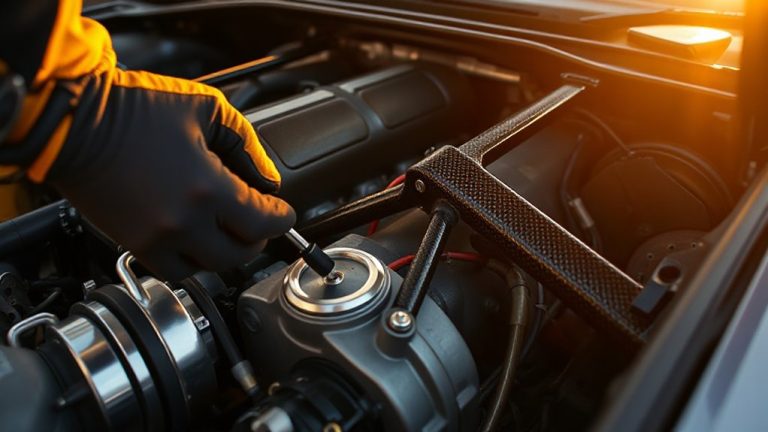
If you want your engine to run properly after installing an aftermarket fuel pump, you need to set the correct base fuel pressure from the start. Most modern fuel systems operate between 45–75 psi, depending on manufacturer specs and fuel type. Incorrect base pressure leads to poor fuel pump calibration and unstable air-fuel ratios. Use a digital fuel pressure gauge to verify output at idle and under load. Adjust the regulator until you hit the target pressure specified for your setup. Pressure regulator tuning guarantees consistent flow across all RPM ranges. Too high, and you risk fuel flooding; too low, and the engine leans out under load. Always reference the pump’s flow curve and your fuel injector duty cycle. Proper base pressure sets the foundation for accurate ECU trims. Never assume the preset factory setting applies to your upgraded pump.
Adjust Fuel Maps for High-Flow Pumps
Why does your engine still run rich or lean after installing a high-flow fuel pump? Because the ECU’s fuel map scaling hasn’t adjusted for the increased fuel volume. High-flow pumps deliver more pressure and volume, but your injectors’ response time-known as injector latency-can skew delivery, especially at low pulse widths. You’ve got to recalibrate the fuel maps to match the new flow dynamics. Even slight latency shifts can cause air-fuel ratio errors. Proper fuel map scaling compensates for these changes across the RPM and load spectrum.
| Parameter | Stock Pump Value | High-Flow Pump Adjusted Value |
|---|---|---|
| Injector Latency (ms) | 0.8 | 0.65 |
| Fuel Map Scalar (%) | 100 | 108 |
| Max Flow (lb/hr) | 220 | 270 |
Adjusting these values guarantees precise fueling and prevents damage.
Test Your Tune in Real Driving
After mapping the fuel tables and adjusting for injector latency and flow rates, you’ve got to validate those changes where it matters most-the road. Real driving exposes your tune to actual road load conditions, not just idealized dyno simulations. You need real time feedback from wideband O2 sensors to monitor AFRs under acceleration, cruise, and deceleration. Small corrections in the fuel trim tables may be necessary when engine demand shifts suddenly. Log data at various RPM and load points-especially above 80% throttle-to catch lean spikes or rich drops. Use ECU logging software to record fuel trims, MAP readings, and IAT over multiple drives. Consistent AFRs between 11.8:1 and 12.8:1 under wide-open throttle indicate a stable tune. If long-term trims exceed ±8%, revisit your base fuel table. The road is your final test. Pass it, and your tune’s ready.
On a final note
You must recalibrate your ECU after installing a high-pressure fuel pump. Fuel trims rely on oxygen sensor feedback to correct air-fuel ratios, but excessive fuel flow disrupts this balance. Unadjusted, short-term trims max out at ±25%, causing lean or rich conditions. Set base fuel pressure to factory specs-usually 3–6 bar, depending on the engine. Then revise fuel maps to match injector flow rates and pump capacity. Test under load using wideband O2 data to confirm AFR stays at 14.7:1 idle and 11.5–12.5:1 wide-open throttle.