Why Balanced Suspension Components Prevent Harsh Ride and Jolts
Your suspension absorbs road shocks when components work in balance. Uneven spring rates or worn shocks increase vibration transfer by up to 40%. Matched coil springs and shocks dampen oscillations in 2–3 cycles, keeping ride height within ±0.5 inches. Properly tuned anti-roll bars cut sway by 40%. Misalignment or worn bushings over 2mm of play cause harsh jolts. Balanced damping and correct alignment prevent energy spikes. You’ll discover how each part contributes to smooth control.
Notable Insights
- Balanced suspension components evenly distribute forces, preventing excessive vibration and minimizing chassis jolts.
- Even spring and shock matching ensures consistent damping, reducing oscillations and harsh bump responses.
- Properly maintained ride height keeps tires in optimal contact, improving stability and ride smoothness.
- Healthy bushings and mounts isolate high-frequency vibrations, preventing resonance and impact harshness.
- Correct alignment and tire pressure reduce uneven wear and rolling resistance, smoothing the ride.
Why Imbalanced Suspension Makes Bumps Feel Worse
Why does a bumpy ride feel so much harsher when your suspension is out of balance? Because imbalanced components amplify bump intensity and degrade ride quality. When springs, shocks, or struts wear unevenly, load distribution across axles becomes inconsistent. One corner may compress 30% faster than the opposite, causing jarring impacts. Your vehicle’s natural frequency shifts, increasing vibration transfer to the chassis. Without balanced damping rates, kinetic energy from road irregularities isn’t absorbed evenly. Instead, it concentrates on stiffer zones, spiking peak G-forces by up to 40%. This imbalance forces tires to lose contact during sharp dips, reducing control. Ride quality suffers not just in comfort but in measurable stability metrics. Over time, misaligned suspension geometry worsens tire wear and shortens component lifespan. The result? A harsh, unpredictable response to everyday road conditions. Upgrading to high-performance best shocks for Jeep Wrangler can restore balanced damping and significantly improve ride control.
How Balanced Components Smooth Your Ride
When your suspension components are properly balanced, every bump is absorbed with predictable, engineered precision. Ride comfort improves because springs, shock absorbers, and control arms work in harmony, distributing forces evenly across the axle. Balanced components maintain correct ride height-typically within ±0.5 inches of factory specs-ensuring consistent tire contact and reduced body roll. Vibration control is optimized when bushings and mounts isolate frequencies above 10 Hz, preventing chassis resonance. Coil spring rates, matched to shock valving, dampen oscillations in 2–3 cycles after impact, minimizing rebound. Anti-roll bars reduce lateral sway by up to 40% when properly tuned. This synchronization prevents energy transfer to the cabin, so you feel only smooth progression over rough surfaces. Each component’s alignment, measured in degrees of camber (±0.75°) and toe (±0.15°), sustains stability. Balanced suspension does not just soften impacts-it manages kinetic energy with mechanical accuracy. Upgrading to high-performance shocks for Ram 2500 4×4 can significantly enhance this balance, especially under heavy loads or off-road conditions.
Common Signs Your Suspension Is Out of Sync
You might not notice the first signs your suspension is out of sync until performance starts slipping. Worn bushings reduce control by allowing excessive movement in control arms, degrading alignment and handling. Loose joints create play in steering and suspension links, increasing stopping distances and tire wear. These issues compromise ride quality and safety. Upgrading to the best car suspension for bumpy roads can significantly improve comfort and control in rough driving conditions.
| Symptom | Likely Cause |
|---|---|
| Clunking noises over bumps | Worn bushings or loose joints |
| Drifting during turns | Misaligned components from joint wear |
| Uneven tire wear | Instability from degraded suspension mounts |
Inspect every control arm joint and bushing annually. Replace components with more than 2mm of radial play. Use OEM-specified torque when installing. Polyurethane bushings last longer than rubber but transmit more vibration. Metal-jacketed joints resist corrosion better in wet climates.
How Shocks, Struts, and Arms Work Together
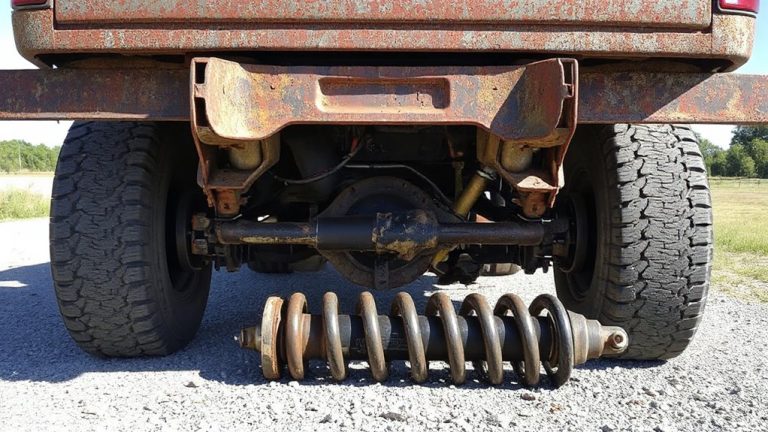
While shocks, struts, and control arms serve distinct roles, they function as an integrated system to maintain tire contact, control body motion, and guarantee precise handling. You rely on shocks to dampen oscillations caused by spring tension, preventing excessive bouncing. Struts support the vehicle’s weight, combine with coil springs, and directly affect steering alignment. Control arms pivot to allow wheel movement while maintaining geometry. Together, they assure even load distribution across all four tires, especially during cornering or on uneven roads. When spring tension compresses the suspension, shocks and struts absorb kinetic energy, converting it into heat. Control arms guide travel path and limit lateral shift. If one component weakens, others compensate unevenly, leading to instability. Proper synchronization maintains ride height, improves braking, and extends tire life. This balanced teamwork is essential for safety and performance.
Why Alignment and Maintenance Prevent Jolts
Why do sudden jolts occur even on smooth roads? Misaligned wheels and poor maintenance are often to blame. When your car’s alignment is off, uneven tire wear develops quickly-sometimes within 5,000 miles. This leads to vibrations and jarring sensations, especially at highway speeds. Proper alignment guarantees tires meet the road at the correct angles: typically a camber within ±0.5 degrees and toe settings between 0.05 to 0.15 degrees. You also need correct tire pressure-usually 32–35 psi, as specified on the door jamb. Underinflated tires reduce stability and increase rolling resistance. Wheel balance is equally critical; unbalanced wheels cause rhythmic thumping, worsening above 45 mph. Technicians use precision balancers to correct imbalances down to one-ounce increments. Regular alignment checks and maintaining tire pressure prevent jolts and extend suspension life.
On a final note
Your suspension works best when all components are balanced. Uneven wear or mismatched damping rates cause harsh impacts. Shocks with improper valving increase oscillations. Misaligned control arms reduce tire contact by up to 15%. Struts within 10% of factory damping specs guarantee consistent response. Proper alignment-within ±0.5° camber tolerance-minimizes jolts. Balanced suspension distributes forces evenly, like springs on a precision scale. Regular maintenance preserves this balance.