Why Front Suspension Systems Are More Complex Than Rear in Most Vehicles
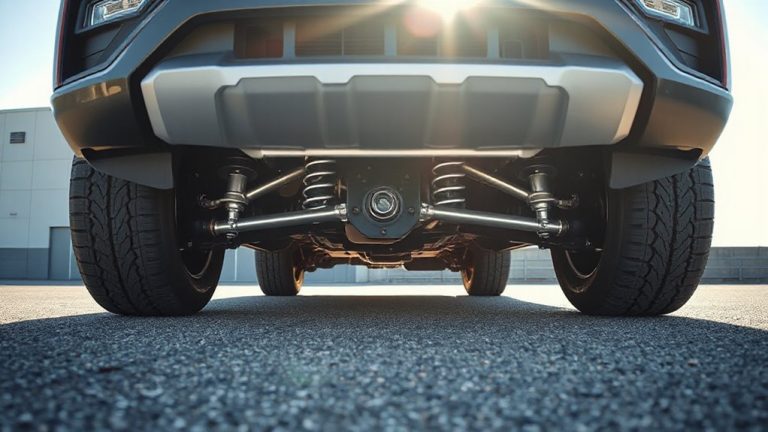
You face more complexity in front suspension because it handles steering, power delivery, braking, and engine weight simultaneously. It manages camber changes up to 1.5° and caster angles of 3°–7° for stability. CV axles operate at angles up to 48°, while control arms limit bump steer to under 0.1° per inch. With 60%–70% of engine mass and 80% of braking load on the front, components must be stronger and more precisely engineered. Tight spaces-often under 300 mm-demand compact, multi-functional designs. There’s more to how these systems balance competing demands.
Notable Insights
- Front suspension must integrate steering, requiring precise knuckle pivots and alignment control during wheel travel.
- Steering geometry challenges like bump steer and caster stability add complexity absent in rear suspensions.
- Front-wheel drive systems introduce torque steer and require CV axles that handle high articulation and power delivery.
- Engine weight over the front axle increases load demands, affecting spring rates, bushings, and suspension durability.
- Front suspension combines braking, steering, and ride functions in tight engine bay spaces, limiting design flexibility.
How Steering Makes Front Suspension More Complex
Precision is everything when your front wheels are doing double duty-handling both suspension movement and steering input. You’re demanding complex coordination between steering geometry and wheel articulation, unlike anything in the rear. Your steering knuckles must pivot precisely while allowing up-and-down suspension travel. A misaligned caster angle-typically between 3° and 7° positive-will cause poor returnability and drift. Camber changes during articulation affect tire contact; more than 1.5° shift can reduce cornering grip. Control arm length and pivot points are carefully calculated to minimize bump steer-ideally under 0.1° per inch of travel. Rack-and-pinion systems respond in under 0.2 seconds, but only if linkage angles stay within design limits. Excessive articulation can bind joints, increasing wear. You need ball joints rated for at least 50,000 cycles under load. Every degree of steering angle impacts scrub radius, affecting stability. Engineering this balance demands tight tolerances-often within 0.05 inches.
Front-Wheel Drive: Power Delivery’s Effect on Design
While handling steering loads adds complexity, adding power delivery to the front wheels introduces even greater design challenges. You must now manage torque steer, the unwanted pulling during acceleration caused by uneven power distribution to the wheels. It worsens with higher horsepower and aggressive suspension geometry. To reduce it, engineers use limited-slip differentials and precise CV joint alignment. Power articulation-how driveline components maintain consistent power transfer while steering and suspending-demands tightly engineered constant-velocity (CV) axles. These axles endure extreme angles, sometimes exceeding 48 degrees during full lock. Modern systems use tripod or slip-style inner joints to accommodate suspension travel up to 100 mm without binding. The combination of steering, suspension movement, and power delivery requires exact phasing of driveline components. Misalignment as small as 3 degrees can accelerate wear. Robust materials like induction-hardened steel shafts guarantee longevity under peak torques exceeding 300 Nm.
Why Engine Weight Increases Front Suspension Stress
Every pound of engine weight matters when it’s perched over the front wheels-typically 60% to 70% of a front-engine car’s total mass sits above the front axle. This uneven weight distribution places constant stress on front suspension components. You’re asking control arms, struts, and springs to support considerably more static load than those in the rear. Load dynamics shift dramatically during acceleration and cornering, amplifying forces transmitted through the suspension. The added mass increases unsprung weight effects, reducing responsiveness. Engineers must reinforce mounting points and use higher-rate springs, which compromises ride comfort. Stiffer bushings and larger anti-roll bars help manage body motion, but complexity rises. Uneven loading also accelerates tire wear and reduces grip balance. Managing this front-heavy reality demands precision in design. You’re not just carrying weight-you’re controlling it, constantly.
Braking Forces and the Front’s Structural Load
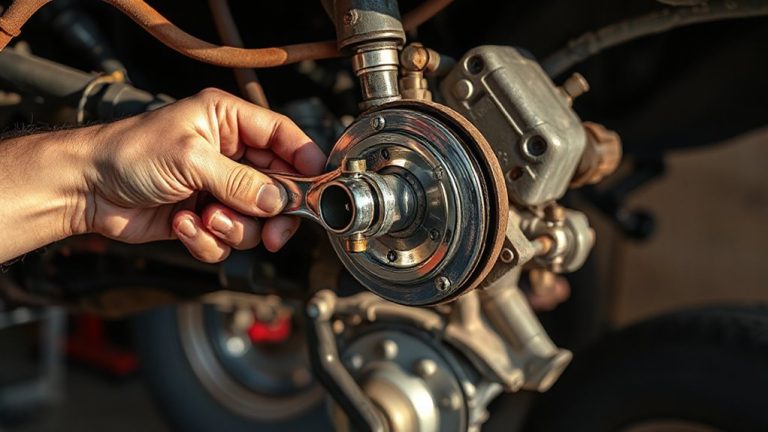
When you hit the brakes, the front suspension doesn’t just slow the car-it absorbs the brunt of the load. During deceleration, load distribution shifts dramatically forward, often placing 70–80% of the vehicle’s weight on the front tires. That surge increases stress on suspension components, requiring stronger control arms, stiffer springs, and more durable bushings. Braking torque, generated at the contact patch, is transferred through the knuckle and strut assembly, demanding precise engineering to resist deformation. Without robust design, the system risks geometry distortion and reduced stopping power. The front suspension must also manage heat-induced expansion from the brakes, further complicating material selection. Transporting heavy equipment like motorcycles or ATVs often requires precise load placement, and using reliable top loading ramps for pickup trucks can help maintain vehicle balance during loading.
| Sensation | Cause | Consequence |
|---|---|---|
| Nose dive | Load transfer | Reduced rear grip |
| Pulsation | Warped rotors | Uneven braking torque |
| Shudder | Suspension flex | Delayed response |
| Groan | Component strain | Long-term fatigue |
| Fade | Overheating | Loss of load distribution control |
Maintaining Alignment Under Steering and Load
Since steering inputs and dynamic loads constantly challenge the front suspension, maintaining precise alignment isn’t optional-it’s critical. You need consistent camber control to keep tires firmly planted during cornering. Without it, grip drops, and tire wear spikes. As weight shifts under braking or cornering, load distribution changes rapidly. The suspension must adapt instantly, preserving stability. Control arms, ball joints, and bushings work together to manage these forces. Proper camber angles-typically between -1.5° and +1.0° depending on application-ensure ideal contact patch. Uneven load distribution can lead to understeer or premature component fatigue. Geometry must remain predictable across operating ranges. Even small alignment shifts, beyond ±0.25°, degrade handling. You rely on engineered compliance and rigidity balance. The system uses precise pivot points and calculated deflection rates. This isn’t just about comfort-it’s about control, safety, and performance under real-world demands.
Front-End Packaging: Fitting Components in Tight Spaces
Packaging the front suspension into a confined engine bay demands precision engineering and spatial optimization. You face severe space constraints, with the engine, radiator, steering gear, and crash structures all competing for room. Every millimeter counts-control arms must tuck tightly beside the oil pan, while the steering rack often mounts directly to the subframe to save space. Component integration becomes critical: knuckles house wheel bearings and ABS sensors, and strut assemblies combine spring, damper, and mounting points in one compact unit. Modern systems use hydro-formed control arms to match complex shapes, reducing bulk. Even fasteners are chosen for minimal projection. With transverse engines and all-wheel drive, you’ve got less than 300 mm of clearance in some cases. Clever packaging-like offset steering gears or nested suspension pivots-lets everything fit without compromising function.
Why the Front Suspension Does More Than Just Absorb Bumps
While smoothing out road imperfections is one of its most visible roles, the front suspension does far more than just absorb bumps-it’s central to steering response, braking stability, and overall vehicle control. It directly affects ride comfort and guarantees consistent tire contact during maneuvers. Precision steering geometry, like caster and camber angles, depends on suspension design, influencing how sharply your vehicle turns. During braking, the front suspension handles up to 70% of the load, demanding robust shock absorption.
| Function | Contribution |
|---|---|
| Steering | Enables responsive, accurate wheel alignment |
| Braking | Manages weight transfer and stabilizes dive |
| Ride Comfort | Reduces vibration and optimizes shock absorption |
Without it, handling deteriorates, and safety declines. You rely on it every time you turn or stop.
On a final note
You see why front suspension systems carry greater complexity. They manage steering, requiring precise geometry like caster, camber, and toe angles-typically ±0.5 degrees tolerance. Front suspensions handle 60–70% of braking force, demanding robust components. Combined with engine weight-often 350–600 lbs-and front-wheel drive torque delivery, stress increases. Compact packaging squeezes control arms, CV joints, and struts into tight spaces, limiting design options while maintaining rigidity and ride quality.