How to Choose Reliable Tools for Effective Car Maintenance at Home
Choose reliable tools by starting with a 3/8-inch drive 72-tooth ratchet and heat-treated chrome vanadium wrenches from 8mm to 19mm. Use a torque wrench calibrated to ±2% accuracy for critical fasteners. Opt for forged alloy steel tools with 45–50 HRC hardness to resist wear. Always pair sockets with a reinforced ratchet. Safety demands UL-certified jack stands rated for 6,000 lbs. Your skill level guides tool complexity-start basic, then expand with precision gear as you gain confidence.
Notable Insights
- Choose wrenches and sockets made from forged alloy steel with a hardness of 45–50 HRC for durability and precise fit.
- Use a 3/8-inch drive ratchet with a 72-tooth mechanism for better control and access in tight spaces.
- Invest in a torque wrench calibrated to ±2% accuracy to ensure proper fastener tension during critical repairs.
- Always pair a hydraulic jack with UL-certified jack stands rated for your vehicle’s weight for safe lifting.
- Match tool complexity to your skill level to avoid underbuying or wasting money on unnecessary advanced tools.
Start With These 8 Car Maintenance Tools
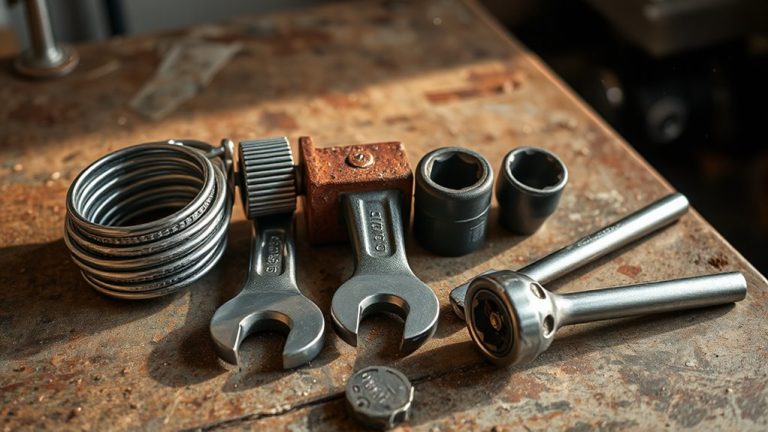
Start with these eight essential tools to handle most basic car maintenance tasks safely and efficiently. A full set of wrench types-including combination, adjustable, and socket wrenches-guarantees you can loosen or tighten bolts from 8mm to 19mm with precision. Use a torque wrench calibrated to ±2% accuracy for critical jobs like oil changes. Invest in a 3/8-inch drive ratchet with a 72-tooth mechanism for tight spaces. Pair it with metric sockets from 10mm to 17mm. A high-quality oil filter wrench handles both cartridge and spin-on types. Choose trusted filter brands like WIX or Bosch to guarantee proper fit and filtration efficiency. Include a funnel with a 1.5-inch diameter spout to prevent spills. Finally, add pliers, screwdrivers, and a digital pressure gauge accurate to ±1 psi. These tools cover 90% of standard maintenance with reliability and control. A dedicated car wash bucket with a built-in grit guard helps maintain scratch-free cleaning during exterior maintenance.
Pick Tools That Last: Avoid Cheap Gear
You’ve got the right tools in hand, but their long-term performance depends on build quality, not just selection. Tool quality directly impacts reliability-cheap tools often use brittle chrome vanadium steel or thin wall tubing that deforms under load. Invest in forged alloy steel with a tensile strength of at least 180,000 psi. A durability focus means checking hardness ratings: look for 45–50 HRC on the Rockwell scale to resist wear. Replace hollow handles; they crack. Solid composite or bi-material grips absorb torque without fracturing. Wrenches with laser-cut jaws maintain precise tolerances-within ±1 degree-to avoid rounding fastener heads. Cheap gear strips fasteners faster than it tightens them. High-grade tools may cost more upfront but last decades under proper care. You’re not just buying tools-you’re building a long-term maintenance solution backed by engineering precision and tested resilience.
Get the Right Socket Set for Your Car
A complete socket set should include both metric and standard (SAE) sizes, since modern vehicles often use a mix of both. You’ll need socket sizes ranging from 6 mm to 19 mm and 1/4-inch to 3/4-inch to cover most fasteners. Use a 3/8-inch drive for everyday tasks-it’s versatile and fits most engine components. For larger jobs, a 1/2-inch drive handles higher torque specifications without breaking. Look for chrome vanadium steel-it resists corrosion and withstands high stress. A ratchet with a 72-tooth gear gives you a 5-degree swing arc, ideal for tight spaces. Match your sockets with a torque wrench to meet exact torque specifications, preventing over-tightening. Precision matters: under-torqued fasteners loosen; over-torqued ones fail. Keep your set organized-missing sockets cost time. Quality sockets fit snugly, reducing rounding risks. Experts recommend choosing from top-rated socket sets for mechanics to ensure durability and performance.
Use Safe Lifts and Jack Stands Every Time
Never rely solely on a hydraulic jack to hold your car off the ground-your safety depends on using proper support. Hydraulic safety fails when seals leak or fluid pressure drops, risking sudden collapse. Always pair your jack with jack stands rated for your vehicle’s weight. Most modern lifts require a minimum 3-ton capacity for passenger vehicles. Lift stability hinges on using stands on level, solid surfaces-never on gravel or cracked concrete. Position stands under reinforced frame points or pinch welds, as specified in your owner’s manual. A typical 3-ton steel stand supports up to 6,000 pounds with a 5-inch lift range. Verify each stand’s UL or ETL certification for load testing. Relying on certified equipment guarantees redundancy if hydraulic safety is compromised. This dual support system minimizes risk, providing stable, hands-free access during undercar work. For home garages, consider investing in best auto lifts that combine durability, safety certifications, and space efficiency.
Choose Tools Based on Your DIY Experience
While professional-grade tools offer durability and precision, your skill level should dictate the type and quality of equipment you invest in. If your experience level is beginner, start with basic, user-friendly tools-like a 3/8-inch drive ratchet with a 72-tooth gear for tight spaces. These tools require less tool expertise and reduce the risk of mistakes. Mid-level DIYers should consider combination sets with metric and SAE sockets, a torque wrench (1/2-inch drive, 20–150 ft-lbs range), and OBD2 scanners for diagnostics. Advanced users benefit from impact wrenches (18V, 200+ ft-lbs torque) and ball-joint separators, which demand higher tool expertise. Always match tool complexity to your experience level. Overbuying leads to wasted money. Underbuying risks incomplete repairs. Choose wisely-each tool should align with your current ability and intended vehicle work.
On a final note
You need reliable tools to maintain your grind safely at home. A 3/8-inch drive 72-tooth ratchet offers precise torque control. Invest in a full metric socket set, typically 8–19 mm, with chrome finish to resist corrosion. Always use a jack rated for at least 3 tons with safety-certified jack stands. These choices guarantee professional-grade results and long-term durability.