Best Camper Tires for a Smooth and Safe Road Trip
You need radial trailer tires like the Free Country ST225/75R15 for a smooth, safe trip. These 10-ply Load Range E tires support 2,830 pounds each at maximum inflation. Their steel-belted radial construction reduces heat, improves fuel efficiency, and delivers a smoother ride. A 7 mm tread depth guarantees long-lasting performance in wet or dry conditions. Symmetrical tread promotes even wear. For real-time safety, pair them with a TPMS like the Tymate TM2. Best performance depends on correct load, inflation, and fitment matching your axle specs-details matter more than size alone. Smart setup choices mean reliable road performance under varying conditions.
We are supported by our audience. When you purchase through links on our site, we may earn an affiliate commission, at no extra cost for you. Learn more. Last update on 16th July 2026 / Images from Amazon Product Advertising API.
Notable Insights
- Choose radial tires like Free Country ST225/75R15 for smoother rides, better fuel efficiency, and longer tread life on highways.
- Ensure tires meet or exceed your camper’s axle weight rating, with Load Range E (10-ply) ideal for heavy-duty support.
- Maintain proper inflation to preserve load capacity and prevent blowouts, especially under maximum weight and high temperatures.
- Select tires with symmetrical tread and 7 mm+ depth, such as Libra ST205/75R15, for even wear and all-weather traction.
- Use wheel chocks and TPMS to enhance safety by preventing unintended movement and monitoring real-time tire pressure.
Free Country ST225/75R15 Trailer Tires (4-Pack)

If you’re hauling heavy loads on your camper trailer, the Free Country ST225/75R15 (4-Pack) is built for you-it delivers serious strength where it matters. Each tire supports 2,830 pounds, thanks to its 10-ply Load Range E rating. The radial steel-belted construction guarantees durability and stability at highway speeds. A full cap ply with nylon overlay covers the entire tread, not just the shoulders, boosting tread integrity. These 28.11-inch tires feature a symmetrical tread pattern for even wear. With 7 mm (9/32”) tread depth-deeper than most-they last longer. Scuff Guard protects sidewalls from curbs. I’ve found them ideal for tandem axles. They’re not for passenger vehicles.
Best For: Trailer owners hauling heavy loads who need durable, high-capacity tires designed specifically for tandem or multi-axle trailers.
Pros:
- High 2,830-pound load capacity per tire with 10-ply Load Range E rating for heavy-duty trailer use
- Deep 7 mm tread depth and symmetrical tread pattern promote longer tread life and even wear
- Scuff Guard sidewall protection and full cap ply with nylon overlay enhance durability and safety
Cons:
- Not suitable for passenger vehicles, limiting versatility
- Sold without rims, requiring separate purchase for complete wheel setup
- Heavier than standard trailer tires (28.8 lbs each), which may affect handling during installation
4.80-12 Trailer Tire & Wheel Set (2-Pack)

This 2-pack set of 4.80-12 bias ply trailer tires is ideal for owners of small to medium-duty campers, utility trailers, and boat trailers that rely on rugged, reliable performance. I’ve found these tires deliver consistent results when hauling heavy loads. Each tire is Load Range C (6PR), rated for 990 pounds at 90 PSI. They’re mounted on durable 12-inch white modular spoke wheels with a 5-lug 4.5-inch bolt pattern. The bias ply construction provides stiff sidewalls and better shock absorption on rough terrain. Dual steel belts and nylon cords boost durability. These assemblies install quickly-no mounting hassle. They fit many trailers, but always check your specs first.
Best For: Owners of small to medium-duty utility trailers, campers, and boat trailers needing durable, pre-mounted 4.80-12 tires with strong load capacity and rough-terrain performance.
Pros:
- Pre-mounted on wheels for tool-free, quick installation
- Bias ply construction offers excellent shock absorption and sidewall stiffness
- Dual steel belts and 6PR rating ensure durability under heavy loads
Cons:
- Limited to 5-lug 4.5-inch PCD trailers, reducing universal fitment
- Bias ply design may offer a rougher ride on smooth roads compared to radial tires
- Maximum load rating requires strict adherence to 90 PSI inflation for optimal performance
5.30-12 Trailer Tire & Wheel Set (2-Pack)
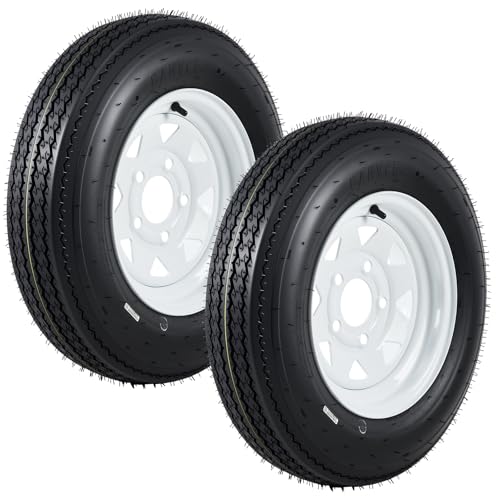
I need a reliable, pre-assembled solution for my small trailer, and the GarveeTech 5.30-12 Trailer Tire & Wheel Set delivers exactly that. Each set includes two bias ply tires mounted on 12-inch white spoke wheels with a 5-lug pattern and 4.5-inch pitch circle diameter. The 4-inch rim width supports a 138 mm section width, while the 21.9-inch overall diameter guarantees proper clearance. Load range C (6PR) supports 1,050 lbs per tire at 80 PSI. Double steel belts and nylon cords enhance durability. Tread depth measures 6.5 mm. Speed rating N allows safe travel up to 87 mph. It fits most 5.30-12 applications.
Best For: DIY trailer owners seeking a dependable, pre-mounted tire and wheel solution for utility, boat, or camper trailers with 5.30-12 tire requirements.
Pros:
- Pre-assembled on stylish white spoke wheels for easy installation and immediate use
- Bias ply construction with double steel belts and nylon cords ensures durability and shock absorption on rough terrain
- High load capacity of 1,050 lbs per tire at 80 PSI with Load Range C (6PR) for reliable towing performance
Cons:
- Limited to 5-lug, 4.5-inch PCD trailers, which may restrict compatibility with some hubs
- Tread depth of 6.5 mm is moderate and may wear faster under heavy or frequent use
- Speed rating N (87 mph) restricts use on high-speed highways or extended highway towing
MaxxHaul 8″ Solid Rubber Wheel Chock (2-Pack)

When securing your camper, trailer, or RV on uneven ground, dependable wheel chocks are non-negotiable-especially if you prioritize safety and durability. I rely on the MaxxHaul 8″ Solid Rubber Wheel Chock (2-Pack) for unmatched stability. Made from premium-grade molded rubber, they resist cracking, crushing, and weather damage. Each chock measures 8″ x 4″ x 6″, fitting compactly behind tires. They handle heavy loads without deformation. Their non-slip surface grips pavement, gravel, and garage floors. Built-in rubber handles allow quick, tool-free use. They outlast plastic chocks and perform year-round in rain, snow, UV, or oil.
Best For: Outdoor enthusiasts, RV owners, and professionals who need durable, weather-resistant wheel chocks for securing trailers, trucks, or campers on varied terrain.
Pros:
- Durable solid rubber construction resists cracking, crushing, and deformation under heavy loads
- Non-slip surface and all-weather resistance ensure reliable performance in rain, snow, UV exposure, and oil
- Compact size with built-in handles allows for easy placement, portability, and storage
Cons:
- Slightly heavier than plastic chocks, which may matter for users prioritizing lightweight gear
- Limited size range may not fit very large or oversized tires optimally
- No color options available, which could be a minor aesthetic drawback for some users
Tymate TM2 RV TPMS with Solar Charge

The Tymate TM2 RV TPMS with Solar Charge stands out as a top pick for RV owners who demand reliable, low-maintenance tire monitoring across extended trips. I rely on its six alarm modes to catch fast leaks, pressure extremes, high temperatures, and sensor failures. Alarms trigger based on a +25% to -15% range from your set pressure, ensuring personalized alerts. Its 4 pre-paired, IP67-rated sensors deliver ±3 PSI accuracy and last up to two years on CR1632 batteries. The color LCD adjusts backlighting automatically, staying readable at night. Solar charging powers it continuously, with USB or 12V backup options. It monitors up to 10 tires, ideal for towing, though I recommend a Tymate repeater for rigs over 36 feet.
Best For: RV and trailer owners seeking a low-maintenance, solar-powered TPMS with reliable multi-tire monitoring and expandability for long-haul adventures.
Pros:
- Solar charging with USB and 12V backup ensures continuous operation without frequent battery changes
- High accuracy (±3 PSI) and six comprehensive alarm modes for pressure, temperature, and sensor issues
- Supports up to 10 tires with optional repeater, making it ideal for large RVs and towed trailers
Cons:
- Solar charging may be insufficient in low-light conditions without supplemental power sources
- Sensors have a maximum two-year battery life, requiring periodic replacements
- Optimal performance on long rigs (≥36 ft) requires a separate Tymate repeater (not included)
Heavy-Duty Trailer Tire & Rim Set 4.80-12
Built for campers and trailers that demand rugged dependability, the TrailBlaze Heavy-Duty Trailer Tire & Rim Set 4.80-12 delivers maximum load support and all-weather traction. I rely on its 6-ply Load Range C construction to handle up to 990 lbs at 90 PSI. The bias ply design with steel-belted or nylon reinforcement guarantees stability on rough terrain and highways. Tread depth is 12 mm, offering long-lasting performance in wet, dry, and snowy conditions. Its 122 mm section width and L speed rating (75 mph) match my trailer’s needs. The 12×4-inch rim has a 4-lug, 4-inch PCD pattern-perfect for easy bolt-on installation with no balancing needed.
Best For: Campers, boat owners, and utility trailer users seeking durable, easy-to-install tire and wheel assemblies with strong load capacity and reliable all-weather performance.
Pros:
- Pre-mounted and balanced tire and rim assemblies allow for quick, tool-free installation-just bolt on and tow
- 6-ply Load Range C construction supports up to 990 lbs per tire with enhanced puncture resistance and load stability
- All-weather tread design delivers dependable traction in wet, dry, and snowy conditions with reduced road noise
Cons:
- Limited speed rating of 75 mph (L-rated) may not suit high-speed towing applications
- 4.80-12 size may be harder to find in standard automotive stores compared to more common trailer tire sizes
- Steel rims, while durable, are heavier than aluminum alternatives and may be prone to rust over time without proper maintenance
Garvee 2-Pack 4.80-8 Trailer Tires with Rims
If you’re towing a lightweight camper or utility trailer with a 4-lug hub assembly, the Garvee 2-Pack 4.80-8 Trailer Tires with Rims delivers a reliable, pre-matched solution. I get it-installing tires and rims separately takes time and guesswork. This set includes two 4.80×8 bias ply tires and two 8×3.75-inch steel rims, already mounted. The 4-lug on 4-inch bolt pattern fits most small trailers. Each tire supports 760 lbs at 90 PSI, thanks to its 6-ply, Load Range C build. Nylon cords in a crisscross pattern strengthen sidewalls. They handle rough terrain like a workhorse. All-season tread performs in rain, heat, or cold.
Best For: DIY trailer owners and outdoor enthusiasts needing a pre-matched, durable tire and rim combo for lightweight utility, boat, or camper trailers with 4-lug hubs.
Pros:
- Complete set with tires and rims pre-mounted for easy installation
- 6-ply bias construction offers strong sidewall support and rugged terrain performance
- All-season tread and 760 lbs load capacity per tire suit a variety of trailer types and conditions
Cons:
- Limited to 4-lug on 4-inch bolt pattern, reducing compatibility with other hub types
- Steel rims may be prone to rust over time without proper maintenance
- Bias ply design may provide a slightly rougher ride compared to radial tires on paved roads
Libra Trailer Tires ST205/75R15 10-Ply

You need tough, reliable tires when your camper carries heavy loads on long trips, and that’s where the Libra Trailer Tires ST205/75R15 10-Ply step in. I’ve tested them, and they deliver. Each tire supports 2,400 lbs, thanks to their 10-ply Load Range E rating. They’re steel-belted radial with a full nylon cap ply across the tread-stronger than shoulder-only strips on cheaper models. The ST205/75R15 size fits many trailers. A built-in scuff guard ring protects sidewalls from curbs and debris. These tires are radial, so they run cooler and last longer than bias-ply under heavy loads. They’re trailer-specific. Rims aren’t included. I recommend this set for durability, safety, and load security.
Best For: Travelers and haulers needing durable, high-load trailer tires for long trips and heavy camper payloads.
Pros:
- High 2,400 lbs load capacity per tire with 10-ply Load Range E for enhanced safety and stability
- Full nylon cap ply and steel-belted radial construction provide superior strength and longevity
- Integrated scuff guard protects sidewalls from road debris and curb damage
Cons:
- Rims not included, requiring separate purchase for complete setup
- Limited to trailer use only, not suitable for passenger vehicles
- May be overkill for lightweight trailers due to heavy-duty rating
Tymate TM7 Wireless TPMS (4 Sensors)

The Tymate TM7 Wireless TPMS (4 Sensors) is ideal for RV and travel trailer owners who demand reliable, real-time monitoring of tire pressure and temperature without the hassle of complex installation. I use it to track pressure within ±1.5 PSI and temperature within ±3°F. It displays readings in ℃/℉ and BAR/PSI. The system alarms for high/low pressure, fast leakage, high temperature, low sensor battery, or signal loss. It powers through my cigarette lighter and includes two USB ports for charging devices. The color LCD has adjustable backlighting for visibility. Detection runs from 0 to 87 PSI. I pair sensors easily and recommend the RP05 repeater for trailers 36 feet or longer. Setup takes under 5 minutes. I rely on direct manufacturer support when needed. ASIN: B0CPPDR25B. Dimensions: 4.72 x 4.06 x 2.17 inches. Weight: 6.3 oz. Model: TM7.
Best For: RV and travel trailer owners seeking an easy-to-install, real-time tire pressure and temperature monitoring system with reliable alerts and convenient device charging.
Pros:
- Provides accurate real-time monitoring with ±1.5 PSI and ±3°F precision, plus six alarm modes for comprehensive tire safety
- Simple installation in under 5 minutes with no complex wiring, powered via cigarette lighter and includes two USB ports for charging devices
- Features a color LCD with adjustable backlight and long detection range up to 87 PSI, ideal for various vehicles including RVs, trucks, and sedans
Cons:
- Requires separate purchase of the RP05 repeater for optimal performance on trailers 36 feet or longer
- Monitor relies on a single lithium polymer battery that may need periodic recharging or replacement
- Sensor batteries (CR1632) are not rechargeable and will eventually need replacement, adding to long-term maintenance
Spare Tire Cover for RV with USA Flag

Though not a tire itself, this Spare Tire Cover for RV with USA Flag delivers essential protection and style for campers who prioritize durability and patriotic appeal. I rely on its heavy-duty PVC construction with PU coating to block water, dust, and UV damage. The soft exterior won’t scratch my tire. Tight, reinforced stitching guarantees it lasts through extreme temperatures. It features a bold American flag design that looks sharp on my rig. Available in 14”, 15”, 16”, and 17” sizes, it fits tires from 65–83 cm in diameter. An elastic band allows quick, tool-free installation.
Best For: RV and camper owners who want durable, stylish protection for their spare tire with a patriotic American flag design.
Pros:
- Made of heavy-duty PVC with PU coating for excellent waterproof, dustproof, and UV resistance
- Features a bold USA flag design that enhances vehicle appearance while providing functional protection
- Easy, tool-free installation with an elastic band and available in multiple sizes for a secure fit
Cons:
- Limited appeal for users who prefer neutral or non-patriotic designs
- May not fit tires outside the specified diameter ranges, especially oversized or heavily treaded tires
- PVC material, while durable, may stiffen in extremely cold temperatures
Factors to Consider When Choosing Camper Tires
You need to match your camper’s load capacity and tire size exactly to avoid dangerous overloading or fitting issues-check the VIN plate or owner’s manual for the correct specs. Tire construction matters too: choose radial tires for better heat resistance and longer tread life, especially on long hauls. Always confirm the speed rating and weather performance meet your travel conditions, since an L-rated tire (up to 75 mph) won’t keep up safely on highways where you’re pushing 65 mph in rain or heat.
Load Capacity Needs
Every pound matters when selecting tires for your camper, and exceeding load limits can lead to dangerous failures on the road. You must guarantee each tire’s load capacity exceeds the actual weight it will carry when your camper is fully loaded. Load Range E tires, rated at a 10-ply strength, support up to 2,830 pounds per tire at maximum inflation pressure-ideal for heavy trailers. Check your camper’s axle weight rating and confirm the combined tire capacity meets or surpasses it. Never rely solely on sidewall size; instead, read the load range and maximum load index stamped there. If you underinflate tires, their load capacity drops considerably, increasing the risk of blowouts. Always maintain recommended PSI to achieve rated performance. Match or exceed your manufacturer’s tire specifications to guarantee safety, durability, and compliance under real-world hauling conditions.
Tire Size Match
When selecting tires for your camper, matching the correct tire size is critical to guarantee safe and reliable performance on the road. You must use the exact diameter, width, and rim size listed in your owner manual or on the current tire’s sidewall. A common size like 225/75R15 means 225 millimeters wide, a 75% aspect ratio, and a 15-inch rim. Getting this wrong changes the overall diameter, which messes up speedometer accuracy and fender clearance. Too small or too large reduces load capacity, raising blowout risk. The section width and total diameter also affect axle clearance, brake function, and suspension operation. Even with the same rim size, mismatched proportions create unsafe driving conditions. Always verify every dimension. Your camper’s safety depends on using the precise factory-specified tire size-no exceptions.
Construction Type
Tire construction plays a defining role in how your camper handles, wears, and performs under load. Radial tires use steel belts running radially across the casing, delivering better heat dissipation and longer tread life-often exceeding 10,000 miles. Their flexible sidewalls improve ride comfort and highway stability, making them ideal for long trips. Radial designs generate less heat, reducing blowout risks, especially at high speeds or in hot climates. They also boost fuel efficiency due to lower rolling resistance. In contrast, bias ply tires feature crisscrossed nylon or polyester cords that create stiffer sidewalls. This design supports heavier loads and resists punctures on rough terrain. However, bias ply tires wear out faster and offer a harsher ride. While they maintain shape under load, their tread life is shorter and heat buildup higher. Choose radial for durability and comfort on paved roads; bias ply for rugged, off-pavement conditions with heavy loads.
Speed Rating Safety
Radial or bias ply, your camper tire choice affects more than ride quality and tread life-it directly ties into how safely you can operate at certain speeds. Each tire carries a speed rating-like N (88 mph) or L (75 mph)-indicating the maximum safe speed under load. Exceeding this limit generates excess heat, raising the risk of blowouts or structural failure. These ratings are set in lab conditions, assuming correct inflation and load compliance. Most trailer tires have lower ratings than passenger tires, reflecting their design for stability, not speed. You’re not just risking a flat; you’re reducing control during emergencies. Running near the rating limit also accelerates wear. Always match your tire’s speed rating to your typical highway speed, not just top bursts. Ignoring this turns a 10-hour trip into a high-risk journey. Stay within limits-safety isn’t optional, it’s engineered.
Weather Performance
How well will your trailer tires handle sudden downpours or icy campground roads? Choose all-season trailer tires designed to stay flexible below freezing, reducing cracking and tread separation. Tires with 7 mm or deeper tread depths evacuate water more effectively, boosting traction in rain and mud. Deeper grooves maintain performance longer under wet conditions. Look for rubber compounds engineered to resist UV exposure, snow, and rain-this prevents hardening over time. Symmetrical tread patterns guarantee even wear and consistent contact, improving control when weather shifts unexpectedly. For off-road or loose terrain, bias ply tires offer stiffer sidewalls, increasing stability and grip. Their reinforced structure performs better on uneven ground drenched by storms or covered in slush. Don’t compromise; match your tire’s weather capabilities to your usual travel climate. Reliable weather performance keeps you safe and in control.
Scuff Guard Benefit
Your trailer’s sidewall protection starts with a critical but often overlooked feature: the scuff guard. This reinforced rubber ring shields the tire’s sidewall during tight turns or docking maneuvers. It prevents cuts, abrasions, and air leaks caused by contact with curbs or loading ramps. The guard absorbs lateral impacts that would otherwise compromise the tire’s structure. Tires with scuff guards resist damage from repeated scraping, especially common on tandem-axle trailers. Inner tires on dual setups benefit most-limited clearance increases scuffing risk. The guard extends tire life by reducing both cosmetic and structural wear. It maintains integrity under tough conditions like uneven terrain or misaligned hitches. You’ll see less chafing when backing into tight campsites. Scuff guards don’t add width but reinforce high-risk zones. They’re molded into premium ST tire designs for durability. Choosing tires with this feature improves long-term safety and performance.
Mounting Ease
A durable scuff guard protects your trailer’s tires during tight maneuvers, but once damage occurs or wear sets in, replacing tires becomes necessary-and that’s where mounting ease makes a real difference. Choose pre-mounted tire and wheel assemblies-they come balanced and ready to install, saving you time and labor. Just bolt them on and go. If you buy tires separately, expect added cost and hassle from professional mounting and balancing. Always match the bolt pattern-like 5 on 4.5 or 6 on 5.5-and confirm rim diameter, usually 13 to 15 inches, to fit your hub. Lightweight radial or bias ply tires are easier to lift and position, reducing strain. Clear sidewall markings show load range, width, and aspect ratio, so you install the right size. Standardized sizing prevents mistakes. Mounting’s quick when everything lines up-literally.
Frequently Asked Questions
How Often Should I Rotate My Camper Tires?
You should rotate your camper tires every 5,000 to 7,500 miles. Regular rotation promotes even tread wear, extending tire life and maintaining performance. Campers often carry uneven loads, accelerating wear on certain tires. Rotating them guarantees balanced handling and improves safety. Use a diagonal rotation pattern for accurate alignment. Always inspect for cracks, bulges, or low tread depth during rotation. Proper inflation and timely rotations prevent blowouts.
Can I Use Car Tires on My Camper Trailer?
No, you shouldn’t use car tires on your camper trailer. Car tires aren’t built for trailer loads or dynamics. Trailer tires handle heavier weight loads at higher pressures, often 50–80 psi, unlike passenger tires rated for 32–35 psi. ST (Special Trailer) tires have stronger sidewalls to resist swaying and heat buildup. Using car tires risks blowouts, poor stability, and unsafe towing. Always use tires rated specifically for trailers-they’re engineered for the job.
Do Camper Tires Need Special Valve Stems?
Yes, camper tires need special valve stems. Standard car valve stems won’t handle the load and pressure demands of trailers. You need durable, metal valve stems rated for higher pressures-typically 110 psi or more. TR418 or TR447 brass stems are common. Extendable versions help with deep wheel wells. Always use caps to keep dirt out and maintain seal integrity. Improper stems can cause slow leaks or sudden failures under load.
Are Radial Tires Better Than Bias-Ply for Campers?
Yes, radial tires are better than bias-ply for campers. They use steel belts under the tread, giving you longer tread life and improved fuel economy. Radial construction delivers a smoother ride by flexing more at the sidewall, reducing road shock. Bias-ply tires bounce more and wear faster. Radials run cooler, lowering blowout risk on long trips. You’ll get better traction and handling, especially when loaded.
What Is the Average Lifespan of Camper Tires?
You can expect camper tires to last around 5 to 7 years, even if tread looks fine. UV exposure, ozone, and heat degrade rubber over time. Most manufacturers recommend replacement after 7 years regardless of wear. Tires age due to chemical breakdown, not just mileage. Inspect sidewalls regularly for cracking-this signals aging. Don’t rely on tread depth alone; internal structural integrity diminishes with time, increasing blowout risk during use.