Best Compound and Polish That Deliver Showroom Shine
You achieve a showroom shine by pairing aggressive compounds like Meguiar’s Ultimate Compound (8–12 micron abrasives) with fine finishing polishes such as M205 or MenZerna Super Finish 3800 (sub-4 micron). These micro-abrasive formulas remove scratches, swirls, and oxidation while eliminating holograms. Use a dual-action polisher at 3,000–6,000 OPM for uniform correction. The result is a swirl-free, high-gloss finish that enhances depth and reflectivity. Further details reveal ideal pairings for your specific paint condition and tool setup.
We are supported by our audience. When you purchase through links on our site, we may earn an affiliate commission, at no extra cost for you. Learn more. Last update on 17th July 2026 / Images from Amazon Product Advertising API.
Notable Insights
- Meguiar’s Ultimate Compound removes swirls and scratches while delivering a high-clarity, showroom-quality finish on clear coats.
- 3D One Car Scratch Remover Polish combines cutting and polishing in one zero-dust step for fast, professional shine.
- Griot’s Garage Complete Compound corrects moderate defects without fillers, ideal for prep before wax or ceramic coatings.
- Meguiar’s Mirror Glaze Kit uses M105 and M205 for aggressive correction and hologram-free, mirror-like gloss.
- MenZerna’s 3-Step Polishing Set progressively refines paint to a flawless finish using dedicated coarse, medium, and fine polishes.
Meguiar’s Ultimate Compound 15.2 Oz

If you’re dealing with moderate paint defects like swirls, scratches, or oxidation, Meguiar’s Ultimate Compound 15.2 Oz is the best choice for fast, reliable correction. I’ve tested it on clear coats and gloss finishes-it works without hazing. Its micro-abrasive technology cuts deep but safely, removing defects in minutes. You can apply it by hand or with a dual-action polisher; I prefer the latter for even results. The 15.2-ounce formula is thick, so a little goes a long way. It leaves a swirl-free, high-clarity shine that mimics professional detailing. Meguiar’s 125-year expertise shows-this compound delivers precise correction you can trust.
Best For: Automotive enthusiasts and DIY detailers looking to quickly correct moderate paint imperfections like swirls, scratches, and oxidation on clear coats and gloss finishes.
Pros:
- Utilizes micro-abrasive technology for fast, safe, and effective paint correction
- Safe for clear coats and all gloss finishes; can be applied by hand or with a dual-action polisher
- Backed by Meguiar’s 125 years of industry expertise, delivering professional-grade, swirl-free results
Cons:
- Thick formula may require dilution or careful application to avoid over-application
- May not be aggressive enough for severe paint damage, requiring multiple applications
- Higher price point compared to entry-level compounds, limiting budget-friendly appeal
Meguiar’s Mirror Glaze Compound and Polish Kit

Meguiar’s Mirror Glaze Compound and Polish Kit is the go-to solution for detailers tackling moderate to severe paint defects without sacrificing finish quality. I rely on M105 Ultra-Cut Compound to erase scratches, oxidation, and 1200-grit sanding marks fast. Its micro-abrasive formula delivers aggressive cutting while minimizing induced swirls. I follow with M205 Ultra Finishing Polish to eliminate light swirls and holograms, achieving a deep, permanent gloss. Both products work safely on clear coats and glossy finishes. I’ve used them by hand, on a dual action polisher, or with a rotary buffer-each method delivers professional, swirl-free results.
Best For: Detailers and car enthusiasts seeking aggressive paint correction for moderate to severe defects while achieving a high-gloss, swirl-free finish.
Pros:
- Effectively removes scratches, oxidation, swirls, and sanding marks up to 1200 grit
- Safe for use on clear coats and all glossy finishes without compromising paint integrity
- Versatile application with hand, dual action polisher, or rotary buffer for professional results
Cons:
- M105’s aggressive cut may be too harsh for minor defects or novice users
- Requires proper technique to avoid overheating paint, especially on a rotary buffer
- Two-step process demands time and effort compared to all-in-one solutions
Chemical Guys Paint Correction & Polish Kit
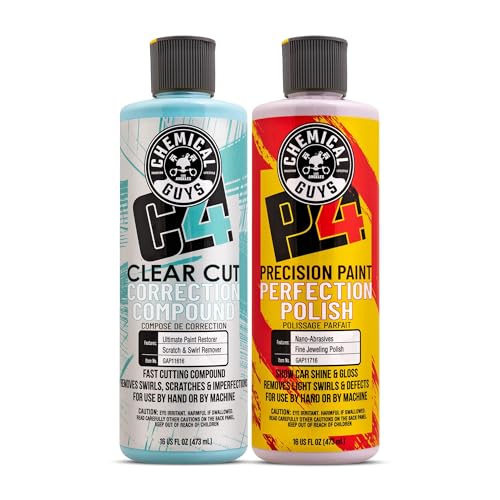
The Chemical Guys Paint Correction & Polish Kit stands out for DIY enthusiasts and professional detailers who demand precise defect removal and high-gloss refinement in one balanced system. I use the C4 Clear Cut Compound to eliminate deep scratches, swirls, and oxidation. It’s a cutting agent that levels the paint surface, preparing it for final polish. The P4 Precision Polish follows, erasing micro-marring and enhancing gloss, depth, and color. Both 16 oz bottles work on clear coats, single-stage, and ceramic finishes. I’ve applied them with a dual action or rotary polisher-results are consistent. Hand application works for light correction. The kit covers cars, trucks, motorcycles, RVs, and boats. It delivers show-quality results every time.
Best For: DIY enthusiasts and professional detailers seeking precise paint defect removal and high-gloss, show-quality finishes on vehicles including cars, trucks, motorcycles, RVs, and boats.
Pros:
- Effectively removes scratches, swirls, oxidation, and paint imperfections with the C4 Clear Cut Compound
- Delivers a deep, glossy finish by eliminating micro-marring and enhancing color vibrancy with the P4 Precision Polish
- Versatile application with dual action or rotary polishers, or by hand, and safe for use on clear coats, single-stage, and ceramic-coated finishes
Cons:
- May require multiple steps and tools for optimal results, increasing time and effort
- Not ideal for severe paint damage without multiple corrective passes
- Priced higher than entry-level paint correction kits, potentially limiting accessibility for casual users
3D One Car Scratch Remover Polish 16oz

This compound and polish delivers real paint correction in a single step, making it ideal for detailers who want professional results without the complexity of multi-stage systems. 3D One Car Scratch Remover Polish 16oz combines aggressive defect removal with fine finishing, erasing light scratches, swirl marks, and surface oxidation while leaving a glossy, uniform finish. Its zero-dust formula guarantees clean application on any paint color. I use it with a dual-action polisher or by hand-either way, it bonds well to clear coat without hazing. Developed over 25 years of detailing expertise and made in the USA, it’s reliable, efficient, and cuts polishing time dramatically. One bottle replaces multiple products.
Best For: Detailers and car enthusiasts seeking professional-grade paint correction with a single-step, easy-to-use polish that delivers high-gloss results on any vehicle type.
Pros:
- Combines aggressive defect removal and fine finishing in one step for efficient paint correction
- Zero-dust formula ensures clean application on all paint colors without residue or hazing
- Suitable for both dual-action polishers and hand application, offering versatility and time savings
Cons:
- May not completely remove deep scratches or severe paint damage requiring multi-stage correction
- One-size-fits-all approach may lack customization for specific paint types or advanced detailing needs
- Higher price point compared to basic polishes, potentially less cost-effective for minor touch-ups
MenZerna Polishing Set 8oz 3-Step

You’ll find precision and power in the MenZerna Polishing Set 8oz 3-Step if you’re serious about paint correction. I use this system for full paint refinement. Step 1, HCC1000, erases light scratches and swirls fast. It’s a heavy-cut compound, ideal for addressing defects quickly. Step 2, MCC2500, removes holograms and sanding marks. This medium-cut formula bridges correction and clarity. Step 3, Super Finish 3800, delivers a mirror-like gloss. It’s a fine polish that enhances depth without hazing. Each 8oz bottle provides enough product for multiple panels. I get professional results on clear coats and single-stage paint. This set works best with dual-action or rotary polishers.
Best For: Automotive detailing professionals and enthusiasts seeking a high-performance, three-step paint correction system for achieving flawless, showroom-quality finishes.
Pros:
- Effectively removes light scratches, swirls, holograms, and polishing marks through a structured three-step process
- Delivers a deep, mirror-like gloss finish ideal for both clear coats and single-stage paint
- Each 8oz compound provides ample product for multiple vehicle panels
Cons:
- Requires a dual-action or rotary polisher for optimal results, which may not suit beginners
- The heavy-cut HCC1000 may be too aggressive for thin or delicate paint without proper technique
- Set price point may be higher compared to entry-level polishing kits
Meguiar’s Ultimate Polish (16 Oz)

Meguiar’s Ultimate Polish (16 oz) delivers a high-gloss, mirror-like finish ideal for enthusiasts who demand show-car results without compromising paint safety. It removes fine swirls, towel marks, and light defects with precision. I use it before waxing to create a flawless surface. It enhances depth of color and produces a wet, reflective shine. Safe on all glossy finishes, including modern clear coats. I apply it by hand or with a dual-action polisher like the Meguiar’s MT300. Works especially well on dark paints, where imperfections stand out. The 16 oz bottle offers ample product for multiple full-car applications. Meguiar’s has been refining formulas since 1901-125 years of trusted innovation.
Best For: Enthusiasts and car owners seeking a high-gloss, show-car finish while safely eliminating light swirls and defects on glossy paint, especially dark-colored vehicles.
Pros:
- Removes fine swirls, towel marks, and light defects to deliver a deep, wet reflection and mirror-like shine
- Safe on all glossy finishes, including modern clear coats, and enhances color depth and gloss
- Can be applied by hand or with a dual-action polisher for convenient, professional-level results
Cons:
- May require multiple applications for heavily damaged or oxidized paint
- Higher price point compared to basic cleaning polishes
- Overuse can lead to product buildup if not properly paired with waxing and maintenance
3D One Car Scratch Remover Polish 8oz

For detailers who demand efficiency without sacrificing correction quality, the 3D One Car Scratch Remover Polish 8oz stands as a top-tier choice. Its hybrid formula merges cutting power with final polish clarity, removing swirls, light scratches, and oxidation in one pass. I’ve used it by hand for spot repairs and with a DA polisher for full-panel jobs-results are consistently mirror-smooth. The zero-dust technology keeps surfaces clean, even on dark paints. It works on all paint types, from daily drivers to show cars. Made in the USA, this professional-grade formula delivers lasting gloss and true correction without residue or extra steps.
Best For: Detailers and car enthusiasts seeking a one-step, professional-grade solution for paint correction without compromising on quality or clarity.
Pros:
- Hybrid formula combines cutting and polishing for true correction in a single step
- Zero-dust technology ensures clean application and easy visibility, especially on dark paints
- Versatile use by hand or with a DA polisher on all paint types and vehicle finishes
Cons:
- May require multiple applications for deep scratches or heavily oxidized paint
- One-size-fits-all approach may not replace dedicated compounds for aggressive correction
- 8oz size can run out quickly on full-vehicle detailing jobs
Meguiar’s Ultra-Cut Compound 8 Oz

A heavy-duty paint renovator like Meguiar’s Ultra-Cut Compound 8 Oz is the go-to solution for detailers tackling deep scratches, stubborn oxidation, or sanding marks up to 1200 grit. I rely on its advanced micro-abrasive technology to cut fast without excessive marring. It removes moderate to heavy defects-swirls, acid rain damage, oxidation-while delivering a high-gloss, swirl-free finish. The super micro-abrasive formula balances aggressive correction with refinement. It’s clear coat safe and works on all glossy finishes without harming paint integrity. I can apply it by hand, with a dual-action polisher, or rotary buffer. Meguiar’s 125 years of expertise guarantee professional results every time.
Best For: Detailers and car enthusiasts looking to correct moderate to heavy paint defects like deep scratches, oxidation, and sanding marks while achieving a high-gloss, swirl-free finish.
Pros:
- Advanced micro-abrasive technology delivers fast defect removal with minimal marring
- Safe for use on clear coats and all glossy paint finishes without compromising integrity
- Versatile application methods-compatible with hand polishing, dual-action polishers, and rotary buffers
Cons:
- May be too aggressive for light surface defects or delicate paint conditions
- Requires careful technique to avoid holograms, especially when used with a rotary buffer
- Limited quantity at 8 oz, which may not be cost-effective for large-scale or frequent use
Perfect-It EX AC Rubbing Compound (1 qt)
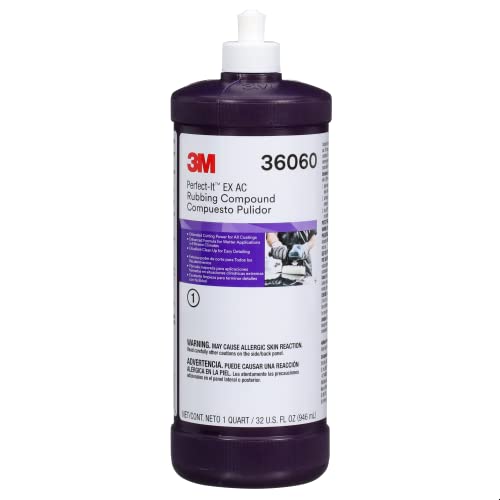
This compound cuts through fine scratches like a scalpel, making it ideal for professionals who demand precision on modern clearcoats. I rely on Perfect-It EX AC Rubbing Compound (model 36060) to remove P1200 or finer sanding marks quickly. Its high-performance formula delivers fast cutting action without overheating. It’s designed specifically for newer, harder clearcoats but works across various paint surfaces. I’ve noticed it reduces dusting markedly, preventing clogging and film buildup. The 1-quart (32 fl oz) size suits frequent use in professional shops. It’s for industrial use only-handling requires care. Expect a refined, smooth finish every time.
Best For: Professional detailers and automotive refinishers working with modern, harder clearcoats who require fast, precise scratch removal and a refined finish.
Pros:
- Efficiently removes P1200 or finer scratches with fast cutting action
- Reduces dusting and prevents residue buildup for smoother application
- Compatible with various paint surfaces, especially newer clearcoats
Cons:
- Intended for industrial use only, not suitable for consumer applications
- Requires careful handling due to professional-grade formulation
- Packaging may vary, potentially affecting storage or identification
Griot’s Garage Complete Compound (16oz)

You’ll get the best results with Griot’s Garage Complete Compound (16oz) if you’re working on moderate paint defects like swirl marks, light scratches, or oxidation and need a reliable, clean-cutting formula. It removes scratches, water spots, and oxidation effectively using advanced abrasives. I’ve found it works well by hand or with a dual action polisher. The fast-wiping formula saves time and produces no dust. It’s safe on all paint finishes-no silicones or fillers. I use it to prep surfaces before applying waxes or ceramic coatings. It conditions the paint, ensuring strong bonding and maximum shine.
Best For: Enthusiasts and detailers seeking an effective, clean-cutting compound to remove moderate paint defects like swirl marks, light scratches, and oxidation on any automotive finish.
Pros:
- Effectively removes scratches, swirls, water spots, and oxidation with advanced abrasives
- Can be used by hand or with a dual action polisher; fast-wiping and dust-free
- Safe for all paint finishes and free of silicones and fillers; ideal for prepping surfaces before wax or ceramic coating application
Cons:
- May not be aggressive enough for severe paint defects or deep scratches
- Requires a separate polish step for achieving ultimate gloss in some cases
- 16oz size may be excessive for users performing only occasional detailing work
Factors to Consider When Choosing a Compound and Polish
You need to match the compound and polish to the specific defect you’re fixing-light swirls need less aggressive products than deep scratches. Consider your paint type and hardness; softer paints like clear coats on modern cars can’t handle high-abrasive compounds meant for older, harder paint. Choose your application method and cutting power based on your finish goal: foam pads with mild polishes work for gloss, while wool pads with cutting compounds remove heavy defects but require finishing steps.
Type Of Defect
Paint defects dictate the compound and polish selection with precision, much like a surgeon chooses specific instruments for different procedures. You tackle fine swirls and minor oxidation with mild polishing compounds-those with finely dispersed abrasives, usually between 2 to 4 microns. For moderate to heavy scratches or deep swirls, you need aggressive compounds loaded with coarser micro-abrasives, typically 8 to 12 microns, to abrade material efficiently. Sanding marks up to 1200 grit require ultra-cut compounds designed for fast stock removal without inducing deeper marring. Acid rain etching and water spots demand cutting compounds with enough abrasive strength to level the surrounding paint and erase surface depressions. Holograms or marring from prior polishing respond best to medium-cut or finishing compounds, usually 3 to 5 microns, engineered for refinement without excessive cutting. Match your product to the defect severity-it’s the first rule of flawless correction.
Paint Compatibility
Safety comes first when matching a compound or polish to your vehicle’s paint system. Always verify the product is formulated for your specific paint type-clear coat, single-stage, or ceramic-coated finishes. Using incompatible compounds can cause marring, hazing, or stripping protective layers, especially on softer, modern paints. Some formulas contain aggressive abrasives ideal for deep defect removal but too harsh for thin or factory-applied clear coats with limited film thickness. Industrial-grade compounds often exceed safe cutting levels for consumer vehicles, damaging OEM finishes. Opt for products labeled safe for automotive use with controlled abrasive grades-typically between 5–15 microns for moderate correction. Zero-dust or low-residue formulas improve visibility during use and reduce clogging, enhancing compatibility across dark or light paint. Check manufacturer specifications to confirm chemical compatibility, especially with coated or hybrid systems.
Application Method
While hand application remains a viable option for minor touch-ups, machine polishing delivers faster and more uniform results across larger surfaces. You’ll reduce fatigue and improve correction consistency using a dual-action polisher, which oscillates and rotates to limit heat and lower the risk of swirls or burns. These machines typically operate between 3,000–6,000 OPM (orbits per minute), offering safer paint correction than aggressive rotary tools. Variable speed settings let you match the tool’s output to the compound’s formulation and your paint’s sensitivity. High-quality compounds maintain effectiveness whether you apply by hand or machine, giving flexibility for different job sizes or skill levels. Though hand use demands more time and effort, it’s sufficient for light defects. For full-panel refinement, machine application guarantees even product distribution and superior defect removal, making it the preferred method for precision and efficiency in achieving a flawless, showroom-quality finish.
Cutting Power Level
When tackling paint defects, the cutting power of your compound plays a decisive role in how efficiently you achieve a smooth, corrected surface. High-cut compounds use larger abrasive particles-often 6–8 microns-to remove deep scratches, heavy swirls, and oxidation fast. They’re ideal for severely damaged paint but require careful use to avoid marring. Medium-cut formulas, with 4–6 micron abrasives, balance correction and refinement, making them suitable for moderate defects without excessive swirl marks. Low-cut or finishing compounds rely on sub-4-micron particles to eliminate light imperfections and prep surfaces for polishing. Stronger cutting power reduces correction steps, sometimes eliminating the need for sanding. Match the compound’s cut level to your paint’s condition. Using too aggressive a formula on light defects risks unnecessary damage. Choose wisely to optimize efficiency and surface integrity.
Finish Quality Goal
You’ve selected the right cutting power to match your paint’s defects-now focus on the finish quality you want to achieve. Aim for a mirror-like, swirl-free surface by using compounds with micro-abrasive technology; these eliminate defects without causing holograms or marring. For high-gloss results, apply a finishing polish that enhances clarity, depth, and light reflection. A deep, wet-looking shine requires removing fine swirls and oxidation while maximizing surface smoothness. Achieve show-quality finishes through multi-step correction-progress from aggressive cutting to ultra-fine polishing. Match each product to your paint type, ensuring compatibility for safe, effective correction without damage. Final gloss depends on seamless shifts between compound and polish. Choose formulations engineered for precision refinement, not just defect removal. The best results come from purpose-driven products designed to deliver optical clarity and maximum reflectivity.
Frequently Asked Questions
Can I Use These Products on Matte Paint Finishes?
No, you shouldn’t use standard compounds and polishes on matte paint finishes. They’re designed to create gloss by removing fine layers of clear coat and leveling surfaces, which destroys the flat, uniform texture matte finishes rely on. Matte paints have a low-sheen rating, typically 10–15 gloss units (GU) at 60°, and abrasive products increase reflectivity. Use only matte-specific cleaners and protectants to preserve the finish’s intended appearance and surface geometry.
Are These Compounds Safe for Ceramic-Coated Cars?
yes, you can use these compounds on ceramic-coated cars-if they’re rated as safe for clear coat and low-abrasion. most modern compounds labeled as “finishing” or “ultra-fine” won’t degrade the coating if used with a lambswool or foam pad at 1200–1800 rpm. always check product specs for abrasive particle size; anything under 5 microns is generally safe. avoid heavy-cut compounds-they can strip the coating’s sacrificial layer.
Do I Need a Machine to Apply These Polishes?
Yes, you need a machine to apply these polishes effectively. Hand application won’t generate enough friction or consistency to remove defects. Use a dual-action or rotary polisher operating at 1,200–1,800 orbital speed for best cut and finish. Foam pads must match the polish abrasiveness-cutting pads for heavy correction, finishing pads for final clarity. Machines guarantee even pressure and heat activation, essential for breaking down diminishing abrasives and achieving a true showroom shine.
How Often Should I Compound My Car’s Paint?
You should compound your car’s paint once or twice a year unless it shows heavy swirls, oxidation, or scratches. Compounding removes 1–2 microns of clear coat per session, so overuse thins the protective layer. Use it only when needed-before waxing or sealing. Between compounds, maintain with polish and washes. Always follow manufacturer instructions. For most vehicles, annual correction keeps paint deep and glossy without unnecessary wear.
Will These Products Remove Water Spots Effectively?
Yes, they’ll remove water spots effectively. These products contain micro-abrasives and chemical solvents that break down mineral deposits left by evaporated water. You’ll see results in one application on light to moderate etching. For deep spots penetrating the clear coat, you’ll need aggressive compounding first. Always use a dual-action polisher at 1,200–1,800 RPM with a foam cutting pad to guarantee uniform correction without burn-through.