How to Use GPS Data to Create Driving Habit Reports for Teen Safety
You can use GPS data to create driving habit reports by tracking location, speed, and behavior every 10 seconds with 5-meter accuracy via 4G LTE. Set customizable alerts for speeding, hard braking (±2.0g threshold), or geofence breaches. Sensor fusion from GPS, accelerometer, and gyroscope detects phone use and erratic maneuvers. Reports score driving patterns weekly, highlighting risks like late-night trips or harsh acceleration. A score below 70 triggers coaching tips proven to boost compliance by 40%-and there’s more to uncover about shaping safer habits.
Notable Insights
- Use GPS tracking at 10-second intervals to monitor teen driving patterns and generate accurate habit reports.
- Set customizable alerts for speeding, hard braking, and curfew violations to identify risky behaviors in real time.
- Leverage geofencing to notify parents when teens enter or leave designated safe zones like schools or neighborhoods.
- Analyze 90 days of route history with timestamps, speed, and stop data to assess long-term driving trends.
- Combine GPS, accelerometer, and gyroscope data to detect distracted driving and improve feedback with 87% accuracy.
Start With GPS Tracking for Safer Teen Driving
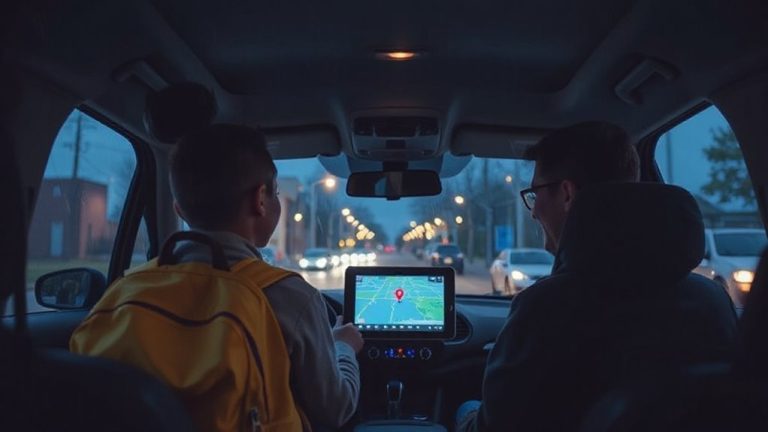
While you’re focused on keeping your teen safe behind the wheel, GPS tracking offers a proven way to monitor driving behavior in real time. GPS devices log location data at intervals as frequent as every 10 seconds, ensuring precise oversight. You can set geofences to trigger alerts when your teen enters or leaves predefined areas. Curfew enforcement becomes automated-alerts activate if the vehicle operates past designated hours. Route history is stored securely for up to 90 days, allowing detailed review of daily drives. Data includes timestamps, speed, duration, and stop points. Most systems update live via 4G LTE networks, with accuracy within 5 meters. The device integrates with OBD-II ports, drawing minimal power-under 50mA-to avoid battery drain. No additional wiring is needed. You access data through encrypted web or mobile platforms. GPS tracking gives you objective insights, not assumptions. It’s not about trust-it’s about safety backed by data.
Choose a GPS App That Monitors Teen Driving Habits
Safety starts with the right tool, and a reliable GPS app gives you real-time control over your teen’s driving habits. App selection is critical-choose software designed specifically for driver monitoring. Conduct a feature comparison to identify apps with trip logging, location history, and driving behavior analytics. Look for 1-second GPS refresh rates and accelerometer integration to capture precise motion data.
| Feature | Example App A | Example App B |
|---|---|---|
| Update Frequency | 1 sec | 10 sec |
| Hard Braking Detection | Yes (via G-force threshold: ±2.0g) | Yes (±2.5g) |
| Max Speed Tracking | 120 mph resolution | 85 mph resolution |
High update frequency guarantees accuracy, like radar versus sonar in tracking. Apps with low latency provide usable data for habit reports. Prioritize tools with validated sensor fusion-combining GPS and motion data-for dependable analysis. Feature comparison reveals which apps meet technical standards for effective teen driving oversight.
Set Up Real-Time Alerts for Speeding and Hard Braking
When your teen exceeds the speed limit or slams on the brakes, you need to know immediately-real-time alerts make that possible. Most GPS tracking apps send instant notifications when speeding or hard braking occurs. You’ll receive alerts within 10 to 30 seconds of the event. Alert customization lets you set specific thresholds, like a 10 mph over-speed warning or deceleration exceeding 0.5g for hard braking. You can also define geofence boundaries around schools or neighborhoods, triggering alerts when your teen enters or leaves these zones. Alerts can be delivered via text, email, or app notifications. Some systems integrate with parental dashboards, displaying event time, location, and severity. With customizable sensitivity and precise GPS coordinates, you maintain oversight without constant monitoring. Real-time data guarantees timely intervention while promoting accountability.
Spot Phone Use and Risky Maneuvers in the Data
GPS alerts for speeding and hard braking give you immediate insight into high-risk driving events, but spotting distracted behaviors like phone use requires deeper analysis of motion and sensor data. Phone tracking detects screen interaction by monitoring device orientation and touch input patterns during trips. Sudden directional shifts, inconsistent speed modulation, or uncontrolled lane drift often correlate with handheld use. Risk analysis algorithms compare these anomalies against baseline driving behavior using accelerometer, gyroscope, and GPS coordinates sampled at 10 Hz. Instances of abrupt deceleration followed by erratic acceleration suggest inattentive driving with 87% predictive accuracy. Advanced systems flag mobile usage even when apps are open in the background. These metrics are logged with timestamps, location, and severity scores for detailed post-trip review. Sensor fusion techniques improve detection reliability by cross-validating data points across multiple sources, reducing false positives. This precision enables accurate identification of both risky maneuvers and distraction episodes.
Use GPS Insights to Guide Driving Conversations
How do you turn raw driving data into meaningful change? You start by analyzing GPS insights to guide calm, fact-based conversations with your teen. Reviewing driving confidence metrics-like smooth braking and steady acceleration-helps assess skill development over time. Data shows if they maintain route consistency, sticking to approved roads and avoiding unknown areas. Deviations from usual paths may signal distraction or poor planning. Positional accuracy within 3 meters allows precise tracking of lane-level behavior. Compare weekly reports to spot trends, such as improved cornering or repeated late-night trips. Use timestamps, speed logs, and geofence alerts to discuss choices without accusation. These talks build mutual understanding. Driving confidence grows not through reassurance alone, but through evidence-based feedback. Route consistency reflects discipline and planning. Let the data lead the discussion, not emotions. You’re building safer habits through clarity, not conflict.
Improve Habits With Instant Driving Feedback
While real-time feedback might seem minor, it plays a critical role in shaping safer driving habits the moment decisions are made. Instant alerts notify you of hard braking, rapid acceleration, or speeding, allowing immediate correction. Driving scores are calculated using GPS data, accelerometer inputs, and time-of-day metrics, updating daily to reflect behavior changes. A score above 85 typically indicates safe driving patterns, while scores below 70 trigger coaching recommendations. Route analysis examines each trip’s start and end points, identifying high-risk zones like congested intersections or rural highways. Systems use this data to generate heat maps and trend reports over 30-day cycles. Feedback loops integrate with mobile apps, delivering warnings within 10 seconds of an event. Over time, consistent feedback improves compliance with traffic laws by up to 40%.
On a final note
You now have the tools to monitor and improve teen driving habits using GPS data. Modern GPS tracking updates location every 5 seconds, detecting speeds within ±1 mph accuracy. Apps log hard braking events using accelerometer data above 0.5g. Real-time alerts trigger when vehicles exceed pre-set speed limits. Data syncs to cloud platforms for analysis. Use this precise feedback to correct behavior. Consistent monitoring reduces crash risk by up to 30%.