Orienting Exhaust Outlets Higher Than Intakes to Exploit Thermal Buoyancy Effect
You can move warm air out efficiently by placing exhaust outlets higher than intakes. Hot air rises because it’s less dense, creating natural upward flow. A 3-foot, 6-inch stack can deliver up to 120 CFM using thermal buoyancy alone. For best results, position exhausts at least 24 inches above intakes and maintain a temperature difference over 5°F. Use smooth, insulated ducts and match intake area to exhaust. There’s more to optimizing this system effectively.
Notable Insights
- Place exhaust outlets at least 8 to 10 feet above intakes to maximize thermal buoyancy and stack effect efficiency.
- Maintain a minimum 24-inch vertical separation between exhausts and intakes to strengthen natural convection airflow.
- Ensure intake net free area matches or exceeds exhaust area to prevent airflow restriction and maintain balanced ventilation.
- Use continuous ridge vents or top-mounted louvers to provide consistent, unobstructed exhaust for warm air escape.
- Avoid placing exhaust outlets near parapets or obstructions to prevent up to 60% loss in system efficiency.
Why Hot Air Rises to Power Natural Ventilation
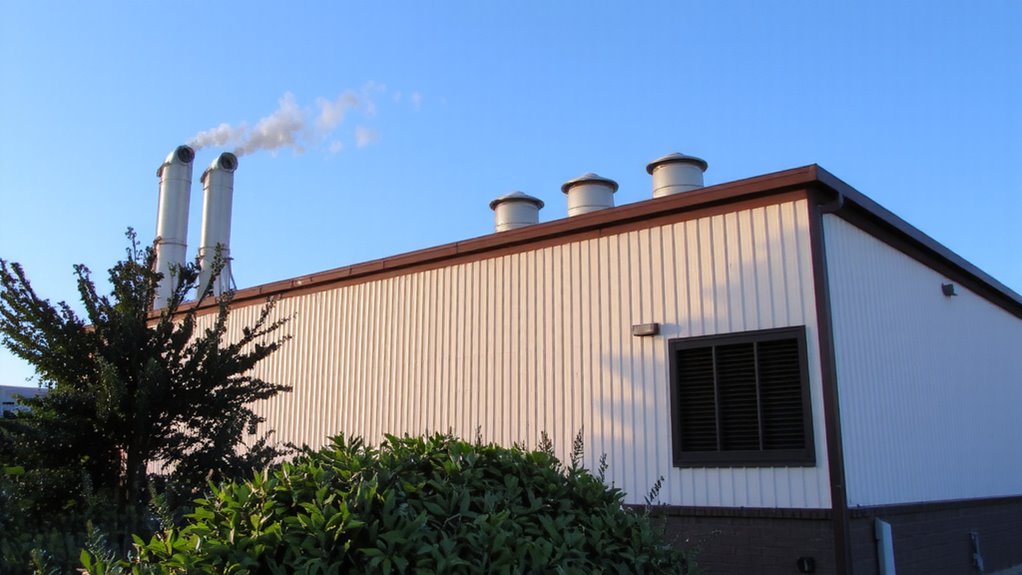
Hot air rises-simple as that. You experience thermal dynamics every time warm indoor air moves upward. Because heated air is less dense than cool air, it naturally ascends, creating upward convective currents. This principle drives natural ventilation systems. Heat transfer occurs as energy shifts from warmer to cooler zones, carrying moisture and contaminants upward. When you position exhaust outlets high, you harness this passive movement. The temperature difference between inside and outside air-often 10–20°F-fuels continuous airflow without mechanical assistance. A 3-foot stack with a 6-inch diameter can move up to 120 CFM under ideal thermal buoyancy conditions. Thermal dynamics guarantee consistent performance in mild to moderate climates. You get effective ventilation with zero energy input. Heat transfer efficiency increases with greater indoor-outdoor temperature contrasts. This physical behavior is predictable, reliable, and rooted in fundamental principles of fluid mechanics and thermodynamics.
How High Exhausts Boost Airflow Efficiency
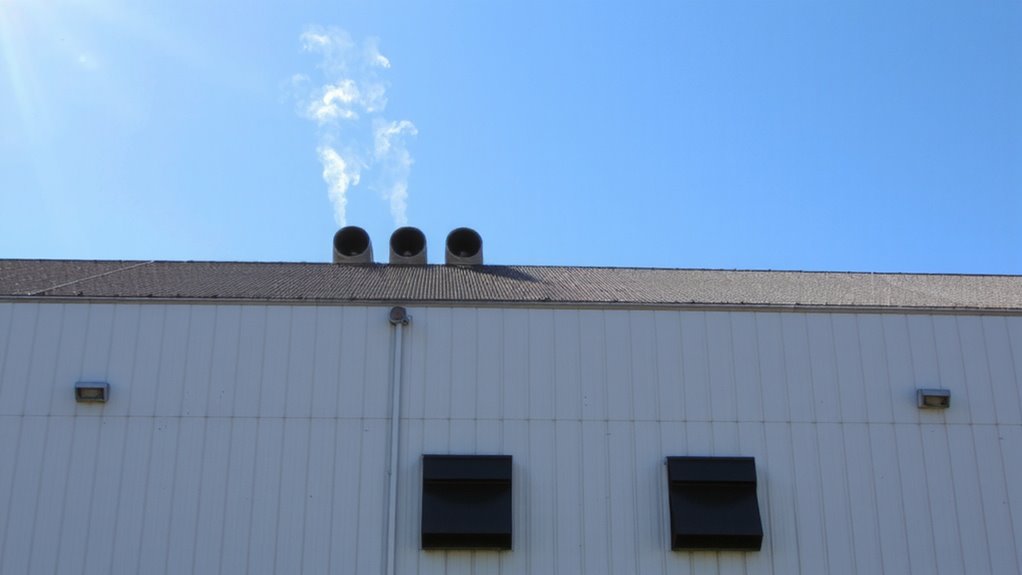
Placing exhaust outlets at higher elevations takes full advantage of thermal buoyancy, the same force that drives warm air upward through a space. Hot air rises, creating a natural pressure difference between the top and bottom of a building. This pressure difference increases air velocity through exhaust openings. You get faster, more consistent airflow without relying on mechanical fans. The greater the vertical distance between intake and exhaust, the stronger the buoyancy effect. For every 3.3°F (1.8°C) of indoor-outdoor temperature difference, stack effect pressure increases by about 0.004 inches of water column per foot of height. Positioning exhausts at least 8 to 10 feet above intakes typically maximizes efficiency. Higher outlets allow warm, stale air to escape easily, improving overall ventilation performance. You’ll see measurable gains in air exchange rates, especially in large or poorly ventilated spaces.
Design Rules for Better Stack Ventilation
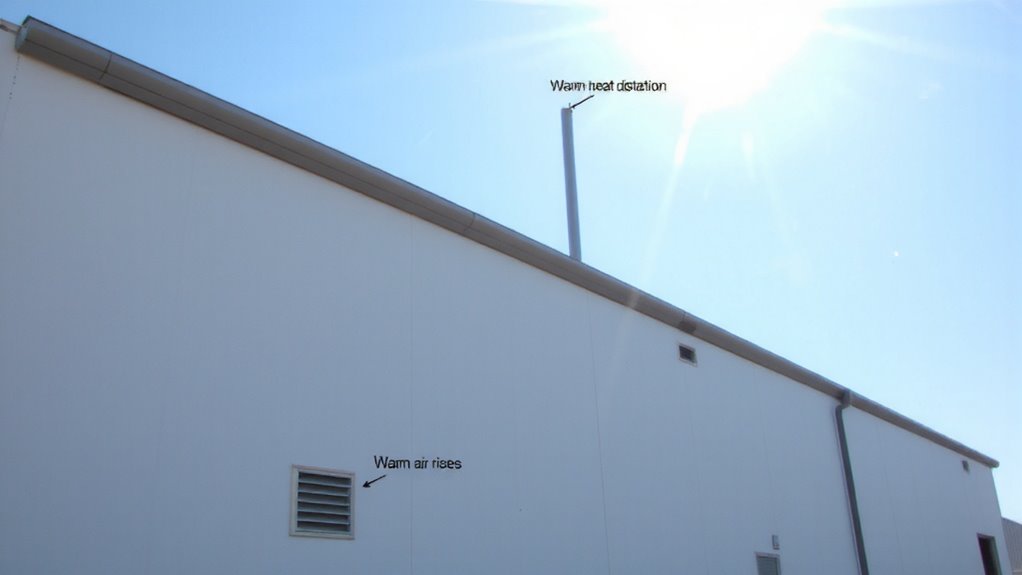
Since warm air naturally rises due to differences in density, you can optimize stack ventilation by carefully sizing and positioning both intake and exhaust openings. Place exhaust outlets at least 24 inches above intakes to strengthen thermal buoyancy. This vertical separation enhances airflow by leveraging natural pressure gradients. Intake area should match or exceed exhaust area to avoid restricting flow. For every 1,000 cubic feet per minute (cfm) of desired airflow, provide at least 1.5 square feet of net free area. Wind dynamics can supplement stack effect but shouldn’t dominate design. Avoid placing intakes on the leeward side where negative pressure can disrupt inflow. Use continuous ridge vents or top-mounted louvers for consistent exhaust performance. Vertical risers should be unobstructed and insulated to maintain air temperature. Properly sized stacks can generate 20–30% more airflow than undersized ones. You don’t need fans if you respect height, area, and alignment.
What Ruins the Stack Effect: and How to Avoid It?
You can design the perfect stack system on paper, but real-world performance often falls short when basic principles are overlooked. Wind turbulence disrupts airflow by creating pressure imbalances that reverse or stall natural convection. Placing exhaust outlets in turbulent zones, such as behind parapets or near mechanical equipment, reduces efficiency by up to 60%. Avoid this by locating outlets at least 3 feet above nearby obstructions and facing them away from prevailing winds. Poor sealing around ducts, joints, and penetrations allows unintended air leakage, undermining buoyancy-driven flow. Seal all connections with UL 181 tape or mastic, ensuring leakage stays below 5% of total airflow per ASHRAE Standard 62.1. Temperature differentials must exceed 5°F for effective stack action-maintain this with insulated shafts. Even small gaps or misaligned caps can cut performance in half. Control variables you can, and the stack effect will work as intended.
Applying Stack Ventilation in Homes and Workshops
How does natural airflow become a reliable cooling strategy in homes and workshops? You can harness stack ventilation by placing exhaust outlets higher than intakes, letting warm air rise and exit due to thermal buoyancy. Solar heating increases indoor air temperature, enhancing the density difference that drives airflow. Intake vents should be located low on walls or near the floor, ideally on the shaded or cooler side of the building. Exhaust vents-like ridge vents or roof turbines-must be at least 18 inches above intake tops to guarantee effective draft. Wind pressure supplements this effect when openings are on opposite walls, but stack ventilation works even in low-wind conditions. Use ducts with smooth interiors (min. 6-inch diameter) to reduce resistance. This system reduces reliance on mechanical cooling, cutting energy use by up to 30% in properly designed layouts.
On a final note
You optimize natural ventilation by positioning exhausts above intakes. Thermal buoyancy drives warm, less dense air upward, enhancing airflow. Elevate exhaust outlets at least 3–6 feet above intakes to maximize stack effect. Maintain unobstructed vertical pathways with smooth duct interiors. Avoid short-circuiting by separating inlet and outlet zones. Properly sized openings-typically 2–4 square feet per 1,000 cfm-ensure effective passive airflow in homes and workshops.