How to Perform a Load Test on a 12-Volt Automotive Battery at Home
You’ll need a 4½-digit multimeter and a load tester that draws half the battery’s CCA for 15 seconds. Let the battery rest 12 hours after charging. Confirm it’s fully charged-12.6+ volts at rest. Connect the load tester, apply the load, and check voltage under stress. A healthy 12V battery holds at or above 9.6 volts at 70°F. If it drops below, the battery likely needs replacement. Further details reveal how temperature and surface charge affect accuracy.
Notable Insights
- Use a digital multimeter to confirm the battery is fully charged (12.6+ V) after a 12-hour rest before testing.
- Wear insulated gloves and safety glasses, and inspect tools for damage to ensure safe handling.
- Connect a battery load tester to draw half the CCA for 15 seconds, ensuring proper red-to-positive and black-to-negative connections.
- Monitor voltage during the load: a drop below 9.6 V at 70°F indicates a weak or failing battery.
- If voltage stays at or above 9.6 V, the battery is healthy; recharge and retest if results are questionable.
Gather Your Tools

You’ll need a digital multimeter with at least 4½-digit resolution to measure voltage accurately-this means it can display readings like 12.65 volts, not just 12.6. This precision is critical for detecting small voltage drops during load testing. For tool preparation, inspect the multimeter leads for fraying or damage; clean contact tips guarantee reliable readings. Include a battery load tester rated for 12-volt lead-acid batteries, capable of drawing half the CCA (cold cranking amps) for 15 seconds. Wear insulated gloves and safety glasses-battery safety is non-negotiable due to risks of short circuits and acid exposure. Use only tools with insulated handles to reduce electrical hazards. Store tools in a dry, organized case until needed. Proper tool preparation prevents errors and accidents, guaranteeing consistent, repeatable results. Each tool must meet ANSI standards for electrical safety. For the most accurate assessment, consider using one of the best battery testers recommended for reliable performance and durability.
Test Resting Battery Voltage
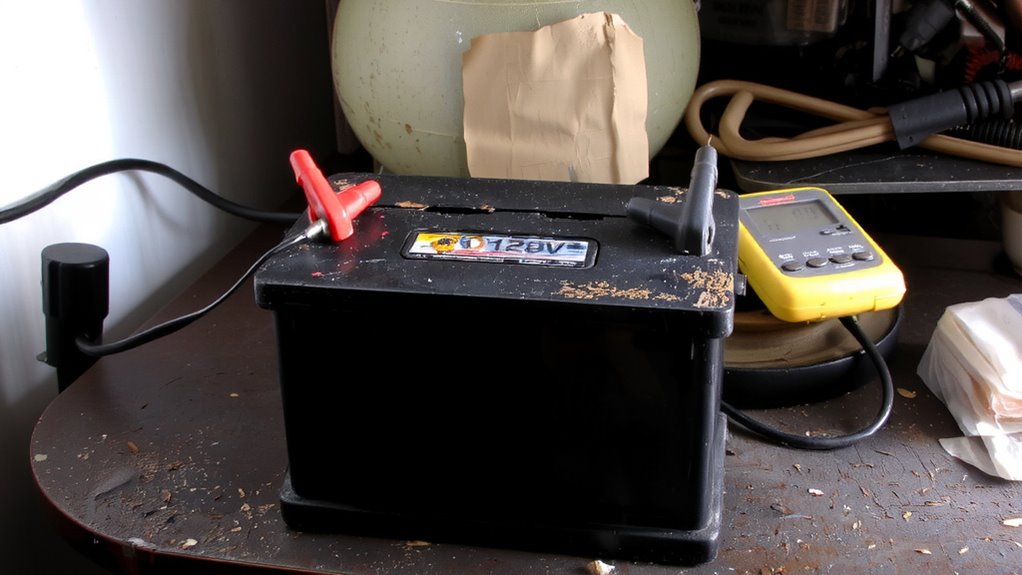
Begin by ensuring the battery has rested for at least 12 hours after any charging or vehicle operation-this stabilizes the surface charge and delivers an accurate open-circuit voltage reading. Voltage stability is critical for interpreting the battery’s true state of charge. Your battery chemistry (typically lead-acid) affects the resting voltage, so use the table below as a reference.
| State of Charge | Voltage (12V Battery) | Condition |
|---|---|---|
| 100% | 12.6+ V | Fully charged |
| 50% | 12.2 V | Half charged |
| 0% | 11.9 V or less | Discharged/dead |
Measure with a digital multimeter across the terminals. A reading below 12.2 V suggests sulfation risk and poor performance. Accurate voltage stability confirms whether the battery is ready for further testing or needs charging. Choosing a high-quality 12-volt battery can significantly improve reliability and test outcomes.
Perform a Load Test at Home

A resting voltage test gives you a snapshot of charge level, but it won’t tell you how the battery performs under real-world demands-only a load test can reveal that. You’ll need a load tester capable of drawing half the battery’s cold cranking amps (CCA) for 15 seconds. Connect the tester leads to the correct terminals-red to positive, black to negative. Apply the load and monitor voltage drop. A healthy 12-volt battery should maintain at least 9.6 volts at 70°F. Battery age affects performance; older batteries degrade and struggle under load. Environmental factors like extreme heat or cold accelerate wear and reduce capacity. Don’t test a frozen or overheated battery-it’s unsafe and inaccurate. Make sure the battery is fully charged before testing. Short test duration prevents damage. Load testing simulates starting conditions better than any other home method.
Read Your Voltage Results
What does your voltage reading actually mean? Voltage interpretation helps you understand your battery’s health after a load test. A healthy 12-volt battery should read at least 9.6 volts under load for 15 seconds. If your multimeter shows this or higher, the battery is strong. Below 9.6 volts? That’s a weak result. Perform result analysis immediately-check for clean connections or testing errors. Cold cranking amps (CCA) matter here: if voltage drops fast, the battery can’t deliver sustained power. A steady reading near 10–11 volts indicates decent capacity. Fluctuating or declining voltage suggests internal damage. Don’t ignore small differences-a drop of just 0.5 volts can signal sulfation or worn plates. Always record your reading for comparison. Accurate voltage interpretation guarantees you make informed decisions about your battery’s performance without guessing. For more reliable assessments, consider using one of the best battery testers available to ensure precise and consistent results.
Decide: Recharge, Replace, or Retest
How do you move forward after seeing your load test results? Your next step depends on voltage stability, battery lifespan, and charging efficiency. If voltage drops below 9.6V under load, the battery likely can’t hold a charge. A reading above 9.6V but below 12.4V suggests it’s undercharged and may recover with proper charging. Below 12.0V after resting indicates significant degradation.
| Voltage After Load | Action |
|---|---|
| Below 9.6V | Replace – battery has reached end of lifespan |
| 9.6V – 12.4V | Recharge and retest – check charging efficiency |
| 12.4V+ | Good – no action needed |
Monitor charging efficiency during recharge. A healthy battery reaches full charge in 4–6 hours with a 10-amp charger. Recheck voltage after a 12-hour rest. Retest if results are inconsistent.
On a final note
You now know how to properly load-test a 12-volt automotive battery at home. A healthy battery should maintain at least 9.6 volts under load for 15 seconds at 50% of its CCA rating. Voltage below this indicates weakening or failure. If results are borderline, recharge and retest. Persistent low voltage means replacement is necessary. Use a reliable digital multimeter and follow safety precautions. This test gives accurate insight into your battery’s ability to perform in real-world conditions.