Cold Weather Effects on Intake Air Temperature and Power Output Optimization
Cold air increases power because it’s denser, packing 10–15% more oxygen at 32°F than at 77°F. This boosts combustion efficiency and allows more fuel to burn completely, raising torque and horsepower-naturally aspirated engines gain 8–12 hp, forced-induction up to 25 hp. Your ECU adjusts fuel and timing automatically, enriching the mixture and retarding spark to protect the engine. For peak performance, tuning recalibrates MAF and IAT sensors, targets ideal lambda (0.82–0.88), and prevents lean conditions. Optimizing for cold air means real gains, but only if managed correctly. You’ll discover how to harness it safely.
Notable Insights
- Cold air increases air density, delivering more oxygen to the engine for improved combustion and higher power output.
- For every 10°F drop in temperature, air density rises by about 4%, enhancing volumetric efficiency and engine performance.
- Cold conditions allow more complete fuel burn, increasing torque and peak cylinder pressure without throttle changes.
- Engine oil thickens in cold weather, reducing lubrication speed and increasing wear during startup.
- Modern ECUs adjust fuel and timing automatically, enriching the mixture and retarding ignition to optimize cold-engine performance.
Cold Air Makes Engines More Powerful: Here’s Why
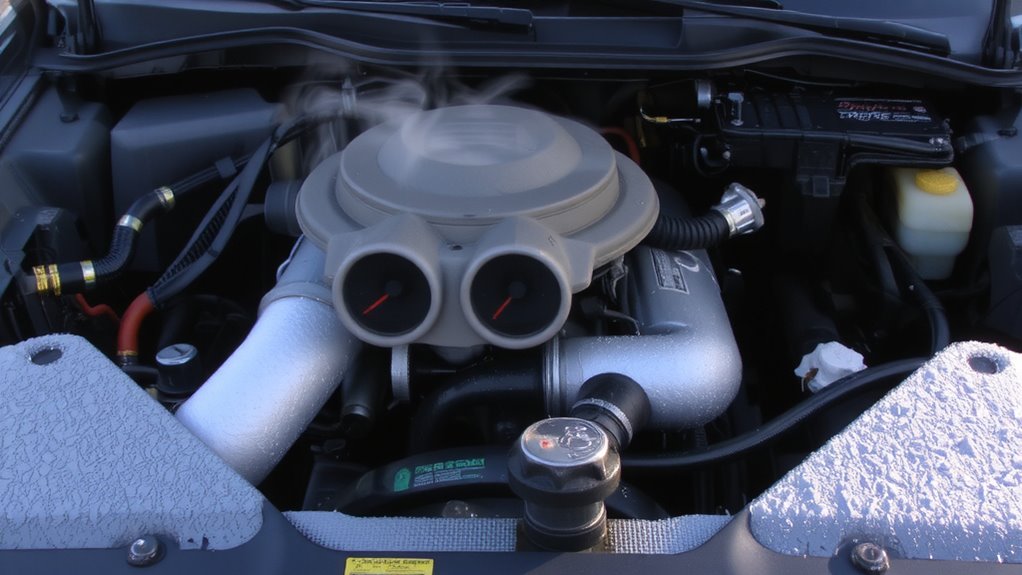
When the temperature drops, your engine actually performs better, and it’s not just because the roads are clearer. Cold air is denser, meaning it packs more oxygen molecules per cubic foot. Higher air density directly improves engine efficiency by allowing more fuel to be burned completely during combustion. Your engine’s mass airflow sensor detects this increased oxygen volume and adjusts fuel injection accordingly. This optimized air-fuel ratio maximizes power output without requiring additional throttle input. In fact, for every 10°F drop in air temperature, air density increases roughly 4%, boosting potential horsepower. Turbine engines and naturally aspirated gasoline engines alike benefit from this physical principle. Denser intake air reduces pumping losses and improves volumetric efficiency. You’re not imagining that crisper throttle response in winter-its foundation is thermodynamics. Cold conditions create an ideal environment for peak engine performance, grounded in measurable gains in air density and engine efficiency.
Denser Air Fuels Better Combustion
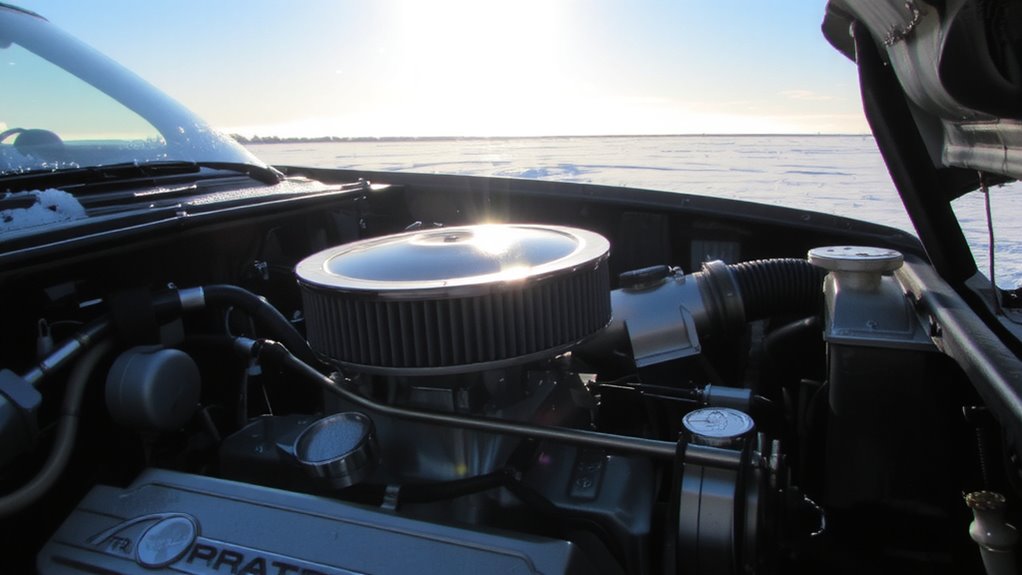
Because cold air is denser, it carries more oxygen into the combustion chamber, and that’s where your engine gains an edge. Higher air density means more oxygen molecules per cubic foot-typically 10–15% more at 32°F than at 77°F. This directly improves combustion efficiency, allowing fuel to burn more completely. You get more power per stroke without adjusting fuel input. Modern engines leverage this with mass airflow sensors that detect air density changes and adjust timing and fueling accordingly. The stoichiometric ratio remains ~14.7:1, but denser air supports more aggressive combustion under load. Peak cylinder pressure increases measurably, boosting torque output. Efficient combustion also lowers tailpipe emissions, especially unburned hydrocarbons. You’re not just gaining power-you’re optimizing the burn. While forced induction systems amplify this effect, even naturally aspirated engines benefit. Simply put, cold, dense air transforms oxygen availability into usable performance, making it a free upgrade when temperatures drop.
Why Cold Weather Can Hurt Performance
Cold air boosts power, but it also introduces challenges that can undermine engine performance. Cold temperatures thicken engine oil, reducing flow and increasing friction, which accelerates engine wear during startup. Below 32°F, oil viscosity can double, delaying lubrication to critical components by up to 30 seconds. This prolonged dry running causes microscopic damage that accumulates over time. Additionally, cold batteries lose cranking power-capacity drops 30–60% at 0°F. A typical 600 CCA battery may deliver only 240 effective amps, risking incomplete combustion or failed starts. Reduced electrical output strains the alternator and extends warm-up periods. Cold intake manifolds condense fuel, disrupting air-fuel mixing before combustion. While denser air improves combustion efficiency, these mechanical and electrical issues offset gains. Without proper maintenance-like using winter-grade oil and battery insulation-you risk long-term engine wear and frequent battery drain, especially in sustained sub-freezing conditions.
How Cold Air Changes Fuel and Timing
Although cold air increases oxygen density-improving potential combustion efficiency-your engine’s management system must adjust fuel delivery and ignition timing to maintain ideal performance. Cold conditions trigger fuel enrichment to compensate for slower fuel vaporization, guaranteeing the air-fuel mixture remains combustible. Without it, the mixture would be too lean, risking misfires and incomplete combustion. Your engine control unit (ECU) increases injector pulse width, delivering more fuel during cold starts and warm-up phases. At the same time, ignition advance is reduced initially to prevent knock, then gradually increased as combustion stabilizes. Proper timing adjustments optimize cylinder pressure, improving power and efficiency. These corrections happen automatically in modern engines, balancing emissions, drivability, and protection. While denser air offers performance potential, accurate fuel enrichment and precise ignition advance are critical. They guarantee the engine runs smoothly until operating temperature is reached, avoiding hesitation, stalling, or excess wear under cold intake conditions.
Tune for More Power in Cold Weather
You’re already getting more power from cold air without realizing it-your engine benefits from increased oxygen density every time you start in low temperatures. Cold air packs more oxygen molecules per cubic foot, improving combustion efficiency. With proper advanced tuning, you can exploit this for measurable performance gains. Modern engine control units (ECUs) adjust fuel and ignition timing automatically, but they often err on the side of caution. Custom tuning overrides conservative factory maps, optimizing air-fuel ratios and advancing spark timing to match cold intake conditions. Dyno tests show gains of 8–12 horsepower on naturally aspirated engines and up to 25 horsepower on forced-induction systems in 32°F air. These improvements stem from precise control of lambda values, ideally maintaining 0.82–0.88 under load. Advanced tuning activates this potential safely, ensuring performance gains remain repeatable and thermally stable.
Prevent Damage When Tuning for Cold
When tuning for cold conditions, engine damage can occur if thermal dynamics and air density changes aren’t properly accounted for. Air density increases as temperatures drop, resulting in higher oxygen content per cubic foot-often 10–15% more at 32°F than at 77°F. Without adjusting fuel and ignition maps, this can lead to excessive cylinder pressures or detonation. You must recalibrate sensor inputs, especially intake air temperature (IAT) and mass airflow (MAF), to guarantee accurate readings. Improper sensor calibration causes lean conditions, raising combustion temperatures dangerously. Frost buildup in the intake tract or on throttle bodies restricts airflow and disrupts air-fuel ratios, particularly below 20°F. Use heated intake sensors and guarantee drain holes remain clear to prevent ice accumulation. Monitor long-term fuel trims; deviations beyond ±10% indicate correction needs. Always perform wideband O2 sensor verification post-tune. Preventive updates to ECU logic protect internals and sustain reliable performance in sustained cold operation.
Why Your Car Feels Stronger in Winter
Because cold air is denser, your engine takes in more oxygen with each intake stroke, effectively turning every combustion cycle into a stronger push against the pistons. More oxygen means more complete fuel combustion, increasing horsepower and torque-typically by 5% to 10% in winter. Your engine runs slightly more efficiently due to reduced intake air temperatures, lowering the risk of pre-ignition. However, cold starts increase engine wear initially, as oil thickens and circulates slower until ideal temperature is reached. Despite this, modern synthetic oils minimize friction and protect components. Battery efficiency drops in cold weather; voltage output can fall by 30% at 32°F. Still, the performance boost from denser air often outweighs this. Keep your battery tested and charged. Cold air intakes enhance this effect, delivering air up to 50°F cooler. You’ll feel stronger acceleration, especially at higher RPMs. Upgrading to a best cold air intake can further optimize airflow and maximize winter performance gains in 5.7L Hemi Ram 1500 trucks.
On a final note
Cold air boosts engine power by increasing air density, allowing more oxygen per intake cycle-critical for efficient combustion. At 68°F, air density is about 1.225 kg/m³; at 32°F, it rises roughly 10%, enhancing power potential. Modern engines adjust fuel and timing automatically, maximizing gains. Tuning can extract extra horsepower, but improper calibration risks detonation. Monitor intake air temperature, fuel trims, and knock sensors. Winter performance feels sharper, but sustained gains require precise calibration and thermal management.