Using Foam Tire Savers to Relieve Sidewall Stress During Year-Round Indoor Storage
You can prevent sidewall stress during year-round indoor storage with foam tire savers. These pads evenly distribute weight, reducing localized strain on ply layers. Made from closed-cell polyethylene, they support 1,500 to 6,000 pounds per tire and resist compression at 45–50 psi. High-density foam maintains tire shape by minimizing deformation. Proper fit guarantees full contact patch support. There’s more to learn about maximizing tire longevity.
Notable Insights
- Foam tire savers distribute weight evenly to reduce sidewall stress during long-term indoor storage.
- High-density closed-cell foam prevents compression set and supports sustained loads up to 6,000 pounds per tire.
- Properly sized savers maintain uniform pressure, preserving tire shape and preventing ply layer fatigue.
- Choose savers that span at least 80% of the tire’s contact patch for optimal support.
- Install on clean, level surfaces and inspect monthly to ensure continued sidewall protection.
How Static Weight Damages Stored Tires
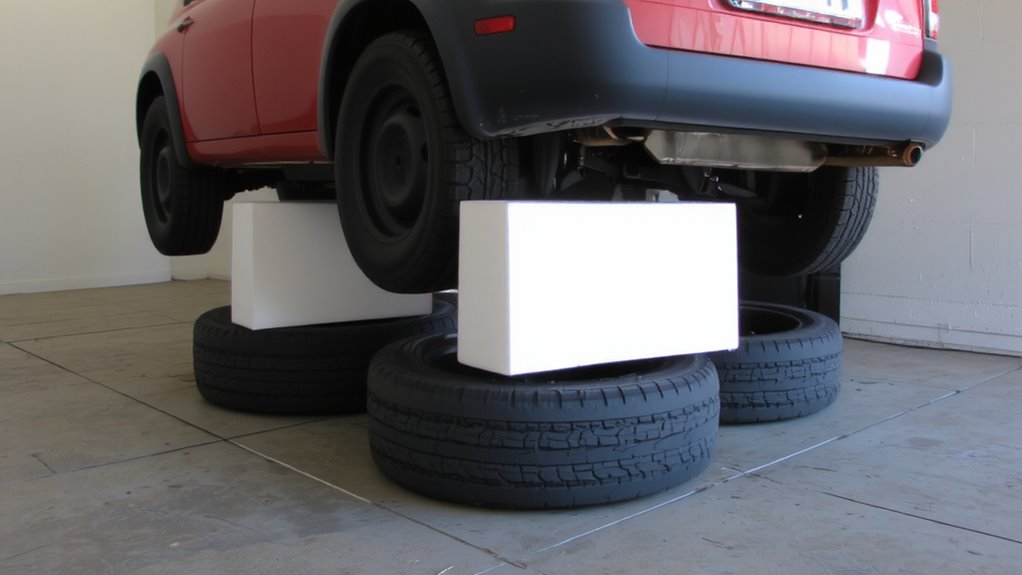
While your vehicle sits idle in storage, the tires remain under constant compression at the bottom, where they contact the floor. This sustained pressure creates uneven weight distribution, concentrating stress on a small section of each tire. Over time, this leads to tire deformation, commonly known as flat spotting. The rubber and internal cords deform permanently if pressure isn’t relieved, especially after 30+ days of inactivity. Even high-quality tires with strong sidewall construction can suffer, as the load exceeds localized flex limits. Deformation worsens with heavier vehicles-each tire may bear 1,500 to 3,000 pounds, depending on make and model. The distortion remains noticeable during initial driving and may take hundreds of miles to correct, if at all. Consistent load on one spot disrupts the tire’s circular symmetry, reducing ride quality and tread life. Preventing this requires redistributing static load before damage occurs.
Why Foam Tire Savers Prevent Flat Spots
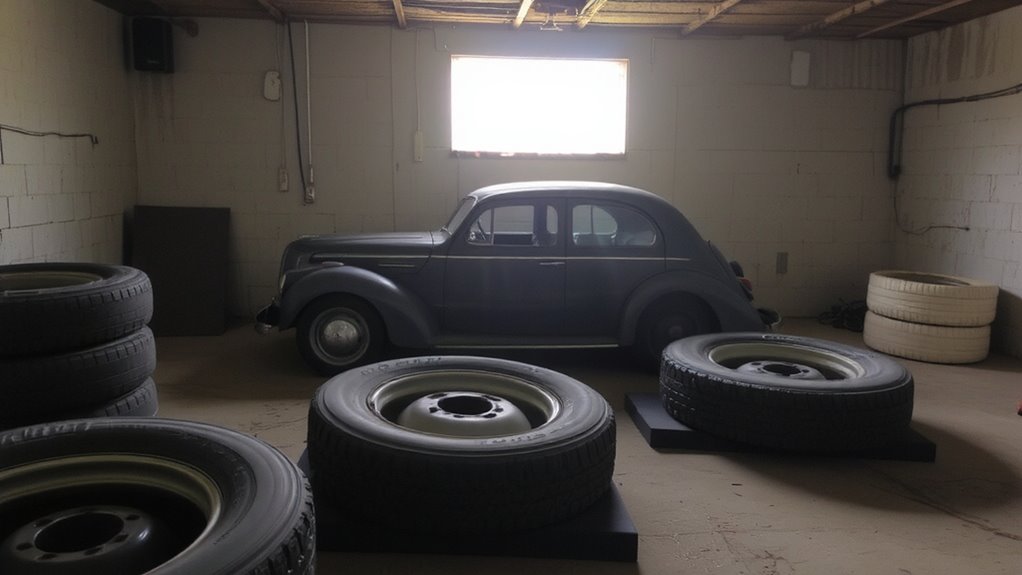
Since prolonged static load distorts tire shape, using foam tire savers helps maintain structural integrity during storage. These supports distribute weight evenly, reducing deformation caused by constant pressure on one spot. Foam savers minimize flat spots by preserving the tire’s natural curvature. Tire chemistry plays a key role-rubber compounds gradually lose material elasticity when held under stress. Without relief, this leads to permanent set deformation. High-density polyurethane foam pads compress just enough to support the load while allowing slight flex, mimicking movement. Most quality savers measure 14” x 16” with a 2” thickness, supporting up to 2,500 lbs per pad. They slow stiffness buildup by reducing strain on the tire’s internal structure. Unlike solid blocks, foam responds dynamically to minor shifts, maintaining roundness. You’ll notice less vibration at startup after long storage. Properly used, these pads extend tire life by counteracting the physics of static loading.
How Foam Savers Protect Tire Sidewalls
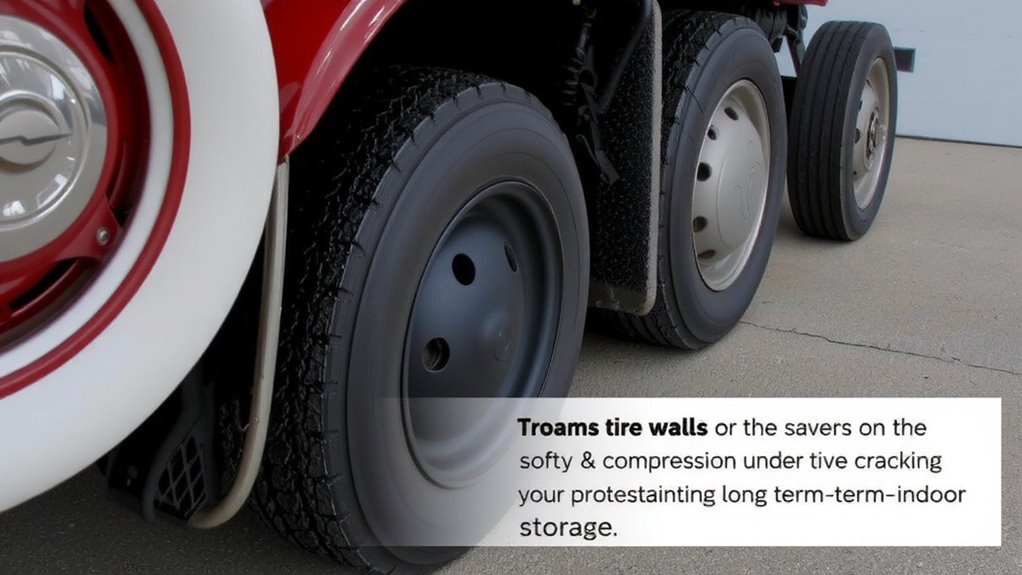
Foam tire savers don’t just prevent flat spots-they also shield your tire sidewalls from long-term damage during storage. They distribute the vehicle’s weight evenly, reducing localized stress on the rubber. Without support, tires undergo constant compression, accelerating material fatigue in the sidewall’s ply layers. Foam savers minimize this by maintaining uniform contact pressure across the tread base. They accommodate minor tire expansion due to temperature shifts, typically up to 0.02 inches in diameter per 10°F change. Their closed-cell polyethylene construction resists compression set, providing consistent support at 45–50 psi load capacity. This stability prevents sidewall cracking and structural weakening over months of inactivity. By preserving the tire’s natural shape, foam savers reduce strain on internal cords and bead areas. They’re engineered to handle loads from 1,500 to 6,000 pounds per tire, ensuring compatibility with sedans, trucks, and RVs.
Pick the Right Foam Saver for Your Vehicle
How do you guarantee your foam tire savers actually match your vehicle’s needs? Selecting the right saver hinges on foam density and vehicle compatibility. Foam density, measured in pounds per cubic foot, should range from 2.5 to 3.5 for most passenger vehicles. Lower density foam compresses too easily, failing to support weight; higher densities suit heavier SUVs or trucks. Check your vehicle’s curb weight and recommended load per tire-savers typically support 1,500 to 5,000 pounds per piece. Match this to your axle loads. Confirm vehicle compatibility by measuring tire width and sidewall height. Savers must span at least 80% of the tire’s contact patch to prevent edge stress. Universal fit models work for standard rims, but custom shapes suit low-profile or wide tires. Always verify manufacturer specs against your vehicle’s weight distribution and tire dimensions.
Install Foam Tire Savers Indoors (Step-by-Step)
Where do you start when setting up foam tire savers for indoor storage? Begin by confirming foam compatibility with your vehicle’s tire size and load rating. Most quality tire savers are made from closed-cell polyethylene foam, designed to support up to 4,000 lbs per pair without permanent compression. Position each saver directly under the tire’s center tread, ensuring full contact with the ground and tire footprint. Indoor placement matters-store on a clean, level concrete or epoxy-coated floor to prevent shifting. Avoid carpeted or uneven surfaces, as they reduce stability and foam effectiveness. Align the tire so it sits fully on the saver, with no overhang. The beveled edges help guide the tire into place without damaging the sidewall. Proper setup maintains tire shape over months of inactivity.
Check and Maintain Tires on Foam Savers
Once your tires are resting on foam savers, ongoing inspection guarantees long-term protection. Check each tire monthly for flat spotting, cracking, or moisture buildup. Foam savers reduce sidewall stress, but they don’t eliminate the need for tire rotation-rotate tires every 90 days to guarantee even weight distribution and prevent deformation. Perform pressure monitoring at least quarterly; maintain inflation to the manufacturer’s PSI to combat deflation from prolonged static load. Underinflation increases sidewall flex even in storage, accelerating fatigue. Use a calibrated digital gauge for accuracy. Inspect foam pads for compression damage or oil degradation; replace if cracked or uneven. Keep tires away from direct sunlight or ozone sources like motors. Clean rubber with a pH-balanced solution annually. Think of foam savers as support, not a substitute for active maintenance. Proper care preserves structural integrity over months of indoor storage.
On a final note
You protect tires best with foam tire savers during long-term storage. These supports distribute load evenly, reducing sidewall stress and preventing flat spots. High-density polyethylene foam handles up to 3,500 lbs per saver, maintaining structural integrity. Their non-absorbent core resists moisture, prolonging tire life. Correctly sized savers minimize deformation. Regular inspections verify peak performance. Foam savers are essential for preserving tire shape and tread.