Distributing Weight Evenly Across All Four Corners of Luxury Sedans in Storage
You must maintain 32–36 psi in cold tires to prevent uneven wear and support proper weight distribution. Park on a level concrete surface with less than 0.5 degrees of tilt to guarantee balanced loading. Use jack stands rated for your sedan’s weight at reinforced frame points, lifting each corner evenly. Rotate tires monthly to prevent flat spots. Improper support risks coil-over deformation and alignment shifts beyond ±0.1 degrees. The full protocol guarantees long-term suspension integrity.
Notable Insights
- Park on a level concrete surface to ensure uniform weight distribution and minimize suspension stress during storage.
- Check and maintain tire pressure at 32–36 psi when cold to support proper load balance across all four corners.
- Use jack stands rated for the vehicle’s weight, positioned under reinforced frame points to evenly sustain the sedan’s mass.
- Avoid asphalt driveways that may settle, creating uneven surfaces and shifting load distribution to individual suspension corners.
- Confirm stability by gently rocking the vehicle after lifting, ensuring no corner bears disproportionate weight.
Check Tire Pressure Before Storing Your Luxury Sedan

Every pound per square inch matters when your luxury sedan sits idle for weeks. You must check tire pressure before storage to prevent uneven tire wear and permanent damage. Modern luxury sedans require 32–36 psi when cold, per manufacturer specs. Underinflation by even 6 psi increases sidewall flex, accelerating tread wear by up to 25%. Tires naturally experience air leakage over time-typically 1–2 psi per month-due to permeation through rubber. That loss compromises load distribution. Cold temperatures reduce pressure further, increasing surface contact area and the risk of shoulder wear. You should use a calibrated digital gauge, not a stick gauge, for accuracy within ±1 psi. Inflate to the placard value, usually on the driver’s door jamb. Maintaining correct pressure guarantees the vehicle’s weight remains evenly distributed across all four tires, preserving tread integrity and maximizing tire life during storage.
Lift the Car With Jack Stands to Prevent Flat Spots
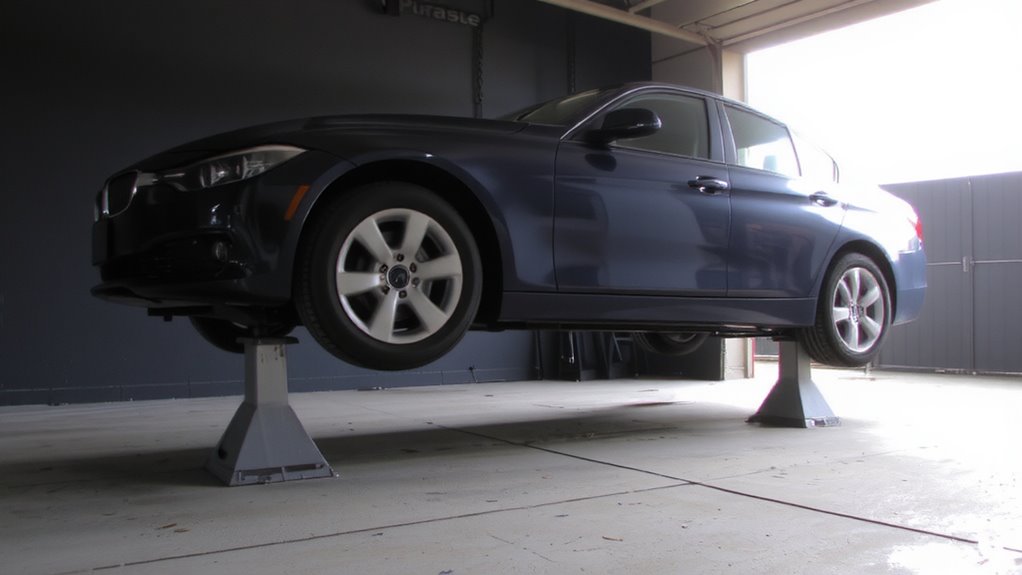
Lifting your luxury sedan off the ground eliminates the risk of flat spots forming on the tires during long-term storage. You must use jack stands rated for your vehicle’s weight, typically 3,000 to 5,000 pounds per stand, depending on model. Set the correct jack height to guarantee the tires clear the ground by at least one inch. Improper height risks suspension strain and uneven load balance. Position stands under reinforced frame points-never control arms or subframes. This maintains structural integrity and guarantees even weight distribution. Load balance is critical; an imbalance as small as 10% between corners can stress components. Use a hydraulic floor jack with 2-ton capacity for lift precision. Once raised, gently rock the car to confirm stability. This method preserves tire roundness and suspension alignment for months of storage. For heavy-duty support, consider using 6-ton jack stands that provide ample safety margin and durability.
Park on a Level Surface to Distribute Weight Evenly

When parking your luxury sedan for extended periods, choosing a level surface is essential to guarantee even weight distribution across all four corners. Surface stability prevents unnecessary stress on suspension components. Even slight inclines cause uneven load transfer, risking deformation in springs and struts. Ground uniform各个环节 ensures consistent support beneath all tires. Concrete garage floors offer maximum flatness, typically maintaining elevation variance within ±1/8 inch over 10 feet. Asphalt driveways may settle over time, introducing subtle slopes that compromise balance. Use a bubble level across the hood and trunk to verify horizontal alignment. Ideal surfaces show less than 0.5 degrees of tilt. This precision maintains factory-calibrated suspension geometry. Weight shifts from uneven ground can accelerate tire wear and misalign control arms. A level environment, combined with stable materials like reinforced concrete, preserves structural integrity. You’re not just storing a car-you’re protecting suspension accuracy and long-term ride quality through disciplined surface selection.
Rotate Tires Monthly During Long-Term Storage
Keeping your luxury sedan parked on a level surface sets the foundation for balanced weight distribution, but static positioning over weeks or months shifts responsibility to other maintenance factors-especially tire health. You should rotate tires monthly during long-term storage to preserve structural integrity. Flat spots can develop when tires remain in one position, especially under full inflation pressure of 32–35 psi. Monthly rotation prevents this by redistributing load across the tire circumference. It also guarantees even tread wear patterns, maintaining traction and alignment accuracy. Tire rotation benefits include extended tire life and consistent performance. Use a simple front-to-rear pattern, as recommended by most manufacturers. This practice sustains ideal contact patch geometry, minimizing deformation. Rotate by hand or with a floor jack and stands, guaranteeing the car remains stable. You maintain tire functionality and avoid premature replacement by adhering to this precise schedule.
Avoid Suspension Stress in Stored Luxury Sedans
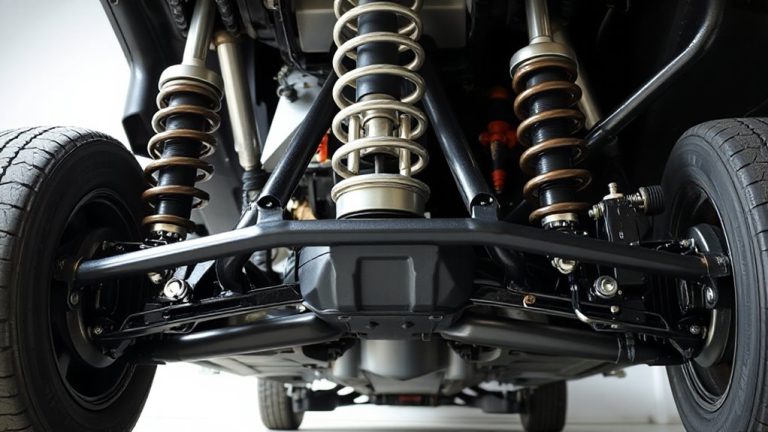
If the suspension system bears excessive load during long-term storage, critical components like air springs and adaptive dampers may degrade prematurely. You must relieve constant pressure to prevent shock absorber fatigue and maintain peak performance. Prolonged compression reduces hydraulic efficiency, leading to inconsistent damping and potential fluid breakdown over time. For spring sag prevention, support the vehicle at its designated lift points using jack stands or axle supports. This redistributes weight from the suspension to external supports, preserving factory ride height. Luxury sedans often use coil-over setups with precise load ratings-typically 800–1,200 lb per corner-exceeding these under static load risks permanent deformation. Even air suspension systems, designed for dynamic adjustment, aren’t meant for months of unchanging compression. Elevating the vehicle slightly guarantees components remain in their neutral state. Proper support maintains system integrity and extends service life without costly recalibration later.
Inspect Alignment After Extended Storage
Though the vehicle remains stationary during long-term storage, unseen shifts in tire contact and suspension geometry can occur, making post-storage alignment inspection essential. You should check wheel alignment to guarantee tires wear evenly and handling remains precise. Over time, static load can subtly distort suspension geometry, especially in luxury sedans with adaptive air suspensions. Misalignment as little as 0.5 degrees in camber or toe can increase tire wear by up to 30%. Manufacturers recommend alignment tolerances within ±0.1 degrees for peak performance. Use a digital alignment rack to measure caster, camber, and toe against factory specifications. Correct any deviations promptly. Even minor shifts affect ride comfort and safety. Think of it like recalibrating a precision instrument-your sedan’s suspension needs accuracy. Proper wheel alignment preserves tire life, fuel efficiency, and guarantees the vehicle responds as engineered. Don’t skip this step.
On a final note
You must store your luxury sedan correctly to preserve its integrity. Uneven weight distribution accelerates tire deformation and suspension fatigue. Position the car on a perfectly level surface, ensuring each tire supports approximately 25% of the vehicle’s curb weight-typically 1,000 to 1,200 lbs per corner for models like the S-Class or 7 Series. Use jack stands rated for 3+ tons at reinforced frame points. Rotate tires every 30 days to prevent flat spots.