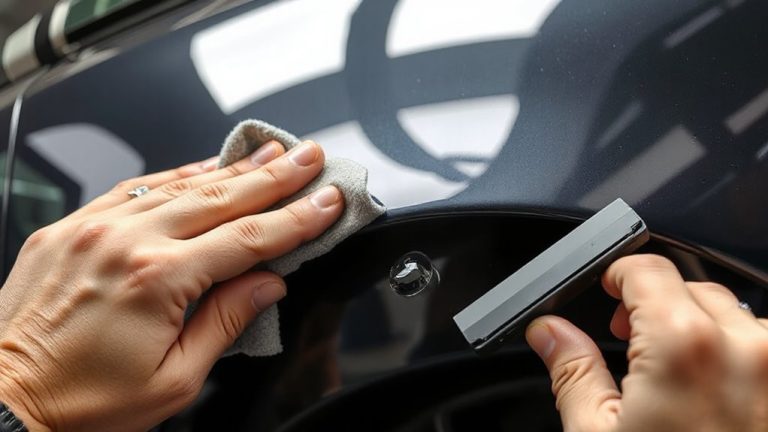
Step-by-Step Guide to Replacing Factory Speakers in a Luxury Coupe
Choose high-performance speakers with 88+ dB sensitivity and 20 Hz–20 kHz frequency response for superior clarity. Confirm factory sizes: 6.5-inch front doors, 3.5-inch front dash, 5.25-inch rear deck, and 4-inch rear pillars, all typically 4 ohms. Remove door panels using plastic tools, checking for hidden screws and disconnecting electrical connectors safely. Mount new speakers with stainless steel hardware, seal with closed-cell foam, and upgrade to 16-gauge OFC wiring. Calibrate crossovers at 80 Hz for subs and 3.5 kHz for tweeters. Proper alignment guarantees accurate sound staging. Next steps reveal finer tuning techniques.
Notable Insights
- Verify factory speaker sizes and impedance to ensure proper replacement compatibility.
- Use plastic trim tools to safely remove door panels without damaging the finish.
- Disconnect electrical connectors by pressing the release tab before removing factory speakers.
- Install new speakers using stainless steel hardware and match existing mounting holes.
- Calibrate the audio system with test tracks and adjust crossovers for optimal sound staging.
Choose the Best Speakers for Your Luxury Coupe
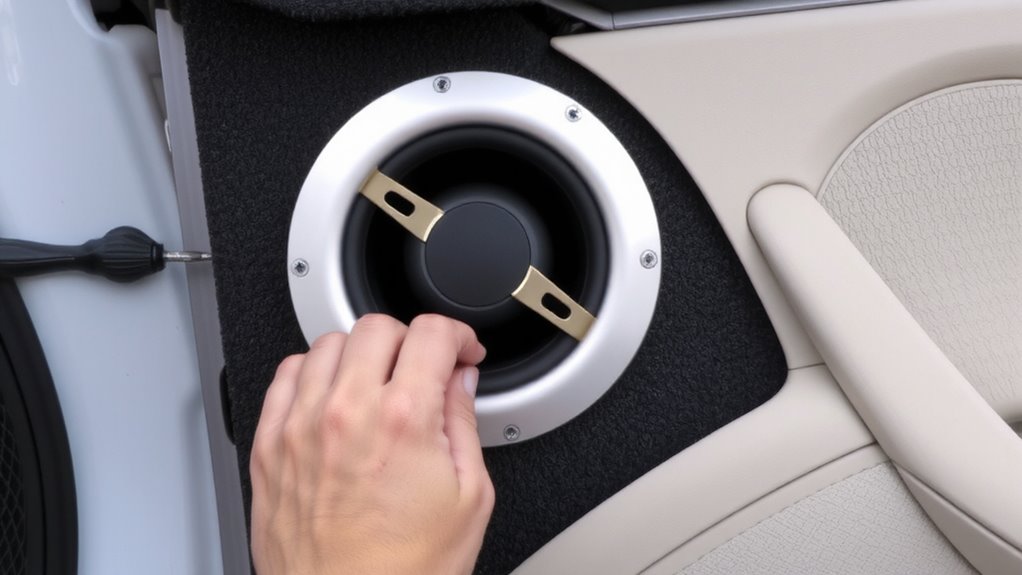
Performance matters when upgrading your luxury coupe’s audio. You need speakers that deliver superior sound quality with minimal distortion. Look for components with frequency responses between 20 Hz and 20 kHz for full-range clarity. High sensitivity ratings-88 dB or above-guarantee efficient power use from your stock amplifier. Sound quality improves dramatically when you choose speakers with polypropylene cones and rubber surrounds, offering durability and accurate midrange reproduction. Brand compatibility is critical-match impedance (typically 4 ohms) to avoid amplifier strain. Aftermarket speakers from proven audio brands integrate smoothly with premium factory systems. Don’t sacrifice engineering integrity; verify thermal power handling (RMS) meets or exceeds OEM specs. A 50-watt RMS rating per channel maintains headroom. Choose based on technical merit, not marketing. Proper selection guarantees balanced output, lifelike imaging, and long-term reliability-just like calibrated suspension components enhance ride control. For budget-conscious upgrades without compromising performance, consider the best budget car speakers that meet these technical standards.
Check Factory Speaker Size and Fitment
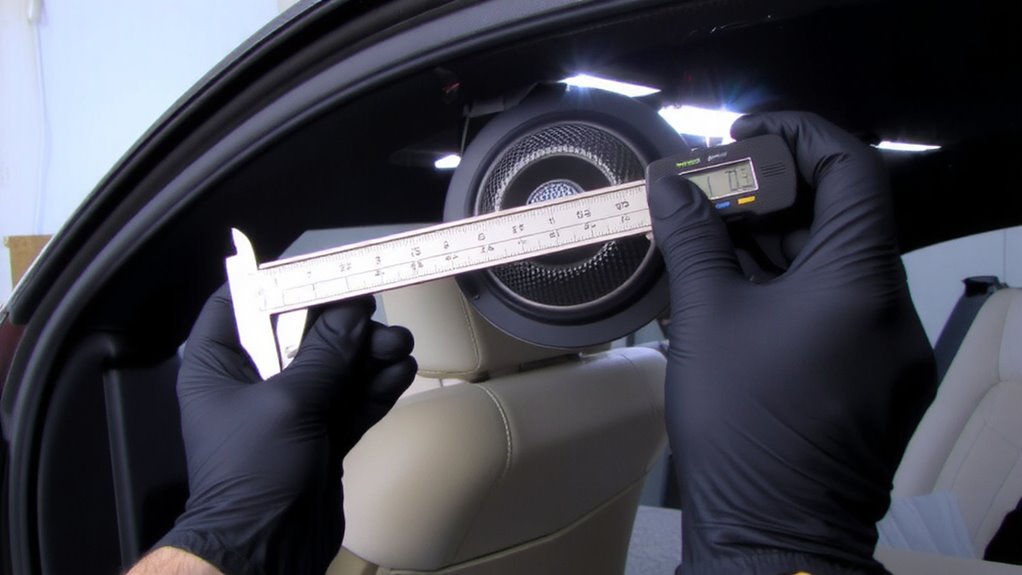
You’ve picked high-performance speakers that match your luxury coupe’s audio demands-now confirm they’ll fit. Factory speaker size and mounting depth vary by model year and trim. Measure the existing speakers or consult OEM specifications to guarantee compatibility. Mismatched dimensions lead to improper installation and reduced sound quality.
| Position | Factory Size (inches) |
|---|---|
| Front Doors | 6.5 |
| Front Dash | 3.5 |
| Rear Deck | 5.25 |
| Rear Pillar | 4 |
Verify speaker impedance matches your amplifier or head unit-usually 4 ohms. Mismatched impedance strains components. Magnetic shielding prevents interference with navigation screens and sensors common in luxury vehicles. Installers often overlook this, risking electronic disruptions. Choose speakers with built-in shielding for safety and performance. Double-check fitment templates before purchase.
Remove Door Panels Safely
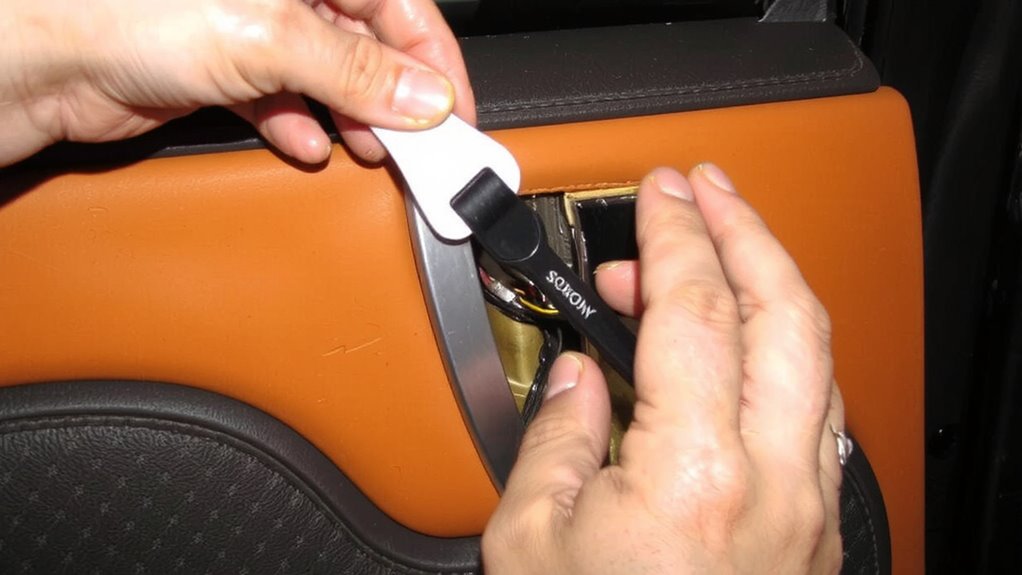
Before you start prying off the door panel, understand that luxury coupes often use delicate trim and hidden fasteners that can crack if mishandled. Use plastic door tools to gently release trim clips without damaging the finish. These clips are designed to snap into place and can break if excessive force is applied. Start at the outer edge, working methodically toward the interior handle. Most panels secure with a combination of twist-lock fasteners and friction-fit trim clips spaced 4–6 inches apart. Check for hidden screws near the armrest, speaker frame, or door pull. Disconnect electrical connectors carefully by pressing the release tab before unplugging. Protect the paint by placing removed hardware in a labeled container. Always handle the panel with both hands to avoid stress cracks. Proper use of door tools guarantees a clean removal and seamless reinstallation later.
Install New Luxury Coupe Speakers
With the door panel free and electrical connectors safely disconnected, you’re ready to install the new speakers. Position the replacement speakers into the factory mounting locations, ensuring alignment with the existing screw holes, typically 35–40mm in diameter. Most luxury coupe speaker upgrades use 6.5-inch coaxial drivers with neodymium magnets and rubber surrounds for durability. Secure them using stainless steel hardware to prevent corrosion. Before reassembly, add sound insulation to the inner door cavity to reduce resonance and road noise-closed-cell foam pads weighing 2–3 lbs per square foot work best. If performing wiring upgrades, replace stock speaker wire with 16-gauge OFC copper cabling to improve signal transfer and damping factor. Make clean, soldered connections at the terminal points to maintain signal integrity. Do not reconnect the door panel yet-verify fitment and clearance. For enhanced audio performance, consider pairing your speakers with a 4-channel amplifier to power all four speakers efficiently and improve overall sound quality.
Test and Tune Your Audio System
How does your upgraded sound system truly perform? Turn the car on and play high-quality audio tracks across multiple genres. Listen for balanced frequencies and clarity at various volume levels. Proper sound staging should place vocals and instruments as if on a stage in front of you, not clustered around the doors. Check for timing discrepancies-delays in rear speakers can ruin the imaging. Use your head unit’s audio calibration tools to adjust crossover points, time delay, and equalization. Many luxury coupes include built-in digital signal processing; leverage it to match speaker output with cabin acoustics. Set crossover frequencies to 80 Hz for subwoofers and 3.5 kHz for tweeters to prevent distortion. Conduct repeated sweeps from 20 Hz to 20 kHz. Fine-tuning guarantees factory-level precision with aftermarket power. Audio calibration isn’t optional-it’s essential for accuracy. For even greater control, consider adding an external best DSP for car audio to enhance signal processing beyond factory limitations.
On a final note
You’ve upgraded with precision. Factory speakers are acoustically limited, typically handling 30–50 watts RMS with 87–90 dB sensitivity. High-end replacements support 75+ watts RMS and exceed 92 dB, delivering tighter bass and clearer highs. Properly sealed installations improve soundstage depth. Impedance must match your amplifier-usually 4 ohms. Final tuning via head unit EQ optimizes frequency response. This upgrade maximizes your luxury coupe’s audio potential efficiently.