How Over-Torqued Lug Nuts Distort Rotor Flatness Within First 500 Miles
You’re distorting your rotor’s flatness when you over-torque lug nuts beyond 80–100 ft-lbs. Excessive force warps the rotor against the hub, creating lateral runout-often over 0.005 inches-within 500 miles. This stress causes uneven pad contact, leading to vibration and thickness variation. Repeated heat cycles accelerate deformation, especially in rotors thinner than 24.4 mm. Using a calibrated torque wrench and proper sequencing prevents this. There’s more to understand about how heat amplifies these distortions.
Notable Insights
- Over-torquing lug nuts exceeds manufacturer specs, distorting rotor geometry and causing immediate flatness deviations.
- Excessive clamping force forces the rotor to conform to hub imperfections, embedding stress and misalignment.
- Uneven tightening creates lateral runout over 0.005 inches, leading to rapid development of pedal vibration.
- Heat cycles from braking expand lug nuts and rotors, worsening micro-distortions within the first 500 miles.
- Repeated thermal stress on over-torqued rotors accelerates material fatigue, making warping irreversible early in service life.
Signs You’ve Already Damaged Your Rotors
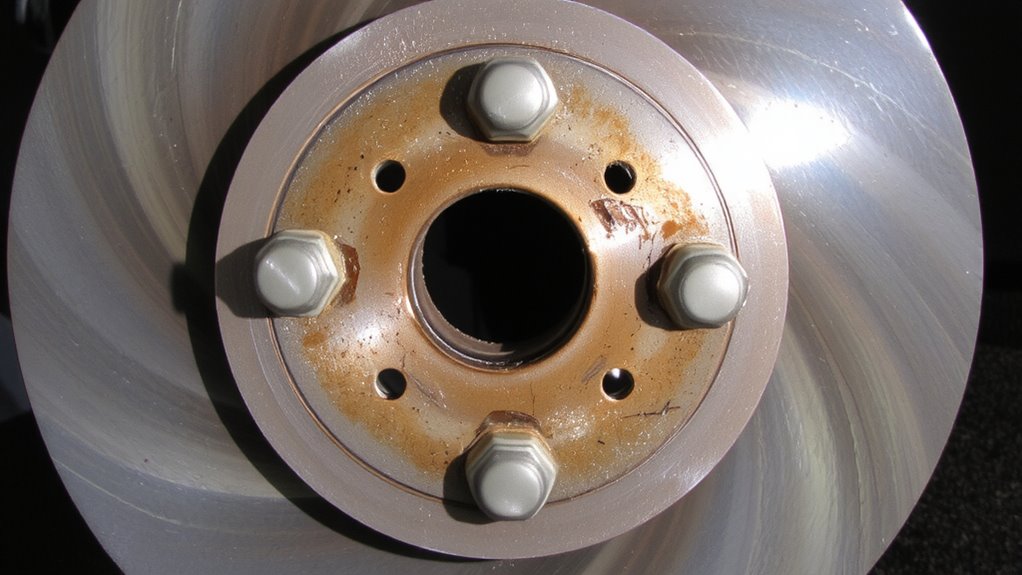
What happens when you ignore the warning signs of rotor damage? You risk permanent brake failure. Brake vibration under deceleration is one of the first indicators. It typically starts around 45–65 mph and worsens as speed increases. This pulsation results from rotor thickness variation exceeding 0.001 inches, often due to uneven wear. When pads contact high spots repeatedly, material removes unevenly, creating a warpage-like effect. You might also notice reduced stopping power and longer distances-up to 20 feet more at highway speeds. Surface scoring and hot spots appear upon inspection, confirming irregular contact. These symptoms compromise safety and accelerate wear on calipers and pads. Even minor distortions disrupt hydraulic efficiency, leading to inconsistent pressure distribution. Ignoring these signs not only threatens control but demands earlier, costlier replacements. Early detection saves up to $300 in labor and parts. Monitor for brake vibration and uneven wear-they’re red flags.
How Over-Torquing Warps Your Brake Rotor
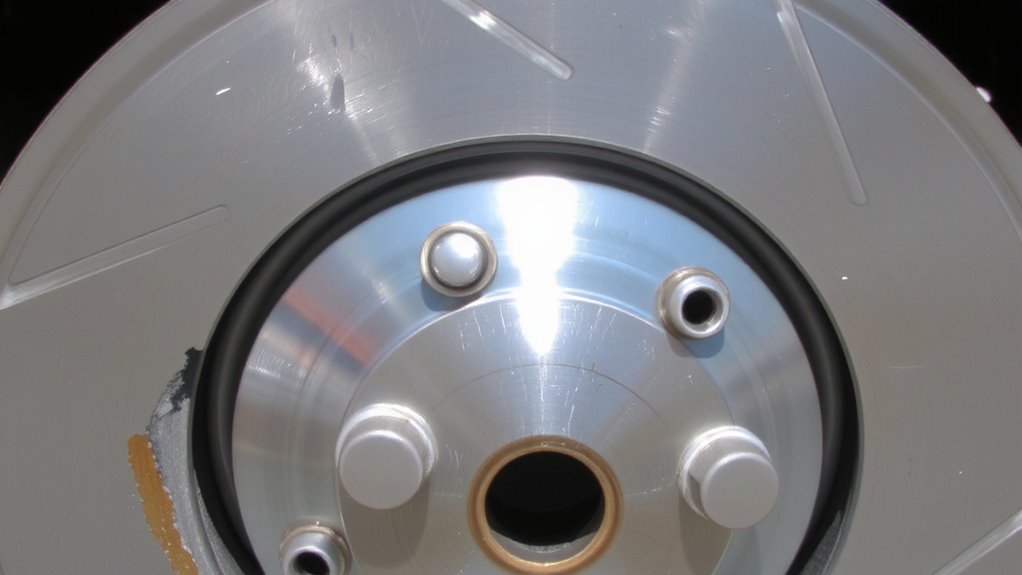
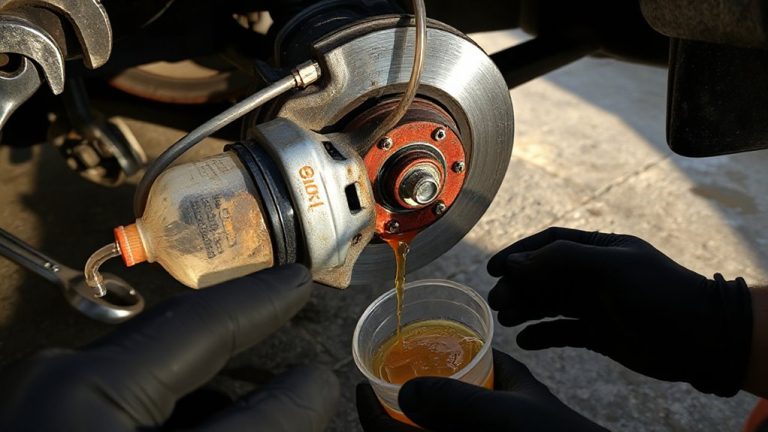
Over-torquing lug nuts creates uneven clamping force that distorts the rotor’s geometry, and you might not notice it until braking performance degrades. You’re applying more force than the recommended 80–100 ft-lbs, which causes the rotor to flex and seat improperly against the hub. This misalignment introduces lateral runout-often more than 0.005 inches-which triggers brake vibration under deceleration. The warped surface doesn’t contact the pads evenly, leading to pulsation felt in the pedal and steering wheel. Over time, this uneven wear accelerates material loss, reducing rotor thickness below the manufacturer’s minimum spec of 24.4 mm. Once that happens, safe braking is compromised. You’ll eventually need rotor replacement, a preventable expense. Using a torque wrench guarantees even, correct clamping. Unlike impact guns, which can exceed 150 ft-lbs, a calibrated tool maintains precision. Consistent torque prevents distortion and extends rotor life.
Why Heat Makes a Warped Rotor Worse
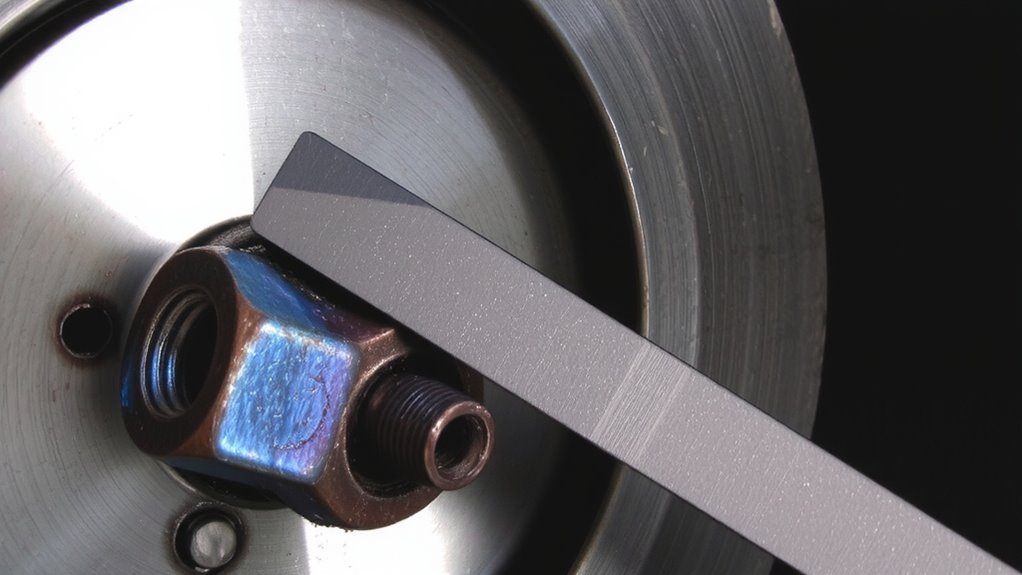
When a rotor is already warped from over-torquing, heat makes everything worse. Thermal expansion causes the uneven rotor surfaces to warp further under high temperatures. As you brake, friction generates heat, swelling the metal unevenly across the rotor’s face. This distortion amplifies vibration and pulsation. Continuous heating and cooling cycles accelerate material fatigue, weakening the rotor’s structure over time. Even small temperature spikes-reaching 600°F during aggressive stops-can permanently deform thinner sections faster than thicker ones. The rotor loses its parallelism, sometimes exceeding 0.001 inches of lateral runout after just a few cycles. Material fatigue reduces the metal’s ability to rebound, making warping irreversible. Heat doesn’t create warping on its own, but on a compromised rotor, it magnifies stress points. Each application of the brakes then intensifies uneven contact, reducing braking efficiency and accelerating wear.
How Lug Nut Pressure Destroys Rotor Flatness
If the lug nuts aren’t tightened evenly, the rotor can’t sit flat against the hub, distorting its shape from the start. Uneven pressure creates warping forces measured at over 0.003 inches runout-enough to cause noticeable vibration. Over-torquing forces the rotor to conform to imperfections on the hub face, locking in stress. As you drive, heat cycles accelerate lug expansion, further warping the rotor. The repeated clamping load creates micro-distortions that compound with each thermal cycle. This stress promotes stress cracking near the lug holes, especially in cast iron rotors rated for 60,000 psi tensile strength. Cracks begin at stress concentrators and grow inward under load. The rotor loses flatness rapidly, often within the first 500 miles. Even slight distortions reduce braking efficiency by up to 15%. Maintaining correct clamping force is critical to rotor integrity and long-term performance.
How to Torque Lug Nuts the Right Way Every Time
Always torque lug nuts correctly the first time to protect rotor integrity and guarantee safe wheel attachment. Use a calibrated torque wrench, never an impact gun, to achieve the manufacturer’s specified value-typically 80–100 ft-lbs for most passenger vehicles. Proper technique means tightening gradually and evenly, in stages: first hand-tighten all nuts, then apply 50% torque in sequence, followed by full value. Follow recommended torque patterns-usually a star or crisscross pattern-to distribute clamping force uniformly. This prevents rotor warping and securing secure seating. Recheck torque after 50 miles of driving, as components may settle. Skipping steps risks uneven pressure, rotor distortion, and compromised safety. Consistency, proper tools, and adherence to specs are non-negotiable. Mastering torque patterns and proper technique protects braking performance and wheel stability over time. For maximum accuracy and ease of use, consider investing in a best digital torque wrench.
On a final note
You’ve likely damaged your rotors if you feel pulsation in the brake pedal within the first 500 miles. Over-torqued lug nuts distort rotor flatness by clamping the rotor unevenly against the hub. This creates high spots that lead to uneven wear. Torque lug nuts to manufacturer specs-typically 80–100 ft-lbs-with a calibrated torque wrench. Use a star pattern to guarantee even pressure.