Acoustic Absorption Layers Within Mufflers and Their Decay Rate Measurements
You rely on fiberglass or mineral wool absorption layers, 25–50 mm thick, to convert engine noise into heat, achieving 20–30 dB reduction in high frequencies. Under exhaust temperatures exceeding 700°F, these materials lose up to 40% mass over 50,000 miles due to thermal cycling, vibration fatigue, and chemical erosion. Density drops from 80–120 kg/m³ to below 50 kg/m³, cutting sound absorption from 70–90% per pass. Advanced alternatives like ceramic wool and stainless steel fibers now offer longer-term stability under extreme conditions.
Notable Insights
- Muffler absorption layers use fiberglass or mineral wool to convert sound energy into heat, reducing noise by 20–30 dB in critical frequency ranges.
- Absorption materials degrade due to high temperatures, moisture, and vibration, with up to 40% mass loss observed after 50,000 miles of service.
- Thermal cycling and acidic byproducts cause fiber erosion and structural weakening, reducing material density from 80–120 kg/m³ to below 50 kg/m³ over time.
- Field testing with sensors measures temperature, vibration, and acoustic performance, enabling real-time monitoring of absorption layer thickness and decay rates.
- Advanced materials like ceramic wool and stainless steel fibers resist degradation, retaining over 95% mass and enduring 150,000+ miles under harsh conditions.
How Absorption Layers Muffle Engine Noise
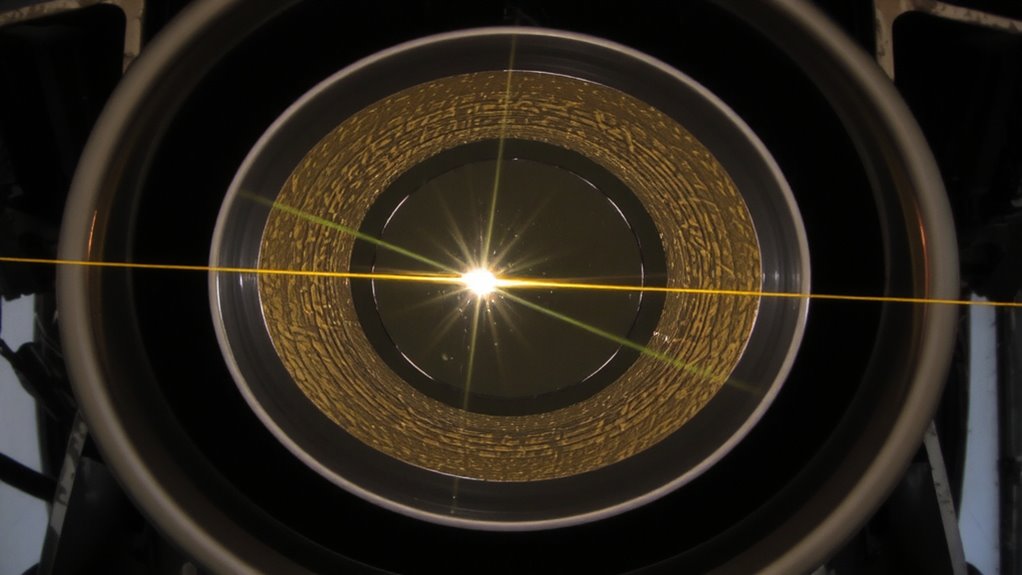
While sound waves travel through the muffler, absorption layers reduce noise by converting acoustic energy into heat. You’ll find these layers made of fiberglass or mineral wool, typically 25 to 50 mm thick, packed around the perforated core tubes. This material provides effective sound dampening by disrupting sound wave propagation. As waves enter the perforated surface, they interact with the porous medium, dissipating energy through friction. High-frequency noise responds best, with attenuation reaching 20–30 dB across 500–2000 Hz. Some noise reflection still occurs at interface boundaries, especially when material density mismatches metal components. To minimize this, engineers use graded density wraps or impedance-matching designs. The absorption coefficient averages 0.7–0.9 in functioning units, meaning 70–90% of sound energy is absorbed per pass. These layers are critical for achieving OEM noise standards without restricting exhaust flow.
Heat, Moisture, and Vibration: What Breaks Down Muffler Absorption Layers
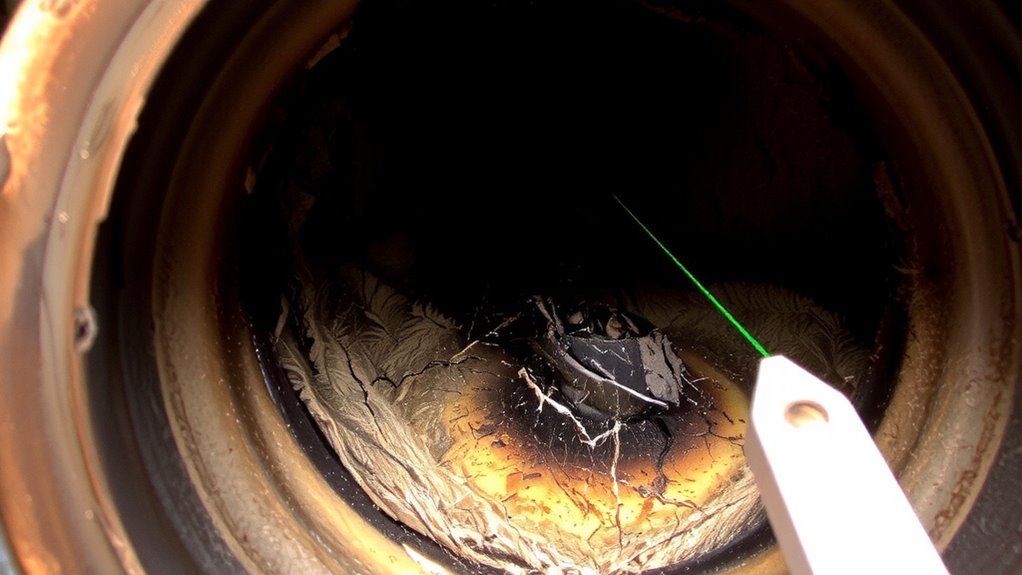
Your muffler’s absorption layers work hard to silence engine noise, but they don’t last forever. High exhaust temperatures-often exceeding 700°F-degrade fiberglass and metallic wool over time. Thermal cycling causes expansion and contraction, weakening structural integrity. Moisture from condensation or humidity accelerates chemical erosion, especially when acidic byproducts form in the exhaust stream. These compounds attack binding agents and fiber matrices, reducing sound-dampening efficiency. Vibration from engine operation induces mechanical fatigue, fracturing fibers and breaking down packing density. Over 50,000 miles, absorption material can lose up to 40% of its original mass due to shedding and erosion. Corrosion from road salts worsens material breakdown in coastal or winter climates. Combined, heat, moisture, and constant shaking compromise layer cohesion, allowing more noise to escape. These factors act continuously, ensuring even high-grade materials eventually fail-typically within 7 to 10 years under normal driving conditions.
How Engineers Test Absorption Layer Wear in Real Exhaust Systems
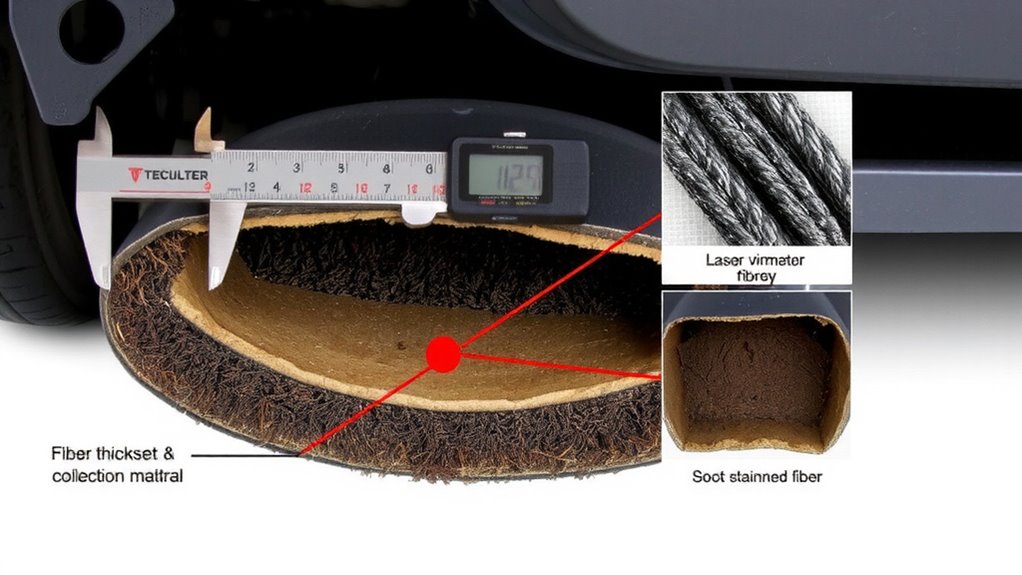
Although real-world conditions are tough to replicate in a lab, engineers use controlled field testing to measure how muffler absorption layers degrade over time. You install field instrumentation directly on exhaust systems to capture temperature, vibration, and acoustic data during normal operation. These sensors enable real time monitoring of material thickness and density changes in the absorption layer. Tests often run for thousands of miles across varied terrain and climates to simulate years of wear. You analyze core samples at intervals, measuring fiber breakage and material erosion down to 0.1 mm precision. Data loggers record exhaust gas fluctuations between 300°F and 1200°F, correlating thermal stress with degradation rates. Field instrumentation includes accelerometers for vibration and microphones for sound transmission loss. Real time monitoring guarantees early detection of structural fatigue. Results guide material upgrades and design improvements, guaranteeing durability without compromising acoustic performance. You rely on this data to predict lifespan and maintain efficiency.
When Absorption Fails: Noise and Backpressure Consequences
Most muffler failures stem from degraded absorption layers, and when that happens, you’ll notice both louder exhaust noise and reduced engine performance. Structural fatigue weakens the internal baffles, allowing sound waves to escape unimpeded. Cracks form at weld points, especially in high-vibration zones, compromising acoustic containment. Material erosion eats away at fiberglass or steel wool packing, reducing density from ideal 80–120 kg/m³ to ineffective levels below 50 kg/m³. As absorption drops, sound transmission loss falls by up to 15 dB, making exhaust tones harsh and drone-like. Backpressure rises when loose material migrates and blocks flow paths. A 20% restriction in the outlet pipe can increase backpressure from 1.5 psi to over 3 psi, hurting volumetric efficiency. You’ll see reduced horsepower, higher exhaust gas temperatures, and decreased fuel economy. These symptoms confirm absorption failure-not just annoying, but mechanically harmful.
Materials That Resist Absorption Layer Breakdown
A handful of advanced materials have proven effective at maintaining acoustic absorption under extreme thermal and mechanical stress. You’ll find that stainless steel fibers, ceramic wool, and high-temperature elastomers deliver long-term material durability in muffler environments. These materials resist decomposition at temperatures exceeding 800°C, guaranteeing consistent sound damping. Their chemical resistance wards off corrosion from exhaust byproducts like sulfuric and nitric acids. For instance, ceramic wool retains 95% of its mass after 1,000 hours at 750°C in corrosive gas flows. Stainless steel fiber mats maintain structural integrity under vibrations up to 30 g-force. You can expect service lives over 150,000 miles in heavy-duty applications. Monolithic sintered metal foams also resist erosion and thermal shock, with pore densities ranging from 10 to 40 pores per inch. These specs guarantee minimal absorption layer breakdown. You’re looking at proven solutions where performance and resilience intersect.
On a final note
You rely on acoustic absorption layers to reduce engine noise effectively. These layers typically degrade over 30,000 to 50,000 miles due to heat cycles exceeding 800°F and moisture corrosion. Engineers measure decay using impedance tube tests, tracking NRC (Noise Reduction Coefficient) drops from 0.95 to below 0.60. Failed layers increase sound output by 8–12 dB and raise backpressure up to 2.5 psi, harming efficiency. Stainless-steel wool and ceramic fibers resist breakdown best.