Setting Up Bluetooth-Linked Air Quality Sensors for Real-Time Cabin Monitoring
Choose a Bluetooth 5.0 sensor with NDIR CO₂ detection, factory-calibrated to ±50 ppm and NIST-traceable for accuracy. Pair it to your phone via the app, where AES-128 encryption secures data. Mount at breathing height-3 to 6 feet-avoiding vents and obstructions. One sensor covers 300–500 sq ft; keep it within 30 feet of your device. It displays real-time PM2.5, CO₂, and TVOC levels with color-coded alerts. Monthly fresh air resets maintain precision. Common interference from Wi-Fi or metal walls can disrupt signal, but restarting the sensor or updating firmware typically resolves issues. Follow proper placement and calibration to guarantee reliable, continuous monitoring-your next steps guarantee long-term accuracy and responsive alerts.
Notable Insights
- Choose a Bluetooth 5.0 sensor with NIST-traceable calibration for accurate CO₂, VOC, and PM2.5 monitoring in cabins.
- Pair the sensor via your phone’s Bluetooth and companion app, ensuring AES-128 encryption protects data transmission.
- Place the sensor at breathing height (3–6 feet) with clear line-of-sight to maintain signal strength and reading accuracy.
- Install one sensor per 300–500 sq ft, avoiding kitchens, bathrooms, and obstructions that skew air quality readings.
- Calibrate monthly with fresh air reset for CO₂ and weekly for TVOC to maintain factory-validated sensor accuracy.
Choose the Right Bluetooth Air Quality Sensors
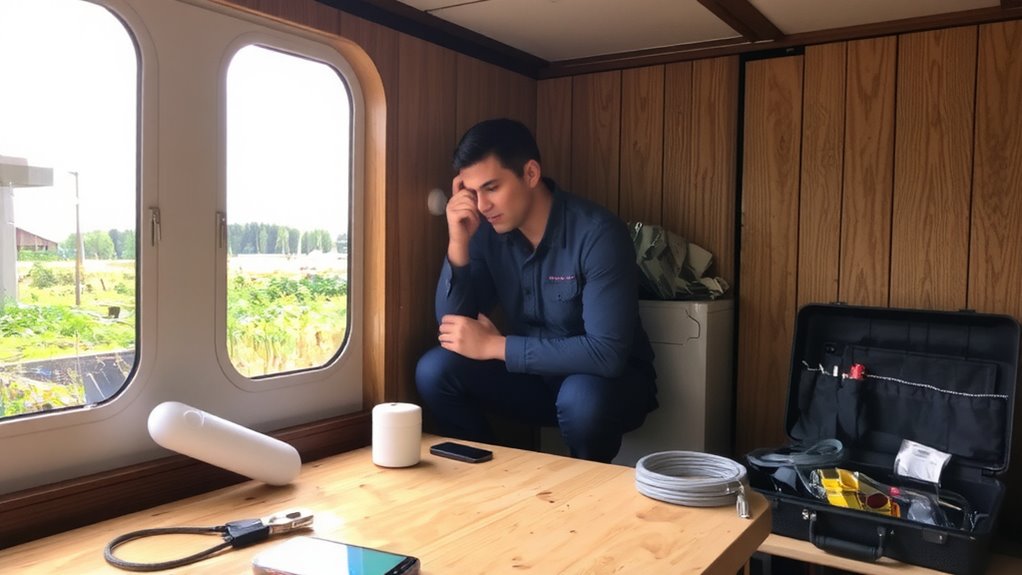
While selecting a Bluetooth-enabled air quality sensor, your choice should hinge on measurable performance and compatibility with your monitoring goals. Look for sensors with factory-performed sensor calibration to guarantee accuracy across CO₂, VOC, and PM2.5 readings. Units with NIST-traceable calibration deliver reliable baselines and reduce drift over time. You need consistent data, not guesswork. Opt for models supporting AES-128 data encryption to protect wireless transmissions between the sensor and network. Unsecured data risks compromise. Bluetooth 5.0 or higher guarantees stable range up to 30 meters and lower power consumption. Check sampling rates-fast-response sensors update every 10 seconds, critical for real-time cabin monitoring. Confirm IP54 or higher rating for dust and moisture resistance. Prioritize sensors with SDK support for custom integration. Choose specs, not brands. Trust verified performance, not promises.
Pair Sensors to Your Phone in Seconds
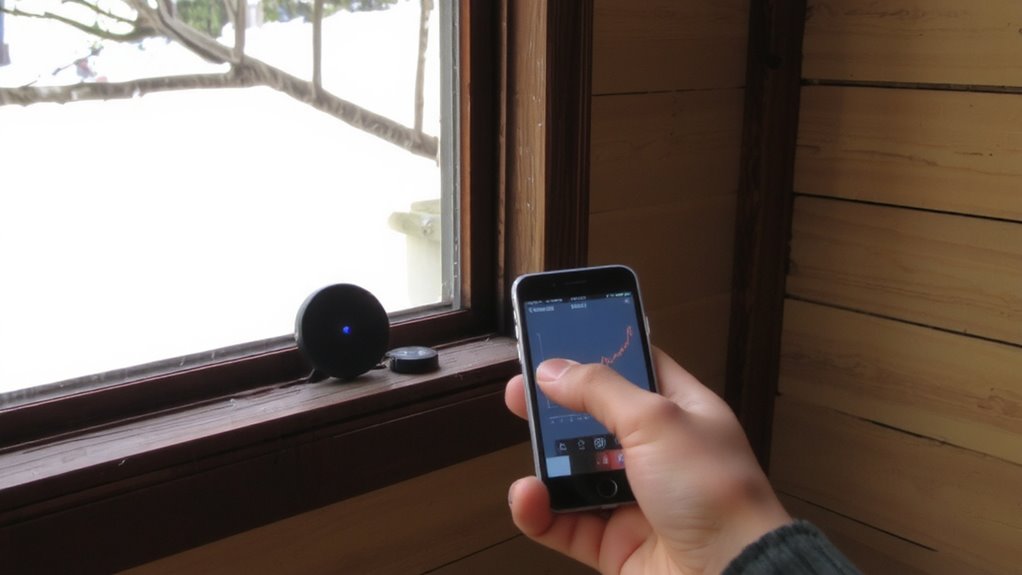
Once you’ve got the right Bluetooth air quality sensor, pairing it to your phone is quick and painless-most models take under 30 seconds to connect. Enable Bluetooth on your phone and power on the sensor; it enters pairing mode automatically. Open the companion app, select the device from the list, and confirm pairing. The app initiates sensor calibration to guarantee accurate readings, aligning internal algorithms with baseline environmental values. Calibration typically completes in under two minutes, adjusting for temperature, humidity, and baseline gas concentrations. Data encryption is enabled by default, using AES-128 encryption to secure real-time transmissions between the sensor and your phone. This prevents unauthorized access and guarantees data integrity. Most sensors use Bluetooth 5.0, offering a stable connection within a 30-foot range, even through cabin walls. Connection persists automatically upon re-entry into range.
Place Sensors for Accurate Cabin Coverage
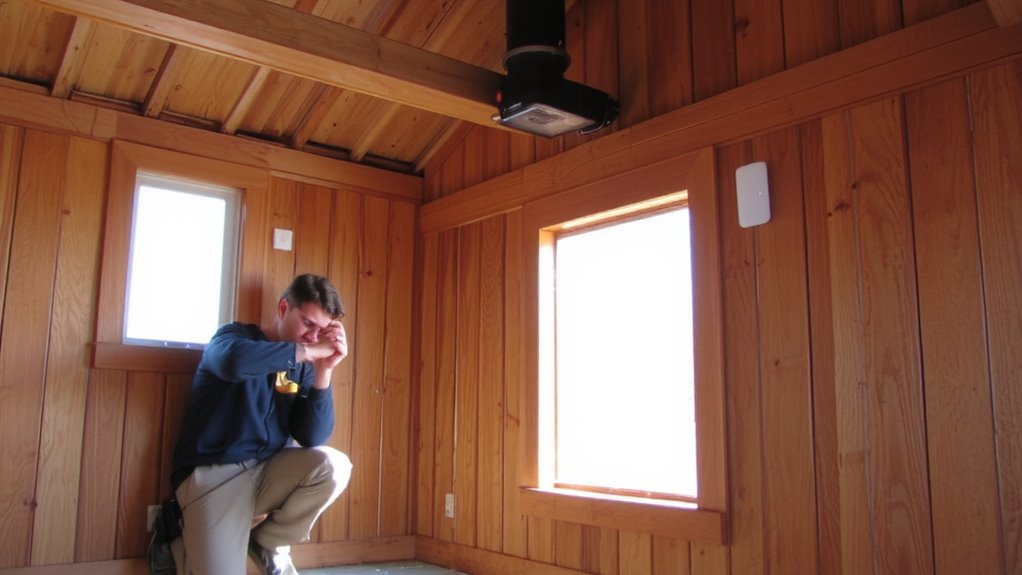
For ideal air quality monitoring, position each Bluetooth-linked sensor strategically throughout the cabin. Proper sensor placement ensures consistent detection of pollutants, humidity, and CO₂ levels. Mount sensors at breathing height-between 3 and 6 feet above the floor-where occupants spend most of their time. Avoid corners, vents, or behind furniture, as these locations create coverage gaps. Place one sensor per 300–500 square feet to maintain effective spatial resolution. Guarantee line-of-sight where possible, since walls and large obstructions reduce Bluetooth signal strength and data reliability. Sensors should not be exposed to direct sunlight or moisture sources like kitchens or bathrooms, which skew readings. Distribute units evenly across sleeping, living, and high-traffic zones. This arrangement supports thorough environmental tracking. Correct placement minimizes blind spots and optimizes system responsiveness.
Read Real-Time Air Quality Data Clearly
How do you make sense of the air you breathe? Real-time air quality data becomes useful only when you can interpret it accurately. Your sensor displays measurements like PM2.5 (μg/m³), CO₂ (ppm), and TVOC (ppb) in clear, color-coded readings on the paired app. Good data interpretation relies on knowing thresholds: for instance, CO₂ above 1,000 ppm signals poor ventilation. To guarantee accuracy, regular sensor calibration is essential. Factory-calibrated NDIR CO₂ sensors maintain ±50 ppm precision but require fresh air calibration monthly. Metal oxide sensors for TVOC need 30-minute warm-up cycles and baseline resets weekly. Misinterpreted data often stems from uncalibrated hardware. Always verify firmware updates and allow sensors 15 minutes to stabilize after startup. With proper calibration and real-time readouts, you’ll detect changes faster and respond with confidence-like noticing a spike in particulates seconds after burning toast.
Fix Common Bluetooth Pairing Issues
You’ve set up your air quality sensor and opened the app, only to find it won’t connect-frustrating when you’re ready to monitor your environment. First, verify device compatibility: your smartphone or tablet must support Bluetooth 4.0 or higher. Older models may lack the necessary protocols for stable pairing. Signal interference is another common culprit. Keep the sensor within 30 feet (9 meters) of your device, avoiding obstructions like metal cabin walls or operating microwaves. Interference from Wi-Fi routers or other wireless devices can also disrupt the 2.4 GHz frequency band. Restart both the sensor and your mobile device to reset unstable connections. Make certain the sensor’s firmware is up to date, as updates often fix known pairing bugs. Clear the app cache or reinstall it if needed. These focused troubleshooting steps resolve most Bluetooth pairing failures efficiently.
Set Up Automatic Air Alerts for Safety
What if your air quality sensor could warn you before pollution levels became hazardous? You can set up automatic air alerts to protect your cabin’s environment. These alerts trigger when pollutants exceed predefined air quality thresholds, such as CO₂ levels above 1,000 ppm or PM2.5 concentrations over 35 µg/m³. The system uses Bluetooth 5.0 to send real-time data to your smartphone or control panel. With alert customization, you choose which parameters activate warnings-voltage, temperature, or specific contaminants. Notifications appear instantly via app pop-ups or audible alarms. Some models support分级 alerts: yellow for moderate risk, red for critical. Response time is under 10 seconds from detection to alert. You can also log historical data for compliance or analysis. Automatic alerts guarantee rapid intervention, improving safety without constant monitoring.
On a final note
You’ve set up an effective air quality monitoring system. Bluetooth sensors like the Aranet4 or Temtop LKC-1000S offer CO₂, PM2.5, and VOC readings with ±30 ppm accuracy. Real-time updates sync every 10 seconds via BLE 5.0, ensuring minimal latency. Proper placement avoids airflow shadows near vents. Alerts trigger at user-defined thresholds. The system delivers reliable, continuous cabin air data, functioning like a smoke detector for invisible pollutants-essential for health and safety.