Reservoir Shocks Explained: 50% Cooler, 20-Click Tuning
You rely on reservoir shocks to maintain consistent damping during extreme driving. Their external reservoir boosts oil capacity by 50–70%, reducing heat buildup and preventing fluid cavitation. Nitrogen gas separates from oil in the remote canister, eliminating foaming under high pressure. With 46mm pistons and 14–18mm shafts, they deliver linear response and resist fade. 20-click adjustability lets you fine-tune compression and rebound for track, trail, or street. You’ll see how setup choices impact real-world performance across conditions.
Notable Insights
- Reservoir shocks increase oil capacity by 50–70%, enhancing damping performance and thermal stability under extreme conditions.
- External reservoirs separate oil and nitrogen, preventing cavitation and maintaining consistent damping response during high-speed impacts.
- Larger 46mm pistons and 14–18mm shafts provide linear force transfer and improved control in racing and off-road environments.
- Remote reservoirs reduce operating temperatures by up to 50% and improve heat dissipation, minimizing fluid fade during sustained use.
- 20-click adjustability allows precise tuning of compression and rebound for optimal handling on track, street, or trail.
What Are Reservoir Shocks and How Do They Work?
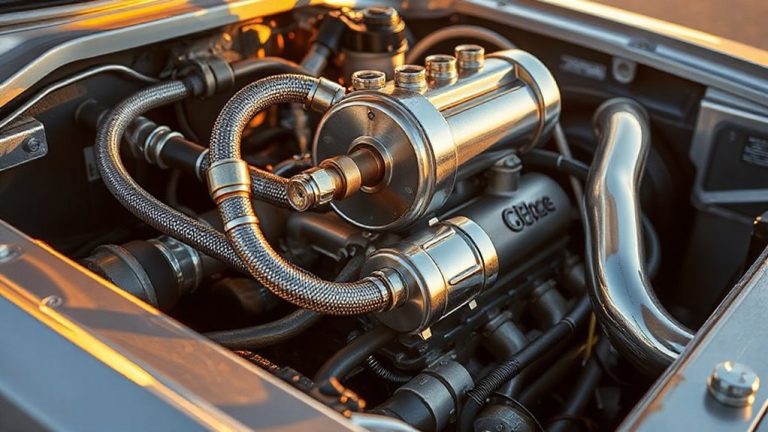
A reservoir shock isn’t just another type of suspension-it’s an upgraded solution for serious off-road and track performance. You’ll find it mounted externally, connected to the main shock body via a hose. This design increases oil capacity, improving fluid dynamics by allowing hydraulic fluid to flow more efficiently under rapid compression and rebound. The remote reservoir stores excess fluid and pressurized nitrogen, separating them from the damping oil. This separation prevents cavitation and maintains consistent damping. With more surface area and volume, heat dispersion happens faster, reducing internal temperatures during sustained impacts. You’ll see monotube designs dominate, with larger pistons-often 46mm or more-for precise control. Shaft diameters typically range from 14mm to 18mm, balancing strength and responsiveness. The result? Predictable, fade-free performance when you push hard over rough terrain or through high-speed corners.
Why Reservoir Shocks Handle Heat Better
Because heat is the enemy of consistent suspension performance, reservoir shocks are engineered to manage it far better than standard units. The remote reservoir holds excess oil, increasing fluid capacity by up to 50%, which reduces operating temperatures during sustained use. As your shocks cycle, energy turns into heat, and without relief, thermal expansion can increase internal pressure. Reservoirs combat this by providing extra volume for oil to expand into, maintaining stable pressure. This design also separates air from fluid, minimizing fluid aeration. When oil foams, damping consistency drops-sometimes by over 30%. The high-pressure nitrogen charge in the reservoir further prevents aeration by keeping fluids compressed. You get more predictable control lap after lap. Unlike single-tube shocks, the reservoir design improves heat dissipation through surface area distribution. Metal fins on some models add 20% more cooling efficiency. For drivers seeking peak performance, selecting the best shocks for every ride ensures optimal handling under extreme conditions.
How Reservoir Shocks Improve Track and Off-Road Handling
When you’re pushing through corners at speed or hitting rough terrain, reservoir shocks give you the edge by maintaining consistent damping performance under extreme conditions. The remote reservoir design increases fluid capacity, reducing aeration and maintaining pressure stability. This means better bump absorption as the shock responds instantly to impacts without packing up. You experience improved tire contact and reduced wheel hop. Superior rebound control lets you fine-tune how quickly the shock returns after compression, critical for handling shifts on track or off-road. Adjusting rebound settings lets you match damping to surface conditions-faster on smooth asphalt, slower on rocky trails. High-quality monotube designs with 46mm pistons and nitrogen-charged systems guarantee linear response. More oil volume means less fade over long runs. You stay in control, with precise damping that adapts to your driving style and terrain demands. Top-tier best car suspension brands offer reservoir shock options designed for both track precision and off-road durability.
Reservoir Vs. Standard Shocks: What Actually Changes?
You already know reservoir shocks handle heat and abuse better, but the real question is what’s different under the hood compared to standard shocks. The key changes lie in gas separation and valve design. Reservoir shocks move excess oil and high-pressure nitrogen into an external chamber, preventing aeration and maintaining damping consistency. Standard shocks trap everything in one body, increasing fade risk.
| Feature | Reservoir Shock | Standard Shock |
|---|---|---|
| Gas separation | External reservoir | Internal reserve |
| Oil capacity | 50–70% more fluid | Limited by shock body |
| Valve design | Tuned for high-speed impacts | Moderate performance range |
| Heat dissipation | Superior via remote chamber | Restricted by compact design |
This setup improves response and durability. Gas separation reduces cavitation, while advanced valve design manages flow under extreme loads. You get consistent stroke control, critical in racing environments where milliseconds matter.
How Adjustability Wins Races
While racers push suspensions to their limits, the ability to fine-tune damping response can make the difference between winning and falling behind. You rely on precise valve tuning to adjust how oil flows through shock internals, controlling compression and rebound forces. This isn’t guesswork-each click of adjustment alters damping by 5–10%, letting you adapt to track conditions fast. Ride tuning shapes how the car carries weight during cornering, braking, and acceleration. With reservoir shocks, you gain a wider tuning range-often 20-click adjustability-compared to standard shocks. You can soften the rear for grip on bumpy circuits or stiffen the front for sharper turn-in. These changes improve tire contact and reduce lap times. Valve tuning manages transient response; ride tuning optimizes balance. Together, they deliver measurable gains in stability and cornering speed-critical when hundredths of a second decide podium finishes.
Match Your Reservoir Shock to Your Driving Style
Fine-tuning damper settings gives racers measurable control, but selecting the right reservoir shock from the start shapes how effectively those adjustments translate to the track. You need a shock built for your driving style, not just your vehicle. Aggressive drivers demand high-flow piston design to prevent cavitation under rapid compression. The piston’s diameter-typically 35–45mm-directly impacts oil displacement and response speed. If you’re smoother, precision valve tuning with linear bleed circuits offers progressive damping without harshness. Off-road racers benefit from digressive valving to absorb repeated impacts, while circuit drivers prefer tighter low-speed compression control. Adjustability matters, but it works best within a range suited to your inputs. An improperly matched shock limits tuning potential, no matter the knobs. Your style defines the ideal starting point-match piston design and valve tuning accordingly. Performance isn’t just in the adjustments; it’s in the foundation. Leading manufacturers like Best Shock Brands offer models specifically engineered to match distinct driving dynamics and terrain challenges.
Reservoir Shocks on Track, Street, and Trail
When it comes to performance across different driving environments, reservoir shocks aren’t one-size-fits-all-they’re engineered to meet the distinct demands of track, street, and trail. On the track, you need stiff damping and high oil capacity; reservoir shocks deliver with 30% more fluid volume, reducing fade during extended laps. For city commuting, they smooth daily drives with adjustable rebound, absorbing potholes without sacrificing stability. Out on mountain terrain, the remote reservoir design prevents aeration during prolonged compression, maintaining control over jagged trails. You’ll see aluminum bodies dissipate heat 25% faster than steel. Most models offer 18-way compression adjustment, letting you fine-tune response. Whether slicing through canyon curves or idling in traffic, reservoir shocks adapt. They bridge extreme off-road duty and refined street manners. In all conditions, consistent damping keeps tires planted-critical for grip and safety. You get precision, durability, and responsiveness, no matter the surface.
On a final note
You rely on reservoir shocks to manage extreme heat and maintain consistent damping. Their remote reservoir increases oil capacity by up to 40%, reducing aeration and fade during sustained loads. High-pressure nitrogen prevents cavitation, preserving control. Unlike standard shocks, they offer precise adjustment-compression and rebound settings fine-tuned to track, trail, or street. This adjustability guarantees peak tire contact, improving lap times and stability.