How to Prevent Frame Rust on Classic Cars Stored in Damp Garages
Keep humidity below 55% to prevent frame rust, since corrosion starts at 60% RH. Use calibrated sensors near the floor to monitor for condensation. Install 80–120 CFM ventilation fans high on walls for air exchange. Place one 20-ounce desiccant trap per 1,000 cubic feet or use a 20-pint electric dehumidifier with a drain hose. Lift the car off the ground and apply rust-inhibiting wax. Check systems weekly and inspect twice a year-you’ll discover overlooked moisture risks they can address next.
Notable Insights
- Monitor humidity weekly using calibrated sensors placed near the floor to detect condensation risks early.
- Install desiccant traps or dehumidifiers to actively remove moisture from enclosed storage areas.
- Use ventilation fans mounted high on walls to expel moist air and prevent stagnation.
- Open garage doors during midday to utilize natural airflow and reduce humidity buildup.
- Maintain relative humidity below 55% with electric dehumidifiers to inhibit rust formation on car frames.
Check Humidity and Spot Moisture Sources
Why does rust creep in where you least expect it? Because moisture hides in plain sight, especially in garages with poor environmental control. You need to monitor relative humidity-ideally below 55%-using calibrated humidity sensors placed near the floor, where condensation accumulates. These sensors should have ±2% accuracy to guarantee reliable readings. Check them weekly. Moisture traps, like desiccant-based systems or rechargeable dehumidifiers, actively pull water from the air. A single 1,000-cubic-foot space might require a 20-ounce moisture trap, emptied every 7–10 days in damp conditions. Place traps along frame rails and under floorboards-common corrosion zones. Ignoring these microclimates lets hidden dampness attack steel. Rust starts at 60% RH, so early detection is key. Use sensors and traps together as a first line of defense. They’re not optional extras-they’re essential tools for preserving metal integrity. Prevention starts with awareness, and awareness starts with measurement. For optimal protection, consider using best moisture absorbers for cars, which are specifically designed to reduce humidity levels in enclosed automotive spaces.
Boost Airflow With Vent Fans or Open Doors
While moisture control starts with monitoring, it doesn’t end there-consistent airflow is critical to keeping frame rails dry. You need active air exchange to disrupt humidity pockets near the floor. Install ventilation fans rated at 80–120 CFM (cubic feet per minute) high on garage walls to exhaust moist air. Position fans to create cross-flow, drawing fresh air from one side and expelling damp air on the opposite. Run them 12–24 hours daily, especially in basements or enclosed spaces with poor natural circulation. Alternatively, adopt an open door policy for 2–4 hours during midday when outdoor humidity is lowest. This reduces thermal stratification and prevents condensation buildup along cold frame sections. Even short-term airflow cuts relative humidity by 15–25% quickly. Combine ventilation fans with passive airing to maintain equilibrium. Air movement isn’t optional-it’s a mechanical requirement for corrosion prevention.
Use Calcium Chloride or Electric Dehumidifiers
Since moisture in the air directly accelerates rust formation on steel frame rails, you need to reduce relative humidity to safe levels-below 50%-using reliable dehumidification. Calcium chloride buckets provide passive protection through calcium absorption, pulling up to 8 pints of moisture weekly from the air. These are low-cost and require no power, but work best in enclosed spaces under 200 square feet. For larger or more humid garages, electric dehumidifiers offer superior dehumidifier efficiency. A 20-pint unit running daily can maintain 45% humidity in a 300-square-foot space, consuming about 250 watts per hour. Units with built-in hygrostats cycle automatically, preserving energy. Compared to desiccants, electric models remove moisture faster and sustain drier conditions. Use one with a drain hose to avoid manual emptying. Both methods inhibit frame corrosion, but electric systems deliver more consistent control where humidity runs high.
Lift the Car to Limit Ground Moisture Contact
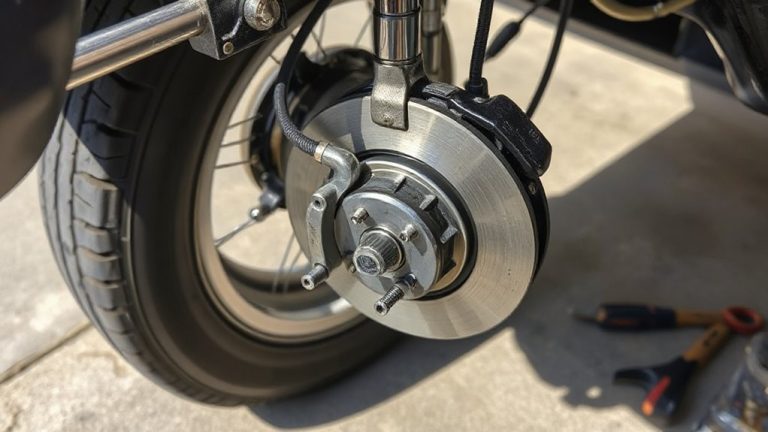
Elevate your classic car reduces exposure to ground-level moisture, a key contributor to frame corrosion. Use heavy-duty jack stands rated for at least 3 tons per corner to safely support the vehicle’s weight. Position stands beneath reinforced frame points to prevent structural damage. This lift minimizes contact with damp concrete, which can wick humidity into the undercarriage. Maintain a consistent 6- to 8-inch ground clearance to allow air circulation beneath the car. Pair this with breathable tire covers to prevent sidewall cracking and trap moisture away from wheel wells. Tire covers also shield rubber from ozone and temperature swings. Make certain all stands are level and secure prior to release-uneven support risks frame stress. Never rely on hydraulic jacks for long-term storage. Jack stands provide stable, permanent elevation. Combined, these steps substantially reduce the risk of moisture pooling around critical metal components. When lifting, ensure you use a reliable floor jack for trucks capable of handling your vehicle’s weight and frame design.
Seal the Frame With Rust-Inhibiting Wax
You’ve lifted the car to keep the frame clear of damp surfaces, and now it’s time to add a protective barrier that stops moisture before it attacks the metal. Apply a rust-inhibiting wax to form a durable frame coating that resists humidity and minor chemical exposure. Use a brush or spray applicator for even wax application, ensuring coverage on all seams, joints, and hard-to-reach channels. High-quality waxes contain synthetic polymers and waxes like carnauba or montan, providing a hydrophobic layer up to 3 mils thick. These formulations typically have a shelf life of 24 months and remain stable between -20°F and 160°F. Reapply every 12 to 18 months for sustained protection. Proper wax application blocks oxygen and chlorides, reducing electrochemical oxidation. The frame coating must be non-conductive and self-healing to resist micro-abrasions. Always clean the frame with a degreaser before starting. For persistent rust spots, consider using a best car rust remover to treat affected areas prior to wax application.
Inspect for Rust Twice a Year
Regularly inspecting your classic car’s frame for rust is essential to catching damage early, before it compromises structural integrity. Perform rust detection twice yearly, focusing on frame rails, suspension mounts, and floor pans-common corrosion hotspots. Use a bright LED flashlight and inspection mirror to examine tight spaces. Look for bubbling paint, flaking metal, or surface pitting-early signs of oxidation. Early intervention stops minor rust from spreading. If surface rust appears, treat it immediately with a wire brush and apply a rust converter containing tannic acid. For scale, anything deeper than 0.5mm in metal loss requires professional repair. Moisture traps in boxed frames demand special attention; consider a boroscope for internal checks. These inspections, combined with proper sealing, extend frame life markedly. Twice-yearly checks guarantee consistent monitoring, aligning with seasonal humidity shifts.
On a final note
You must control moisture to protect your classic car’s frame. Damp garages accelerate rust, especially in floor pans and frame rails. Use a dehumid moving air at 50 pints/day or calcium chloride buckets (replace every 7–10 days). Elevate the vehicle on jack stands to reduce ground moisture contact. Apply rust-inhibiting wax-like Woolwax or Fluid Film-to frame surfaces. Inspect twice yearly with a flashlight and mirror.