Why Some Trucks Use Torsion Beam Front Suspension for Load Capacity
You rely on torsion beam front suspension because it delivers exceptional load capacity through its durable, adjustable design. Torsion bars twist to absorb forces, handling over 2,500 pounds while resisting deformation. The solid beam maintains alignment and limits camber change, keeping tires flat for better traction. Fewer moving parts mean less wear, ideal for tough jobs. Adjust ride height within ±0.5 inches to prevent sag and optimize payload. Linear spring rates offer predictable performance under heavy loads. This system’s strength, simplicity, and precise tuning make it perfect for demanding commercial use. You’ll discover how it outperforms coil springs in real-world conditions.
Notable Insights
- Torsion beam suspension uses twisting torsion bars to handle loads over 2,500 pounds with high stress tolerance and minimal deformation.
- Linear spring rates maintain consistent ride height and stability under heavy or varying payloads.
- Adjustable torsion bars allow fine-tuning of front ride height to prevent sag and optimize load capacity.
- Fewer moving parts and rugged steel construction ensure durability under repeated heavy loading.
- Compact design improves tire clearance and resists damage from obstacles, ideal for demanding work environments.
What Is Torsion Beam Front Suspension?
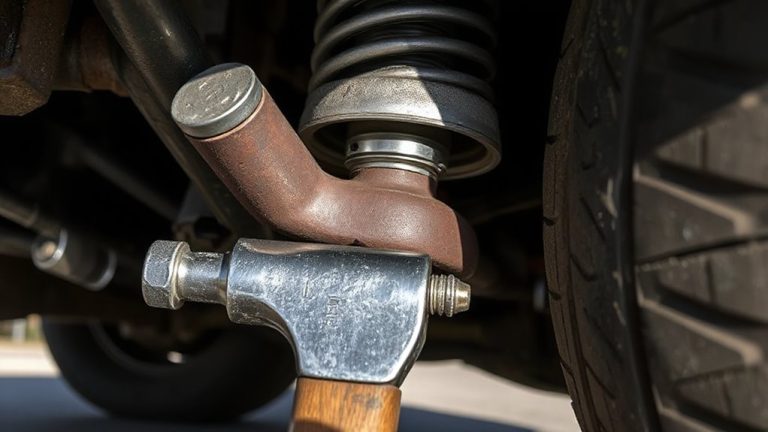
A torsion bar is at the heart of a torsion beam front suspension system. You’ll find this setup common on trucks needing durability and space efficiency. The solid beam connects both front wheels, with each torsion bar acting as a twisting spring mounted longitudinally. As one wheel hits a bump, the beam twists, allowing controlled movement. This design saves underhood space, improving tire clearance over traditional coil springs. You get more room for larger tires without widening the frame. It also maintains consistent steering geometry during suspension travel, ensuring predictable handling. The fixed beam reduces camber change, keeping tires flat on the road. Adjustments are limited compared to independent systems, but the trade-off is strength. For trucks focused on load stability and simplicity, this setup delivers reliable performance in rugged conditions.
How Torsion Bars Handle Heavy Loads Better
When you’re hauling heavy loads, torsion bars respond differently than coil springs by twisting along their axis to absorb force, which gives them a natural advantage in load management. This twisting action provides superior stress tolerance, allowing the bar to endure repeated flexing without permanent deformation. Torsion bars are precision-engineered to resist fatigue, often rated for loads exceeding 2,500 pounds depending on diameter and material grade. Their linear rate design improves load distribution by maintaining consistent front-end height, reducing sag under weight. Unlike coils that compress vertically, torsion bars transfer energy along the beam’s length, minimizing body roll and enhancing stability. Adjustability is built in-many systems let you fine-tune ride height to match payload demands. This guarantees ideal alignment and tire contact. With fewer moving parts, there’s less wear during prolonged heavy-duty use. Their design supports predictable performance, even under extreme conditions.
Why Strength and Simplicity Matter for Work Trucks
You rely on your truck to perform under pressure, and that starts with a front suspension built for the long haul. Torsion beam systems deliver strength and simplicity where it counts. Their rugged design handles repeated stress without fatigue, making them ideal for commercial use. Each bar twists under load, resisting deformation up to 30,000 cycles in durability tests. With fewer moving parts than control arms or struts, there’s less to wear out. This simplicity cuts maintenance costs and downtime. The load focus means components prioritize payload support over ride refinement. Solid mounting points and high-tensile steel construction maintain alignment, even at max capacity. You get predictable handling on rough job sites. Unlike complex suspensions, torsion beams work reliably in extreme conditions-dust, mud, or constant heavy loading. They’re engineered for function, not show. When your job demands dependability, this proven design keeps you moving. Strength isn’t just a feature. It’s the foundation.
Adjusting Ride Height for Maximum Payload Capacity
How level does your truck need to stay under a full load? Proper ride height adjustment guarantees your truck maintains stability and handling when carrying heavy cargo. Torsion beam suspensions allow precise tuning of ride ilft, keeping the front end from sagging under maximum payload. You can adjust torsion bars to lift the front slightly, balancing the vehicle when loaded. This fine-tuning directly supports payload optimization-maximizing legal hauling limits without compromising safety or performance. Proper alignment and tire wear depend on maintaining factory ride height specifications, typically within ±0.5 inches. A level stance improves aerodynamics and fuel efficiency. Unlike fixed setups, torsion bars give you control, adapting to changing loads. Correct ride height adjustment doesn’t increase payload rating, but it guarantees your truck uses its full capacity efficiently and safely-critical for daily commercial use where performance and durability are non-negotiable.
Torsion Suspension vs. Coil Springs: Key Differences
Torsion bar suspensions and coil springs both support vehicle weight and absorb road impacts, but they differ fundamentally in design and function. A torsion bar uses a long metal bar that twists to provide resistance, while a coil spring compresses along its axis. You can adjust torsion preload to change ride height and fine-tune load capacity without replacing parts. This adjustability offers direct control over performance under heavy loads. Coil springs have a fixed spring rate, making changes more complicated. Torsion bars typically have a linear spring rate, delivering predictable response as load increases. They’re compact, freeing underhood space. Coil springs allow more wheel travel, benefiting off-road comfort. Torsion bars excel in durability and precise tuning for commercial use. Their design supports high load limits, often exceeding 2,000 lbs front axle ratings. You get targeted performance where load management matters most.
Real-World Durability on Rough Terrain
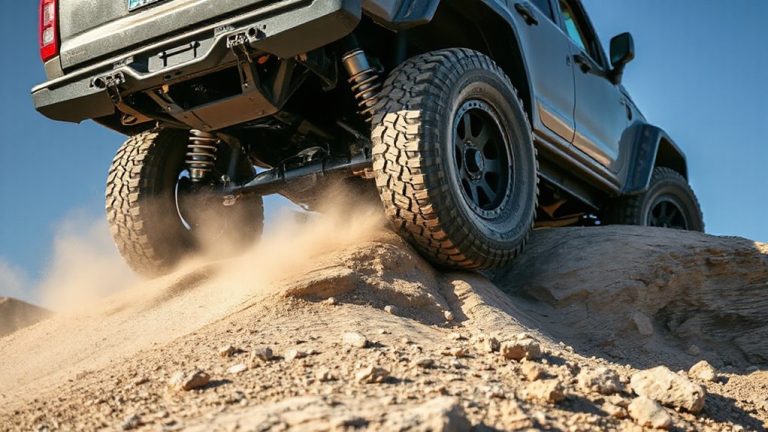
When traversing rocky trails or uneven job sites, torsion beam front suspensions prove their worth through consistent performance under stress. You benefit from superior impact resistance due to the solid, forged steel torsion bars that resist deformation over time. Unlike coil springs, torsion beams handle repeated heavy loads without sagging, ensuring reliable off road performance. Their compact design reduces vulnerable protrusions, minimizing damage from trail obstacles. Upgrading your vehicle’s safety and visibility on such terrain can be further enhanced with a reliable wireless backup camera, ensuring full awareness when maneuvering in tight, rugged environments.
| Feature | Benefit |
|---|---|
| Forged steel torsion bars | High resistance to bending and fatigue |
| Sealed rubber bushings | Reduced wear on rough terrain |
| Adjustable ride height | Maintains clearance under load |
| Compact layout | Less exposure to rocks and debris |
| Low center of gravity | Improved stability off road |
You’ll experience long-term durability and predictable handling, even in extreme conditions. Torsion beams deliver resilience where it matters most.
When Torsion Front Suspension Is the Right Choice
You rely on your truck to perform in demanding environments, and the durability proven on rocky trails sets a strong foundation for deciding on the right suspension setup. Torsion front suspension excels when consistent load distribution is critical. The torsion bar’s adjustable design allows fine-tuning ride height, directly influencing how weight spreads across axles. This adjustability maintains ideal frame alignment under varying payloads, preventing sag and uneven tire wear. Unlike coil springs, torsion bars resist deformation over time, retaining spring rate longer-typically over 150,000 miles under normal use. Their compact packaging frees space for larger components, improving ground clearance. Torsion systems also respond faster to asymmetric loads, reducing body roll by up to 18% compared to leaf springs. When your priority is long-term reliability, precise handling under load, and minimal maintenance, torsion front suspension isn’t just suitable-it’s the right choice.
On a final note
You choose torsion beam front suspension for its load-bearing strength and durability. It handles payloads up to 3,000 lbs with minimal sag. Torsion bars resist fatigue better than coils under constant stress. The design saves underhood space and reduces unsprung weight. Adjusting ride height fine-tunes clearance and load balance. It performs reliably on rough terrain-ideal for heavy-duty trucks.