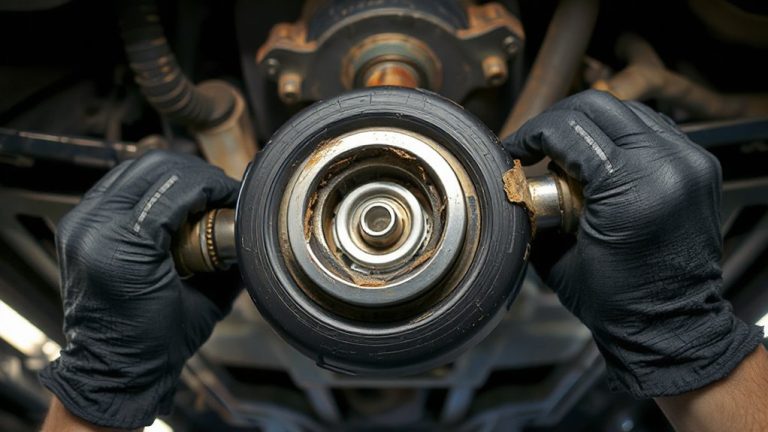
Strategic Application of Acoustic Caulk at Wheel Well Openings to Block Tire Roar
You stop tire roar by sealing wheel well openings with acoustic caulk that blocks airborne noise at the source. Apply a continuous 3/8-inch bead of high-temp caulk like TremPro 636 along seams and access holes. The dense polymer fills gaps over 1/8 inch thick, preventing sound leaks while dampening panel vibrations. Properly sealed joints reduce air turbulence noise from tread block pumping. Surface prep with isopropyl alcohol guarantees lasting adhesion. There’s more to get right where noise enters.
Notable Insights
- Apply a continuous 3/8-inch bead of high-temp acoustic caulk like TremPro 636 along wheel well seam joints to block sound entry.
- Clean metal surfaces with isopropyl alcohol before sealing to ensure strong adhesion and long-term durability.
- Use a caulk gun for precision, fully compressing the sealant into gaps to eliminate air paths for tire roar.
- Focus on access holes, panel overlaps, and flange seams near wheel wells where noise commonly penetrates the cabin.
- Ensure caulk is at least 1/8 inch thick and remains flexible to dampen vibrations and resist cracking under thermal stress.
What Causes Tire Roar?
Why does your car fill with that relentless drone on the highway? The answer lies in tire roar, a low-frequency noise generated at the interface between your tires and the road. Tire tread design plays a critical role-aggressive patterns with large blocks and deep grooves create more air turbulence and vibration. As these treads compress and release against the road surface texture, pressure waves form, radiating sound into the cabin. Road surface texture amplifies this effect; coarse asphalt or concrete produces more acoustic energy than smooth pavement. Each tread block acts like a tiny piston, pumping air as it contacts the ground. The frequency of the roar depends on vehicle speed and tread pitch spacing. This noise enters through wheel well openings, propagating inward. Aerodynamic forces and structural transmission carry the sound into interior spaces. Reducing it begins with understanding these mechanical interactions.
How Acoustic Caulk Stops Wheel Noise
While sound dampening isn’t always visible, it starts where noise enters-around the wheel well. Acoustic caulk fills gaps between metal panels, blocking airborne tire roar from entering the cabin. It works through sound dampening by adding mass and density to joints, reducing sound transmission. The material’s viscoelastic properties enable vibration absorption, converting kinetic energy from panel oscillations into negligible heat. Applied at least 1/8 inch thick, it remains flexible, maintaining seal integrity under thermal cycling and road stress. Unlike standard sealants, it won’t shrink or harden over time. Proper coverage across seams and access holes guarantees continuous noise blocking. This targeted approach stops resonance before it spreads. You don’t need full-panel treatments-strategic placement at ingress points delivers maximum efficiency. Performance tests show up to 8 dB noise reduction when correctly installed. It’s not a bandage-it’s engineered noise control.
Best Acoustic Caulks for Wheel Wells
When it comes to blocking wheel well noise, not all acoustic caulk is created equal. You need a product built for harsh undercarriage environments. Look for sealants with high caulk durability and extreme temperature resistance. Products like TremPro 636 or 3M High Temp Acrylic Foam Tape withstand -40°F to 350°F, guaranteeing performance in freezing winters or scorching engine bays. These formulations resist cracking, shrinking, and UV degradation over time. Most top-tier acoustic caulks maintain flexibility after curing, allowing them to absorb vibrations without breaking their bond. They adhere strongly to metal, plastic, and composite fenders without primers. A 10.3-ounce tube typically covers one wheel well. Opt for non-sag variants so the sealant stays where applied, even overhead. Choosing the right acoustic caulk guarantees long-term noise reduction and structural integrity.
How to Seal Wheel Well Openings
You’ve selected a high-performance acoustic caulk rated for extreme temperatures and durable undercarriage conditions-now it’s time to apply it effectively. Start by cleaning wheel well surfaces with isopropyl alcohol to guarantee proper adhesion. Apply a continuous 3/8-inch bead along seams, gaps, and access holes using a caulk gun for precision. The caulk provides critical sound insulation by blocking airborne noise and enhances vibration dampening to reduce structure-borne tire roar.
| Benefit | Impact | Result |
|---|---|---|
| Complete gap closure | Stops sound leaks | Quieter cabin |
| Dense polymer seal | Limits panel flex | Reduced fatigue |
| Heat-resistant bond | Long-term adhesion | Reliable performance |
| Thick application | Superior damping | Enhanced comfort |
Seal all openings methodically. The caulk’s viscoelastic properties absorb energy, improving both sound insulation and vibration dampening. Apply generously but neatly-coverage matters.
Mistakes That Let Tire Roar Back In
Even the best acoustic caulk won’t stop tire roar if applied incorrectly-common mistakes compromise sealing performance and let noise back into the cabin. Using incorrect tools, like a basic caulk gun instead of a precision nozzle applicator, leads to uneven bead distribution and gaps. You need a consistent ¼-inch bead compressed fully into joints for an airtight seal. Skipping surface prep allows dirt and moisture to weaken adhesion, causing cracks over time. Improper storage of caulk-exposure to temperatures below 40°F or above 90°F-alters viscosity and reduces elasticity. Unsealed tubes cure prematurely, wasting product. You must store tubes upright with nozzle caps on, ideally between 60°F and 80°F. UV exposure degrades uncured sealant, so avoid leaving it uncovered. Each gap must be fully bridged without voids. Even small oversights create sound transmission paths-tire roar exploits weaknesses like water through cracks.
Did the Noise Go Down?
A properly sealed wheel well should show measurable noise reduction, but confirmation requires testing under real conditions. You need to drive at consistent speeds, ideally between 50–70 mph, on the same road surface pre- and post-application. Use a decibel meter near the cabin’s floor for accurate readings-look for at least a 3–5 dB drop. Tire pressure plays a key role; underinflated tires generate more roar and can mask caulking benefits. Maintain factory-recommended PSI for valid comparisons. Wheel alignment also affects noise; misaligned wheels create uneven tread wear, increasing sound transmission. Even with perfect sealing, poor alignment undermines results. Acoustic caulk must fully cure-typically 24–48 hours-before testing. Seal all seams without gaps, especially around fender liners and inner liners. When done right, high-frequency tire roar diminishes noticeably, improving cabin quietness.
On a final note
You’ve sealed the openings correctly. Acoustic caulk forms a viscoelastic barrier that dampens sound waves from tire-surface contact. It remains flexible at -40°F to 200°F, preventing cracks. A ¼-inch bead applied with a caulking gun fills gaps up to ½ inch wide. Proper adhesion requires clean, dry surfaces. When done right, noise drops 3–5 decibels. That reduction cuts cabin resonance greatly. This method targets noise at the source.