Ventilating Covered Cars Weekly to Prevent Condensation Buildup Under Shrouds
Open your covered car weekly for 15–30 minutes to prevent condensation under the shroud. Trapped moisture forms when humidity exceeds 50%, especially with non-breathable covers. Lift the edges midday to allow natural convection and air exchange. Use covers with 500+ g/m²/day breathability and 2.5–3.5 oz/yd² density for maximum vapor transfer. Uncover between 6 a.m. and 10 a.m., when ambient humidity is below 45% and temperatures rise above dew point. This routine reduces corrosion risk from thermal differentials up to 8°C. A well-ventilated vehicle avoids mold, protects seals, and maintains interior dryness-key factors in long-term storage preservation.
Notable Insights
- Lift cover edges weekly for 15–30 minutes to enable air exchange and reduce trapped moisture.
- Use breathable covers with >500 g/m²/day vapor transmission to enhance moisture wicking.
- Uncover vehicles between 6 a.m. and 10 a.m. to align with dew point and minimize condensation.
- Open doors and windows for 20 minutes after uncovering to promote passive ventilation.
- Avoid non-breathable covers that trap humidity and create damp microclimates on cold surfaces.
Let Air In Weekly to Prevent Covered Car Moisture
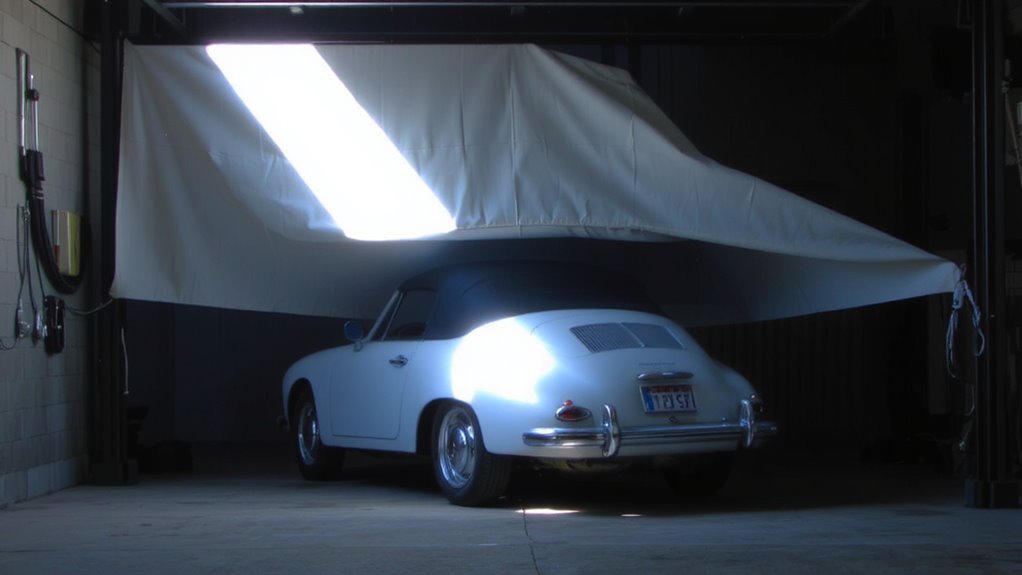
Occasionally letting fresh air into your covered car each week prevents trapped moisture from causing damage. Proper air circulation reduces humidity buildup under the cover, minimizing corrosion and mold. You should lift the cover’s edges for 15–30 minutes weekly, allowing exchange between interior and ambient air. This passive ventilation leverages natural convection, especially effective during midday when temperature gradients are highest. Climate control isn’t active here, but environmental management is still critical. Use breathable car covers with polypropylene or nonwoven fabric layers, typically 2.5–3.5 oz/yd² density, to aid moisture wicking. Covers with built-in ventilation panels increase airflow efficiency by up to 40%. Even in garages with stable temperatures, stagnant air raises relative humidity above 60%, triggering condensation. Weekly airing maintains levels below 50%, the threshold for metal corrosion. Simple, consistent exposure acts as preventive maintenance, protecting paint, seals, and electrical systems.
Why Your Covered Car Gets Damp
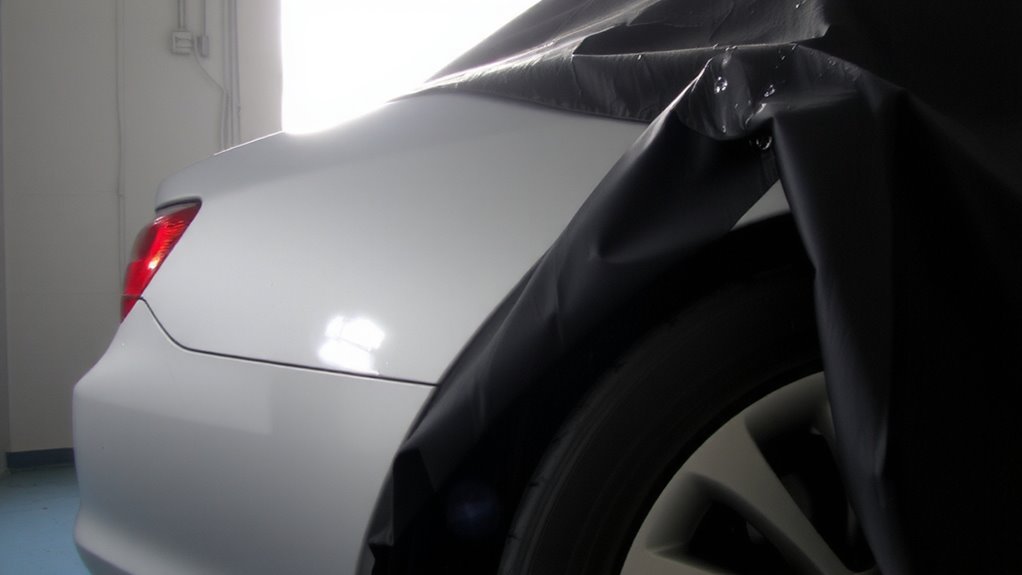
Why does moisture still collect under your car cover even when it’s protected from rain and snow? Temperature fluctuations cause condensation when warm air meets cold surfaces. Your car’s exterior cools at night, turning airborne moisture into dew under the cover. Non-breathable materials trap this humidity, creating a damp microclimate. Modern car covers with polypropylene or polyurethane coatings resist water ingress but may lack vapor permeability. Fuel tanks release trace hydrocarbons, which attract moisture through hygroscopic action. Even minor battery leakage emits sulfuric acid vapor, increasing local humidity and corrosive risk. These emissions condense on cooler metal parts, accelerating oxidation. A fitted cover restricts airflow, preventing natural evaporation. Thermal imaging shows temperature differentials up to 8°C between chassis points and ambient air, promoting condensation. Without weekly ventilation, trapped moisture accumulates, risking paint etching, mold, and electrical faults. Proper material selection and periodic airing reduce this. For optimal protection, consider using a best indoor car cover that balances breathability and moisture resistance.
When to Uncover Your Car for Best Results
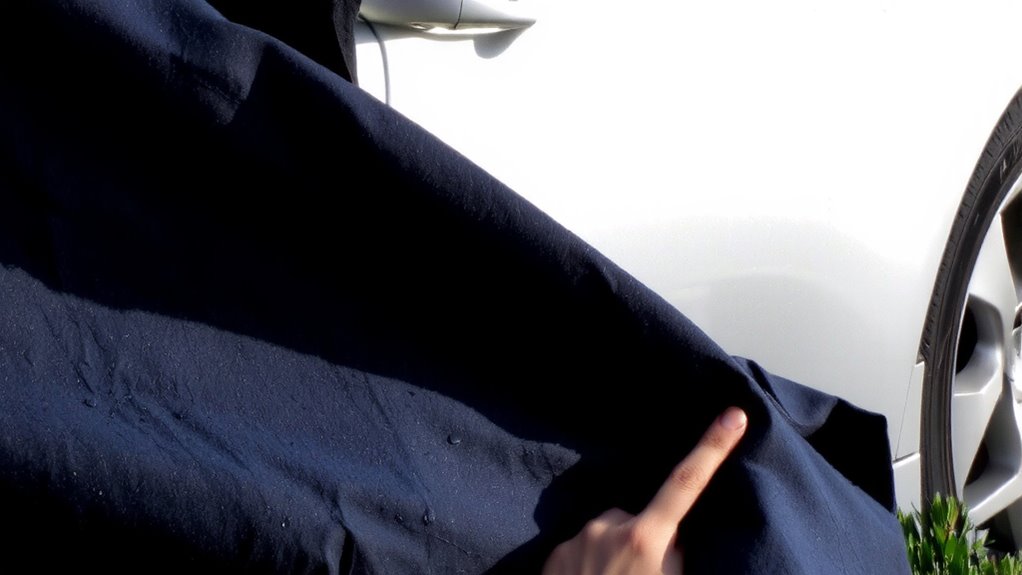
When temperatures rise above the dew point, typically between 6 a.m. and 10 a.m. in most climates, it’s the ideal time to uncover your car. This window minimizes condensation risk by allowing trapped moisture to evaporate before heat accelerates interior humidity. If you’re in seasonal storage, removing the cover during mid-morning guarantees UV-resistant fabrics aren’t stressed by rapid thermal expansion. Always inspect for dampness before re-covering. For maximum car detailing results, uncover in low-humidity conditions-below 45% RH-to prevent water spotting or surface corrosion. Synch your schedule with local dew point data, available via weather apps with accuracy within ±1°C. Persistent moisture under covers can elevate surface pH, promoting paint degradation. Uncovering weekly during this timeframe maintains material integrity and cabin air quality. Consistent timing supports effective climate management, especially with multi-layered, breathable car covers rated above 5,000 mm hydrostatic head.
How to Ventilate Your Car Safely in 4 Steps
Start ventilation right after uncovering your car, especially if you’ve just exposed it during the 6 a.m. to 10 a.m. window when humidity levels are low. Open all doors and windows for at least 20 minutes to allow trapped moisture to escape. This passive airflow prevents mold and supports engine cooling by reducing thermal retention in enclosed compartments. Next, start the engine and let it idle for 10–15 minutes to initiate fuel stabilization, ensuring additives remain active and combustion components stay conditioned. Monitor coolant temperature to confirm the thermostat engages-typically at 195°F-verifying the cooling system is functional. Avoid revving the engine; steady idle promotes even heat distribution. Finally, inspect rubber seals and drain channels for blockages that restrict airflow. Proper ventilation maintains internal humidity below 60%, minimizing corrosion risks. Conduct this routine weekly to preserve mechanical integrity and optimize long-term storage outcomes.
Pick a Breathable Cover to Stop Moisture Builds
A high-quality breathable car cover does more than shield your vehicle-it actively manages moisture by allowing water vapor to escape while blocking liquid penetration. Material selection is critical for long-term humidity control. Non-breathable covers trap warm, moist air against the surface, creating condensation that promotes corrosion. Choose multi-layer, micro-porous fabrics engineered to release vapor while resisting rain and dust.
| Feature | Benefit |
|---|---|
| Polypropylene lining | Prevents surface abrasion and absorbs minimal moisture |
| Micro-porous membrane | Allows vapor transmission at 300–600 g/m²/day |
| UV-resistant polyester | Maintains integrity under prolonged sun exposure |
| Elastic hem with gussets | Guarantees secure fit, reducing flutter and moisture ingress |
These technical properties guarantee ideal humidity control. Breathability ratings above 500 g/m²/day indicate superior performance. Your cover isn’t just a shield-it’s a dynamic barrier essential to preservation.
On a final note
Open your car’s windows slightly once a week to allow air exchange. This reduces relative humidity under the cover, preventing condensation. Use covers with at least 15 g/m² breathability ratings to enable vapor transmission. Park in shaded, well-ventilated areas during ventilation. Make sure the vehicle surface is dry before re-covering. Moisture buildup leads to corrosion, especially on steel components with iron content above 98%. Consistent airflow disrupts dew point conditions, much like attic vents prevent roof moisture.