Drying Techniques That Prevent New Water Spots Immediately After Final Rinse
Dry immediately after the final rinse to stop water spots from forming as minerals concentrate during evaporation. Use a high-quality microfiber towel with an 80/20 blend of polyester and polyamide for maximum water absorption and zero streaks. Apply long, straight strokes in one direction, overlapping by 1 inch to guarantee full coverage. For large surfaces, use a 12- to 18-inch squeegee with a 3–5 mm flexible rubber blade at a 30-degree angle. Pre-rinse with 5% white distilled vinegar to dissolve mineral residues before drying. Infrared dryers can raise surface temperature 20–30°F in 30 seconds, accelerating dry time and reducing spotting risk. You’ll soon discover even more effective methods.
Notable Insights
- Dry immediately after rinsing to prevent water evaporation and mineral deposit formation.
- Use a high-quality 75% polyester, 25% polyamide microfiber towel for a streak-free finish.
- Employ one-direction, overlapping strokes from top to bottom to eliminate streaks and swirl marks.
- Use a squeegee with a 12–18 inch blade at a 30-degree angle for large flat surfaces.
- Pre-rinse with 5% white distilled vinegar to dissolve minerals before final drying.
Stop Water Spots by Drying Immediately
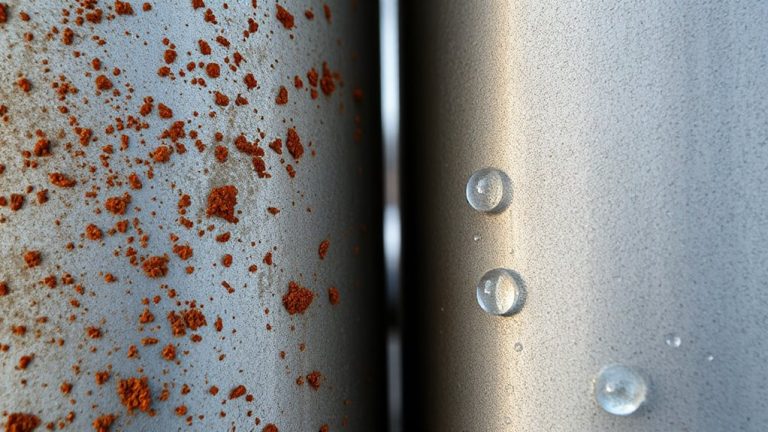
While water evaporates naturally, leaving surfaces to air-dry increases the risk of mineral deposits forming water spots, especially in hard water areas. Air drying allows dissolved calcium and magnesium to concentrate as moisture recedes, leaving visible etch marks. You must intervene before evaporation completes. Immediate drying halts spot formation at the source. Use a drying method that combines speed and efficiency-heat application accelerates evaporation while minimizing residue. Infrared dryers, for example, emit 1,500–2,000 watts of focused thermal energy, raising surface temperature by 20–30°F within 30 seconds. This reduces drying time by up to 70% compared to passive air drying. Rapid moisture removal prevents mineral bonding to substrates like glass or painted finishes. For best results, apply heat evenly across the surface while wiping. The combination of thermal energy and physical removal guarantees complete protection against spotting. Immediate action is your first defense. Investing in a high-quality car drying kit can significantly enhance drying efficiency and reduce the risk of water spots.
Wipe With a Microfiber Towel for Streak-Free Shine
You’ll get the cleanest finish by wiping surfaces with a high-quality microfiber towel-immediately after rinsing or applying heat. Fiber quality determines absorption and lint-free performance; opt for 75% polyester, 25% polyamide blend for maximum efficiency. Towels with an 80/20 split offer superior water grab and reduced streaking. Towel thickness affects durability and liquid capacity; ideal thickness ranges from 380 to 800 grams per square meter (GSM). Thicker towels hold more water but require more frequent laundering. Use a 70/30 weave for delicate surfaces like glass or polished metal. Flat-weave towels minimize trapped debris, reducing micro-scratches. Microfibers are split during manufacturing, increasing surface area and capillary action by up to 7x versus cotton. This enables rapid moisture lift without smearing. Replace towels when fabric becomes smooth, as worn fibers lose hydrophilic properties. Proper care extends life and maintains drying performance. For optimal results, choose from the best microfiber towels recommended for car care.
Use a Squeegee on Large Surfaces
When drying large, flat surfaces like windows, shower doors, or vehicle exteriors, a squeegee offers faster and more consistent results than cloths alone. You reduce water spotting by minimizing residual moisture. A squeegee blade should be 12 to 18 inches long for ideal edge control, ensuring full contact with the surface. High-quality rubber blades-3 to 5 mm thick-maintain flexibility and durability across repeated use. You must maintain firm, even pressure to break surface tension and channel water smoothly. Tilt the blade at a 30-degree angle to push water ahead without skipping. Proper edge control prevents leftover streaks and pooling. Replace worn blades monthly to maintain effectiveness. Unlike cloths, the squeegee removes water efficiently, avoiding re-deposition of minerals as droplets evaporate. It’s ideal for spot-prone areas where surface tension would otherwise hold moisture. Use it immediately post-rinse for best results. Pairing this technique with a high-quality car drying towel ensures any remaining moisture is absorbed without introducing lint or streaks.
Wipe in One Direction to Prevent Streaks
Because wiping back and forth can spread water unevenly and trap debris, wiping in one direction helps eliminate streaks and guarantees a consistently dry surface. Use long, straight strokes from top to bottom, overlapping each pass by 1 inch for full coverage. Unlike circular motion drying, which can redistribute contaminants and leave swirl marks, one-direction wiping secures uniform results. Pair this technique with a static free drying towel made of 100% microfiber (70/30 polyester/polyamide blend) to minimize electrostatic attraction and lint residue. Machine-washable and lint-free, these towels measure 16” x 24” and absorb up to 7 times their weight in water.
| Method | Result |
|---|---|
| One-direction wipe | No streaks |
| Circular motion drying | Swirl marks |
| Static free drying | No lint transfer |
| Back-and-forth wipe | Trapped debris |
Pre-Rinse With Vinegar to Block Hard Water Spots
Ever wondered why water spots still appear even after a thorough dry? Hard water minerals remain on the surface after rinsing, leaving behind calcium and magnesium deposits as water evaporates. A pre-rinse with vinegar blocks these spots effectively. Vinegar’s acetic acid dissolves mineral residues before they bond. Use a vinegar concentration of 5% acidity-standard white distilled vinegar-for best results. Higher concentrations risk damaging sensitive finishes. Always test for surface compatibility first. Avoid using on natural stone, waxed wood, or aluminum, as vinegar can etch or corrode these materials. Apply the vinegar-water solution evenly with a fine mist sprayer. Let it dwell for 30 seconds, then rinse thoroughly with clean water. This step guarantees minerals are neutralized and flushed away. Follow with your standard drying technique. Pre-rinsing with vinegar greatly reduces spotting, especially in high-mineral water areas.
On a final note
Dry immediately after rinsing to prevent water spots. A 100% polyester microfiber towel with 300 GSM density lifts moisture without scratching. Use a 12-inch rubber-blade squeegee for large surfaces; pull water downward in straight, overlapping strokes. Wipe in one direction to avoid redistributing minerals. Pre-rinse with a 1:3 white vinegar-to-water solution to dissolve hard water residue. This method reduces spot formation by up to 90% under high-mineral conditions.