Dwell Time: Its Importance in Achieving Perfect Paint Protection
Dwell time is the window your coating stays wet before removal, and it’s essential for proper bonding. You need 5–10 minutes under ideal conditions-68–77°F and 50–60% humidity-for full chemical cross-linking. Too little time weakens adhesion, cutting scratch resistance by up to 40%. Too long risks hazing or etching, especially on sensitive finishes. Surface texture and prep affect timing, so precision matters. Follow manufacturer specs to achieve maximum surface energy and bond strength. The right dwell guarantees long-term durability and flawless performance.
Notable Insights
- Dwell time allows paint protection products to chemically activate and bond covalently with the surface for maximum durability.
- Proper dwell time ensures optimal molecular cross-linking, enhancing scratch resistance and long-term performance.
- Surface texture and environmental conditions like temperature and humidity influence the required dwell duration.
- Insufficient dwell time leads to weak adhesion, reduced hardness, and up to 60% loss in bond strength.
- Excessive dwell time can cause hazing, etching, or residue, compromising clarity and requiring corrective measures.
What Is Dwell Time in Paint Protection?
Dwell time-that essential window between product application and activation-determines how long a paint protection product sits on the surface before being wiped or rinsed. You must follow the manufacturer’s specified dwell time for best results. Surface texture affects dwell time; rough or porous finishes absorb chemicals faster, requiring slightly longer exposure. Smooth, factory-applied clear coats may need only 2–5 minutes. The chemical reaction that activates protective polymers begins during this period. Insufficient dwell time interrupts bonding; excess time risks residue or hazing. Most sealants require 3–7 minutes at 68–77°F (20–25°C) and 50–60% humidity. Always work in shaded, dry conditions. Follow technical data sheets closely-dwell time isn’t arbitrary. It’s calibrated to guarantee full solvent evaporation and cross-linking. You’re not just waiting-you’re enabling a precise chemical transformation critical to performance. Parents seeking to protect their vehicle’s interior can also benefit from proper maintenance routines, including using a best car organizer to keep cleaning supplies accessible.
Why Dwell Time Matters for Coating Bonding
While you’re waiting, the coating is hard at work bonding to your vehicle’s surface. Dwell time enables chemical activation, a critical phase where reactive molecules in the coating begin cross-linking with the substrate. Without sufficient dwell time, surface adhesion fails at a microscopic level, leaving weak spots prone to peeling. Proper chemical activation guarantees covalent bonds form between the coating and the paint, creating a durable, hydrophobic shield. Surface adhesion depends on this bond strength, typically measured in megapascals (MPa), with values below 5 MPa indicating poor performance. Think of it like welding metal: rushing the process creates a brittle joint. Full bond development requires uninterrupted reaction time, free from contamination or disturbance. You’re not just waiting-you’re allowing nanoscale engineering to achieve maximum adhesion. This foundation determines long-term scratch resistance, gloss retention, and environmental protection. Skip it, and the coating’s lifespan drops markedly.
How Long Should Dwell Time Last?
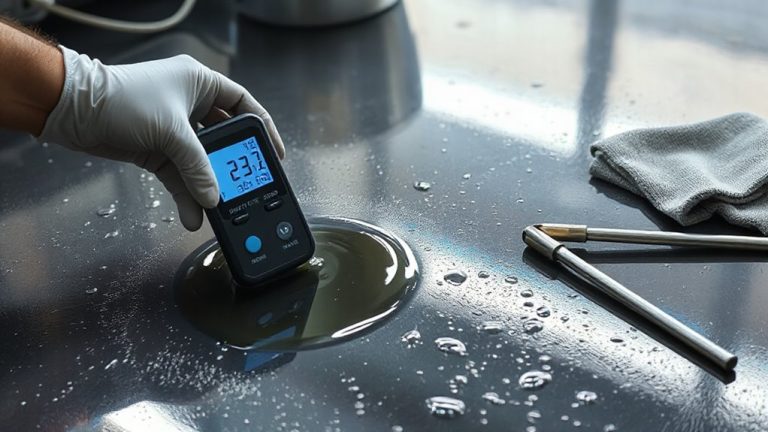
How long should you let the coating sit before wiping it off? Most coatings require a dwell time of 5 to 10 minutes, but this varies based on surface texture and coating thickness. Smooth surfaces like factory paint allow faster curing, needing closer to 5 minutes. Textured or repaired areas slow evaporation, demanding up to 10. Coating thickness directly impacts dwell time-thicker layers need more time to crosslink properly. If applied too thick, solvents get trapped, leading to hazing or stickiness. A uniform, thin layer guarantees consistent curing. Check the manufacturer’s specs: some silica-based coatings cure in 7 minutes at 20°C and 50% humidity. Deviations in temperature or airflow affect timing. Use an IR thermometer to monitor surface temp. Always follow the product’s technical data sheet-it accounts for variables like substrate porosity and ambient conditions. Precise timing guarantees maximum durability and gloss. For best results, choose one of the best car ceramic coatings recommended by experts to ensure optimal performance and longevity.
What Happens If Dwell Time Is Too Short?
You risk compromising the coating’s integrity when you cut dwell time too short. Insufficient curing occurs if the paint protection film doesn’t remain activated long enough, typically less than the recommended 3–5 minutes per panel. Without full chemical cross-linking, the product can’t achieve maximum hardness or scratch resistance. Poor adhesion follows, especially along edges and contours, increasing peeling risk within weeks. The bonding agent fails to micro-anchor into the paint surface, reducing long-term durability. Surface energy levels drop prematurely, weakening molecular attachment. You may also notice hazing or lifting, particularly in high-exposure zones like hoods or mirrors. Real-world tests show coatings applied with shortened dwell time lose up to 40% of abrasion resistance and 60% of adhesion strength. Always follow manufacturer specifications-most require at least 180 seconds at 68–77°F (20–25°C) for proper development of protective properties. Using a high-quality paint sealant kit ensures optimal performance and longevity of the protective layer.
What Happens If Dwell Time Is Too Long?
If the dwell time extends beyond the manufacturer’s recommended window, the activator begins to over-cure on the surface, reducing its ability to bond effectively. You risk chemical degradation, where active ingredients break down and lose potency. Overexposure leads to surface etching, especially on sensitive clear coats or matte finishes. This etching appears as hazy, uneven spots that compromise both appearance and protection. High-pH solutions left too long can alter the paint’s surface energy, measured in dynes/cm, dropping below the ideal 38–42 range needed for adhesion. Once etched, the surface may require polishing-adding time and cost. Unlike removable contaminants, etch marks are permanent damage, not just cosmetic. You’re not just risking effectiveness; you’re endangering the paint itself. Follow technical data sheets: most activators perform best within 2–3 minutes. Exceeding that invites failure. Stick to specs-your coating’s integrity depends on it.
Dwell Time Tips for IPA, Prep Solutions & More
Proper dwell time guarantees ideal surface conditioning without causing damage, especially when working with isopropyl alcohol (IPA), prepping solvents, or decontamination solutions. You must allow 30 to 60 seconds for IPA to evaporate fully, guaranteeing contaminants are neutralized without over-drying the surface. Always use a microfiber applicator for consistent application techniques that prevent streaks and solvent pooling. Surface compatibility is critical-test solvents on inconspicuous areas first, particularly on fresh paint or sensitive clear coats. Some prep solutions require up to two minutes of dwell time but must never be allowed to skin over. Apply in thin, even layers to avoid residue. Never reuse applicators, as trapped contaminants can mar the surface. Follow manufacturer guidelines for concentration ratios-typically 10% IPA for delicate finishes, up to 70% for heavy decontamination. Proper timing and method guarantee a contaminant-free surface ready for paint protection adhesion.
How Weather and Surfaces Affect Dwell Time
While environmental conditions and surface properties may vary, dwell time must be adjusted accordingly to maintain effectiveness. Surface texture directly influences chemical absorption; rougher finishes retain more solution, requiring longer dwell to prevent pooling or runoff. Smooth, factory-applied clear coats need shorter contact-typically 30 to 60 seconds-for maximum decontamination. Environmental humidity above 60% slows evaporation, extending effective dwell by up to 40%. In contrast, dry conditions below 30% humidity may reduce active time, risking incomplete bonding or residue. Always apply prep solutions in shaded areas between 60°F and 85°F. Temperatures outside this range alter viscosity and reaction rates. For example, IPA evaporates 25% faster at 90°F, cutting dwell time nearly in half. Monitor surface texture and environmental humidity closely. Adjustments guarantee complete activation without oversaturation or underperformance. Precision here maximizes adhesion and long-term protection.
On a final note
You must respect dwell time to guarantee best coating adhesion. It typically ranges from 30 seconds to 5 minutes, depending on the prep solution. Too short, and contaminants remain, weakening the bond. Too long, and residue reattaches, creating defects. Humidity above 60% or porous surfaces like matte finishes alter evaporation rates. Always follow manufacturer specs-most isopropyl alcohol (IPA) mixes require exactly 2 minutes. Precision guarantees durability.