The Science Behind Effective Microfiber Material Properties and Selection
You get superior cleaning with microfiber because its split-filament 70% polyester, 30% polyamide fibers create capillary channels that trap grime and wick moisture. Each fiber, split to 0.15–0.2 denier, increases surface area and electrostatic attraction. Tight weaves (500+ threads per square inch) polish, while looser weaves (300–399) absorb more. High fiber density-up to 300,000 fibers per square inch-boosts debris capture. The right blend, weave, and split precision determine performance across surfaces. Discover how these factors align for specific cleaning tasks.
Notable Insights
- Polyamide offers higher tensile strength than polyester, enhancing durability in microfiber cloths.
- Splitting fibers to sub-0.2 denier increases surface area and capillary action for superior cleaning.
- A 70% polyester–30% polyamide blend optimizes absorbency, strength, and wicking performance.
- Weave density directly affects absorbency, with looser weaves offering higher liquid retention.
- Electrostatic attraction and capillary channels enable microfibers to trap dirt, oil, and moisture effectively.
Polyester vs. Polyamide: How Fiber Type Affects Cleaning
While both polyester and polyamide are synthetic microfibers commonly used in cleaning textiles, your choice between them markedly impacts absorbency, durability, and cleaning efficiency. Polyamide offers superior fiber durability, with tensile strength up to 6.5 grams per denier, making it resistant to abrasion and repeated laundering. Polyester, while less durable at 5.0 grams per denier, provides better moisture resistance. For cleaning precision, polyamide’s finer filament structure-often split to 0.15 denier-creates more capillary channels, enhancing liquid and particulate pickup. Polyester fibers, typically split to 0.2 denier, have lower wicking ability. Blends of 70% polyester and 30% polyamide optimize both traits, balancing strength and absorbency. Your application determines the ideal ratio. In high-friction tasks like glass cleaning, polyamide’s durability and precision reduce streaking. For dry dusting, polyester’s stiffness may suffice. Top-performing microfiber towels for car care often use this optimized blend to ensure lint-free results and best microfiber towels for delicate surfaces.
Tight Weave vs. Loose Weave: What’s Best for Absorbency?
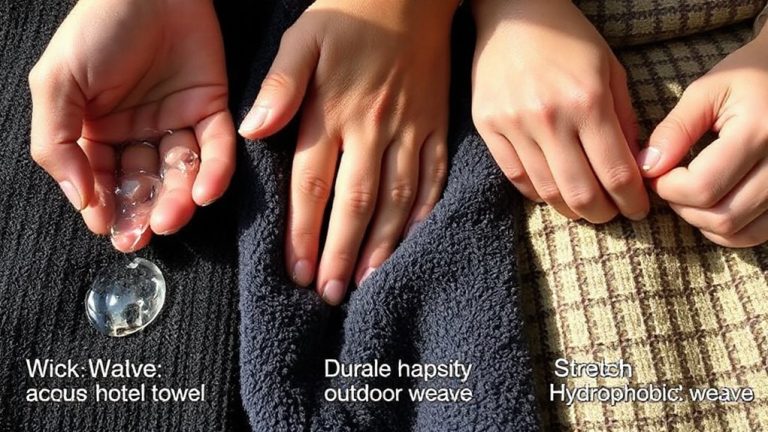
A tightly woven microfiber fabric typically has a thread count of 300 to 600 threads per square inch, creating a dense structure that resists fraying and improves longevity during repeated use and washing. Weave density directly impacts absorbency and cleaning performance. High-density weaves limit fiber spacing, reducing liquid uptake but increasing surface contact for polishing. Loose weaves offer wider fiber spacing, enhancing absorbency by allowing quicker fluid capillary action.
| Weave Type | Weave Density (threads/in²) | Fiber Spacing & Absorbency |
|---|---|---|
| Tight | 500–600 | Narrow spacing, lower absorbency |
| Medium | 400–499 | Balanced spacing, moderate absorbency |
| Loose | 300–399 | Wide spacing, high absorbency |
| Specialty | Varies | Designed for specific tasks |
You’ll choose based on task demands-tight weaves for durability, loose for liquid capture.
How Manufacturing Splits Fibers (And Why It Matters)
Since splitting transforms basic fibers into high-performance strands, understanding this step is key to choosing effective microfiber. Fiber splitting breaks down bundled filaments into finer, multi-stranded structures-often yielding fibers as thin as 1/100 the diameter of a human hair. This process increases surface area dramatically, enhancing cleaning efficiency. Splitting occurs during manufacturing through chemical or mechanical means, requiring precise control to avoid damage. Manufacturing precision guarantees uniform splits, consistent texture, and maximum fiber distribution. Poor precision leads to clumping, reduced absorbency, and premature shedding. High-grade microfiber typically uses a 70/30 polyester-polyamide blend, split into 8 or 16 segments per fiber. These micro-channels create capillary channels that wick liquids effectively. You rely on this engineered structure every time you wipe a surface. Proper fiber splitting directly influences durability, lint-free performance, and cleaning effectiveness-making it a core factor in material selection.
Why Microfiber Traps More Grime Than Regular Cloth
Because microfiber’s split structure creates an immense surface area lined with tiny channels, it grabs and holds more grime than regular cloth. Each fiber is split into strands thinner than 1 denier, increasing contact points that lift and trap dirt. The ultra-fine fibers generate electrostatic attraction, pulling dust, oils, and microscopic particles like a magnet. This charge enhances pickup on both dry and damp surfaces. Unlike cotton, which relies on surface abrasion that can scratch or smear, microfiber embeds grime deep within its matrix. Its split fibers form capillary channels that wick moisture and debris away from surfaces. You get more effective cleaning with less effort. High-quality microfiber, typically 80% polyester and 20% polyamide, maintains this performance after hundreds of washes. The result is a cloth that doesn’t just move dirt-it captures and contains it. Top-performing options often come as part of a car microfiber towel kit, offering multiple textures and weights for different detailing tasks.
Match the Cloth to the Job: Microfiber for Glass, Floors, and More
You’ve seen how microfiber traps grime better than regular cloth-now it’s time to put that performance to work in the right places. For glass cleaning, use a microfiber cloth with high fiber density-over 200,000 fibers per square inch-to lift smudges without streaks. The fine fibers reduce cleaning pressure needed, preventing scratches on delicate surfaces. For floors, choose a heavy-duty weave with a fiber density near 300,000 fibers per square inch; it grabs dust and debris effectively. These cloths withstand high cleaning pressure during mopping or wiping. In kitchens or bathrooms, medium-density cloths (around 180,000 fibers per square inch) balance absorbency and scrubbing power. Color-coding prevents cross-contamination. Always match fiber density to surface sensitivity. Low cleaning pressure suits glass, while floors demand aggressive pressure. Microfiber adapts-when engineered correctly-to every cleaning task.
On a final note
You make smarter cleaning choices by understanding microfiber composition. Polyester resists wear, enduring 300+ washes; polyamide absorbs up to seven times its weight in water. Split fibers create capillaries that wick liquids via capillary action. A 70/30 polyester-polyamide blend optimizes durability and absorbency. Tight weaves (200+ gsm) trap fine dust; open weaves lift moisture fast. Match weave and blend to task for maximum efficiency.