Tuning ECU Fueling for Hybrid E85/Gasoline Blends Using Real-Time Ethanol Sensors
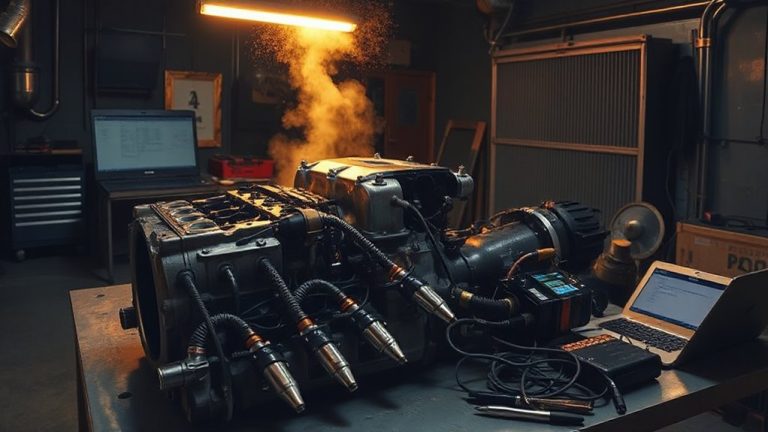
You can tune your ECU for hybrid E85/gasoline blends using a real-time ethanol sensor that measures fuel alcohol content. Sensors like the AEM 30-4100 output 0–5V or CAN signals compatible with most aftermarket ECUs. The ECU uses this data to adjust fuel pulse width and ignition timing, maintaining a 9.8:1 AFR for E85 or 14.7:1 for gasoline. Closed-loop control responds in under 100 ms, optimizing performance and preventing knock as blends shift. Accurate detection from E0 to E85 guarantees stoichiometry and enables aggressive timing above 30% ethanol, where octane gains reduce knock risk. Proper sensor placement in the return line guarantees consistent sampling. Calibration tables scale injector duty and spark curves dynamically, preserving engine safety and efficiency. A well-integrated system adapts seamlessly across fuel types, maximizing power without compromise-understanding the tuning workflow reveals how each component interacts for peak results.
Notable Insights
- Real-time ethanol sensors enable dynamic ECU adjustments by measuring alcohol content in the fuel stream.
- Sensor signals (0–5V, PWM, or CAN) must be compatible with ECU input requirements for accurate data transmission.
- ECU calibration tables use ethanol percentage to adjust fuel pulse width and maintain stoichiometry across all blends.
- Higher ethanol content allows advanced ignition timing due to increased knock resistance, optimized in real time.
- Fast response ECUs adapt fueling and timing within 100 ms to prevent lean/rich conditions during blend transitions.
How Ethanol Sensors Enable Dynamic Flex-Fuel Tuning
How do you maintain ideal engine performance when the fuel blend in your tank could be 30% ethanol one day and 85% the next? Real-time ethanol detection makes it possible. Modern flex-fuel systems use an ethanol sensor to measure the exact alcohol content in the fuel stream. The sensor sends this data to your ECU, triggering instant adjustments. Accurate ethanol detection allows dynamic fuel mapping, altering injector pulse width and ignition timing to match the blend. E85 has higher octane but lower energy density, so you need 25–30% more fuel by volume. Without proper fuel mapping, you risk lean conditions or poor drivability. With precise ethanol detection, the ECU recalibrates continuously, maintaining stoichiometry. This guarantees peak combustion, power, and efficiency regardless of blend. The result? Smooth shifts between gasoline and high-ethanol mixes, engine protection, and peak performance-all managed autonomously through intelligent fuel mapping.
Pick an Ethanol Sensor Compatible With Your ECU
Your ECU’s ability to adapt to changing fuel blends hinges on the ethanol sensor you choose. Sensor compatibility is critical-select a sensor that matches your ECU’s input requirements, whether it expects a 0–5V analog signal, PWM output, or CAN bus communication. Many aftermarket ECUs support universal ethanol sensors like the AEM 30–4100 or Innovate MTX-L, which output a linear voltage corresponding to ethanol content (0%–100%). Verify the sensor operates within your fuel system’s alcohol tolerance, typically up to E100. Poor ECU integration leads to inaccurate fueling adjustments and potential engine damage. Install the sensor in the return line or rail for consistent sampling. Confirm that your ECU can accept real-time ethanol percentage data and adjust stoichiometry and ignition timing accordingly. Always verify sensor response time-under 1 second-so tuning changes keep pace with fuel shifts.
Program Your ECU for Real-Time Ethanol Input
What happens when the ethanol content in your fuel changes mid-drive? Your engine needs immediate adjustments to maintain peak performance. You must program your ECU to accept real-time ethanol input so it can dynamically alter fuel mapping and ignition timing. Without this, your engine may run too rich or too lean, risking damage. Modern ECUs support flex-fuel integration, letting you define ethanol percentage thresholds that trigger specific tuning changes.
| Ethanol % | Fuel Mapping Adjustment | Ignition Timing Shift |
|---|---|---|
| 0–30% | Slight increase in pulse width | +1–2° advance |
| 31–70% | Moderate enrichment | +3–5° advance |
| 71–100% | Significant enrichment | +6–9° advance |
You’ll use calibration tables to match fuel delivery and spark to ethanol levels. Real-time sensor feedback guarantees accuracy. This setup keeps combustion efficient and safe, no matter the blend.
Tune Air-Fuel Ratios for Any E85 Blend
When ethanol concentration shifts in your fuel blend, air-fuel ratios must adapt in real time to maintain ideal combustion. Ethanol requires a richer mixture than gasoline, so your engine’s fuel mapping must adjust accordingly. The stoichiometric balance for E85 is about 9.8:1, compared to 14.7:1 for pure gasoline. Without dynamic tuning, you’ll risk running too rich or too lean. Real-time ethanol sensors feed data to your ECU, enabling immediate corrections to injector pulse width. This guarantees precise air-fuel ratios across all blend levels-from E0 to E85. Modern ECUs use adaptive fuel mapping strategies that scale injector output based on ethanol content. You get consistent combustion, peak power, and improved emissions control. Accurate stoichiometric balance isn’t optional-it’s essential for performance and reliability. Proper tuning turns variable fuel blends into a seamless operating experience.
Prevent Knock and Boost Power Automatically
Why leave power on the table or risk engine damage when the fuel changes? Modern ECUs use real-time ethanol sensors to prevent knock and boost power automatically. When ethanol content hits a certain ethanol threshold-typically above 30%-the system capitalizes on E85’s higher octane. You gain the ability to run more aggressive timing and increased boost without detonation. Advanced knock detection continuously monitors engine acoustics using piezoelectric sensors. If knock is detected, the ECU retards ignition timing in milliseconds. Simultaneously, fuel maps adjust to enrich the mixture, cooling combustion temps. These closed-loop responses happen within 50–100 milliseconds. The result? You safely extract maximum performance across any E85/gasoline blend. No manual tuning needed. Power delivery stays smooth, engine integrity remains intact. It’s like having an onboard performance engineer watching every combustion event, ensuring ideal output without compromise.
On a final note
You now have full control over fuel delivery for any E85-gasoline blend. Modern ethanol sensors, like the Bosch LSU 4.9, detect ethanol content within ±2% accuracy in real time. Your ECU uses this data to adjust air-fuel ratios, maintaining stoichiometry-14.7:1 for gasoline, 9.8:1 for E85. This prevents knock and optimizes power. Automatic enrichment guarantees safe tuning across all blend levels, just as a thermostat regulates temperature.