Flashing the ECU on a Porsche 991.2 Carrera for Track-Focused Fueling
Your 991.2’s stock ECU limits track performance with conservative fueling, capping air-fuel ratios at 11.8:1 under WOT and triggering thermal throttling after two laps. A custom ECU flash recalibrates injector pulse widths and lambda targets to maintain 11.2:1–11.8:1 ratios, preventing lean spikes at 6,000+ RPM. It stops timing retard by improving combustion stability and sustains 18 psi boost without lag. You gain 40–50 hp safely on stock hardware. Proper tuning keeps EGTs in check and preserves turbo longevity. Ideal calibration includes real-time data logging and cooldown enrichment strategies you’ll want to understand before pushing limits.
Notable Insights
- Stock ECU tuning limits track performance with conservative fueling and thermal management strategies.
- ECU flashing optimizes air-fuel ratios to 11.2:1–11.8:1 for better combustion and reduced exhaust temperatures.
- Custom tunes eliminate high-RPM lean conditions and prevent knock-induced timing retardation.
- Flashing recalibrates throttle response and ignition timing for rapid, consistent track inputs.
- Professional flashing includes dyno validation and data logging to ensure reliability under sustained load.
Why the 991.2’s Stock ECU Can’t Handle Track Stress
While Porsche designed the 991.2 Carrera’s ECU to balance performance, emissions, and daily drivability, it wasn’t built to endure the sustained high-load conditions of track use. You’ll notice degraded throttle response after several laps, as the ECU prioritizes thermal protection over performance. It relies on conservative sensor calibration to prevent knock and overheating, limiting boost and ignition timing under prolonged stress. The stock air-fuel ratio targets-around 11.8:1 under wide-open throttle-can overheat the turbochargers and exhaust components during extended high-RPM operation. Factory throttle maps are tuned for smooth street delivery, not rapid pedal inputs on track. The ECU’s closed-loop corrections, meant for variable driving conditions, can’t adapt quickly enough to consistent high load. This mismatch between design intent and track demands leads to reduced power output and potential long-term sensor calibration drift. You’re effectively driving with built-in compromises that hurt track performance.
How ECU Flashing Fixes Fueling Under High Load
You can eliminate the fueling limitations of the stock ECU by recalibrating its internal maps through a custom flash. The factory tune restricts fuel delivery under sustained high load, often triggering lean conditions above 6,000 RPM. These lean conditions increase combustion temperatures, risking detonation. When the ECU detects knock, it institutes timing retardation-sometimes pulling 6–8 degrees of ignition timing-robbing power and efficiency. A performance flash adjusts fuel trims and injector pulse widths to maintain stoichiometric balance, even during extended high-RPM operation. It also recalibrates lambda targets and O2 sensor feedback to prevent over-corrections. By optimizing air-fuel ratios across load and RPM ranges, you eliminate dangerous lean blips. Proper fueling reduces the likelihood of timing retardation, preserving peak output. The result is consistent power delivery, improved throttle response, and safer track operation-all without altering hardware.
Balance Power Gains With Long-Term 991.2 Reliability
Tune intelligently to get more power without sacrificing the 991.2’s renowned durability. Aggressive tuning increases output, but unchecked changes accelerate engine wear and elevate thermal stress. The 991.2’s 3.0L twin-turbo flat-six relies on precision calibration to manage combustion temperatures and load. Exceeding factory thermal thresholds, especially during track use, risks pre-ignition and detonation. You need a tune that respects OEM safety margins-retaining protective strategies like adaptive knock control and charge-cooler monitoring. Increased boost or leaner mixtures may raise peak power, but sustained high exhaust gas temperatures degrade piston rings and turbochargers over time. A well-modulated ECU map balances performance with longevity, using real-time data logging to avoid borderline conditions. Thermal stress accumulates with repeated high-load cycles, so your tune must include cooldown strategies and fuel enrichment where needed. Protect the engine’s integrity-because power means nothing without reliability.
Choose the Right ECU Tune for Your Track Use
Every track-focused 991.2 Carrera owner faces a critical decision: how aggressively to tune the ECU without compromising durability under extreme conditions. Your ideal tune balances power delivery, thermal management, and long-term reliability. Track tuning demands precise fuel optimization to handle sustained high-RPM operation. Without it, lean conditions can cause detonation and engine damage. You’ll need a tune that adjusts air-fuel ratios to maintain 11.2:1 to 11.8:1 under load, ensuring peak combustion and cooling. Torque delivery should be linear, with boost pressure stabilized near 18 psi to avoid lag and spikes. Most professional maps recalibrate throttle response and ignition timing for circuit use. These modifications must align with your car’s stock hardware limits. A conservative yet effective tune gains 40–50 hp while preserving turbocharger and DFI system life. Choose accordingly.
Inside a Professional ECU Flash: What to Expect
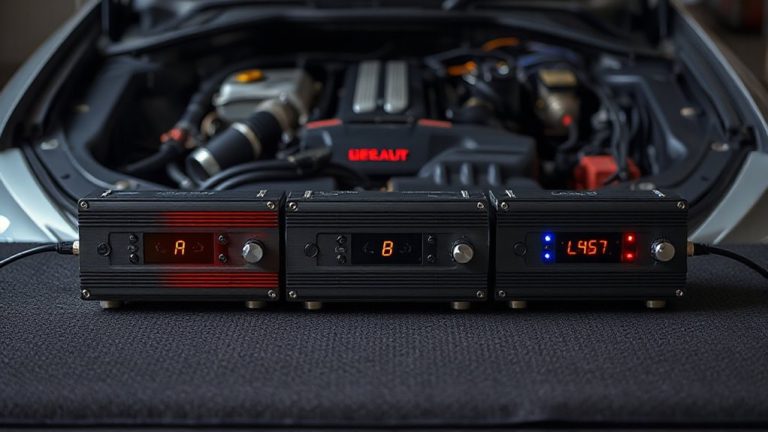
While the engine remains off and the car sits idle, a professional ECU flash begins with connecting a high-speed diagnostic interface-typically via the OBD-II port beneath the dashboard. The technician loads your custom tune onto the ECU using calibrated software, preserving stock safety parameters while optimizing fuel trims. You’ll then move to dyno testing, where the car runs under controlled load to validate power output and air-fuel ratios. Real-time data logging captures combustion efficiency, ignition timing, and boost behavior across RPM bands. Adjustments fine-tune fuel delivery for high-temperature track conditions. The process repeats in iterative cycles-flash, test, log-until peak performance and safety align. Final verification guarantees lambda values stay within 0.85–0.92 under wide-open throttle. No guesswork: every change is measured, repeatable, and traceable to track demands.
Red Flags Your 991.2’s Fuel Map Needs Adjusting
How’s your 991.2 responding under hard throttle? If it hesitates or surges unpredictably, you might be experiencing fuel starvation. This often occurs when the factory fuel map can’t keep up with increased airflow from track demands. The engine control unit (ECU) relies on input from the oxygen sensor to adjust the air-fuel ratio in real time. A skewed or sluggish oxygen sensor reading can mislead the ECU, causing lean conditions under load. You’ll notice misfires, elevated exhaust temps, or a sharp drop in wideband lambda values-especially above 5,000 RPM. These aren’t just annoyances; they’re warning signs. Prolonged lean operation risks detonation and piston damage. A properly tuned fuel map recalibrates injector pulse widths and correlates oxygen sensor data with throttle position and load. Think of it as precision hydration for your engine-delivering fuel exactly when and where it’s needed.
On a final note
You need an ECU flash to optimize fuel delivery under sustained high-RPM loads. Stock maps run overly rich, hurting throttle response and increasing intake temps. A calibrated tune adjusts AFR to 11.8–12.2:1 under full load, improving combustion efficiency. It maintains factory safety thresholds, including detonation control and lambda correction. This preserves engine longevity while accessing consistent 30–40 ft-lbs of torque. The system retains OEM OBD-II compliance and adapts in real time to fuel quality.