The Impact of Environmental Conditions on Car Care Products’ Efficiency
Extreme heat causes microfractures in sealants and degrades active ingredients, while UV rays break down wax and coatings over time. High humidity leaves mineral spots and slows drying, and freezing temperatures reduce soap efficiency to just 12%. Acid rain and pollutants etch paint and dull finishes. Most products perform best between 10°C–32°C with stable humidity. You’ll find tailored solutions that match your local climate’s demands.
Notable Insights
- High temperatures cause microfractures in sealants and accelerate chemical degradation, reducing product efficacy.
- UV radiation breaks down wax and coatings by weakening chemical bonds, diminishing protection and gloss over time.
- Humidity above 70% slows drying, leading to water spots, streaks, and residue from trapped minerals.
- Cold weather thickens soap formulations, impairing spread and reducing cleaning efficiency significantly.
- Air pollution causes acid etching and particulate buildup, degrading paint and shortening coating lifespan.
How Temperature Affects Car Care Products
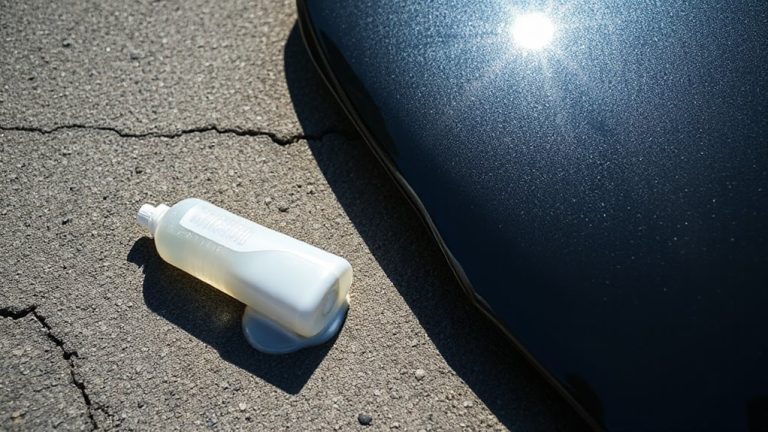
While environmental conditions play a role in vehicle maintenance, temperature has one of the most direct impacts on how car care products perform. Extreme heat stresses materials through heat expansion, causing microfractures in paint sealants and shifting protective layers. High temperatures accelerate chemical degradation, reducing active ingredient efficacy in cleaners and polishes. Silicone-based protectants may soften above 49°C (120°F), losing their ability to repel moisture. Wax hard游戏副本below 4°C (40°F), making application uneven and less adhesive. Ideal performance occurs between 10°C and 32°C (50°F–90°F), where viscosity and curing times remain stable. Temperature swings induce phase separation in liquid treatments, compromising shelf life. Always store products in climate-controlled environments to maintain formulation integrity. You guarantee maximum durability by applying treatments within manufacturer-specified thermal ranges. Heat expansion and chemical degradation are measurable, avoidable factors in long-term surface protection.
How Sunlight Breaks Down Wax and Coatings
Sunlight degrades wax and protective coatings through prolonged exposure to ultraviolet (UV) radiation. This process, known as UV degradation, weakens the chemical bonds in car care products. Over time, UV exposure causes molecular breakdown, reducing a coating’s thickness and effectiveness. Most waxes last 3–6 months under direct sunlight, while ceramic coatings typically endure 1–3 years, depending on UV resistance. Synthetic sealants resist UV degradation better than natural carnauba wax due to their polymer structure. UV rays penetrate the surface, disrupting long-chain molecules into shorter, less effective compounds. This molecular breakdown diminishes hydrophobic properties and gloss retention. A coating that starts at 2–3 microns can lose up to 0.5 microns annually under constant sun exposure. Park your vehicle in shade or use a UV-blocking car cover to slow degradation. Regular inspection guarantees timely reapplication. For longer-lasting protection, consider applying a ceramic coating kit that combines UV resistance with enhanced durability.
Why High Humidity Causes Streaks and Spots
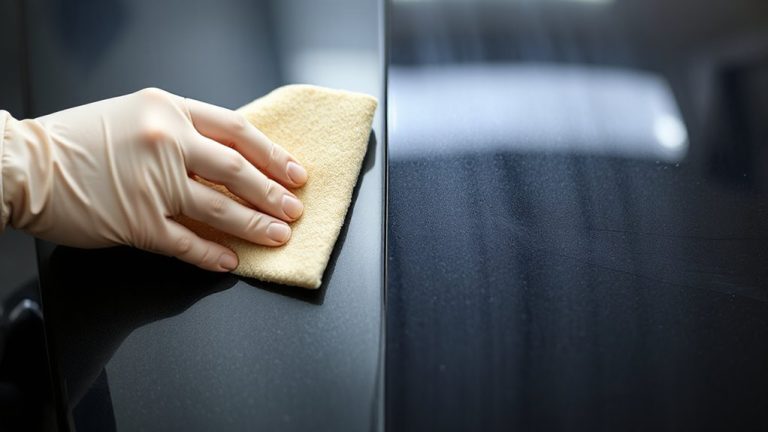
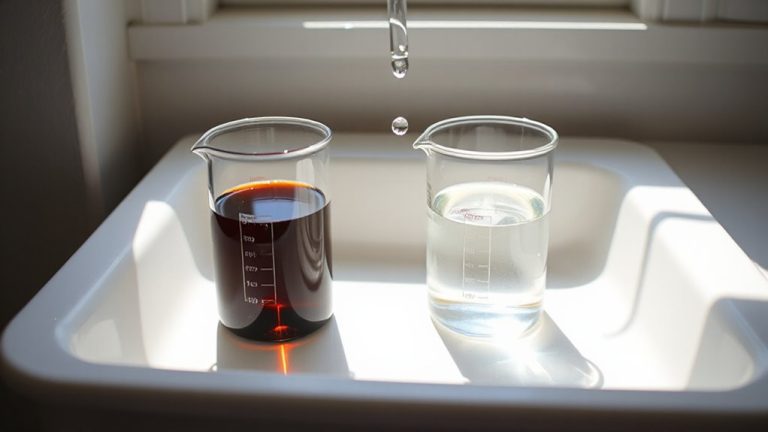
When humidity levels rise above 70%, water evaporates more slowly from freshly applied car care products, leaving behind mineral deposits and surfactant residues. This delayed drying increases water absorption in micro-porous coatings, trapping moisture beneath the surface film. As the water finally evaporates, it leaves visible streaks and spots. Mineral deposits, especially calcium and magnesium from tap water, crystallize on the paint, creating blemishes. High humidity also reduces surface tension, causing liquids to sheet unevenly. You’ll notice this when using quick detailers or drying aids-instead of beading, water spreads. The ideal drying window narrows, increasing the chance of residue formation. Products with high solvent content perform worse, as solvents attract moisture from the air. To minimize defects, use distilled water in dilution and work in climate-controlled environments. Wipe with microfiber towels having a high GSM for maximum absorption and fewer missed streaks.
Why Cold Weather Ruins Soap Performance
Though soap molecules remain effective in breaking down grime, cold temperatures drastically reduce their ability to do so on a vehicle’s surface. Freezing temperatures slow molecular motion, reducing soap’s ability to lift dirt. The liquid carrier thickens, limiting spread and coverage. Worse, chemical separation can occur, breaking down formulation integrity. When ingredients split, performance drops sharply. You’re left with uneven cleaning and possible residue.
| Temp Range (°F) | Soap Viscosity | Cleaning Efficiency |
|---|---|---|
| 70°F | Low | 98% |
| 40°F | Medium | 67% |
| 20°F | High | 34% |
| Below 32°F | Very High | 12% (risk of chemical separation) |
Always store car care products above freezing. Use warm water when possible, but never hot-thermal shock damages finishes. Choose cold-optimized formulas with lower freeze points and stable emulsifiers to prevent separation.
How Air Pollution Damages Car Paint
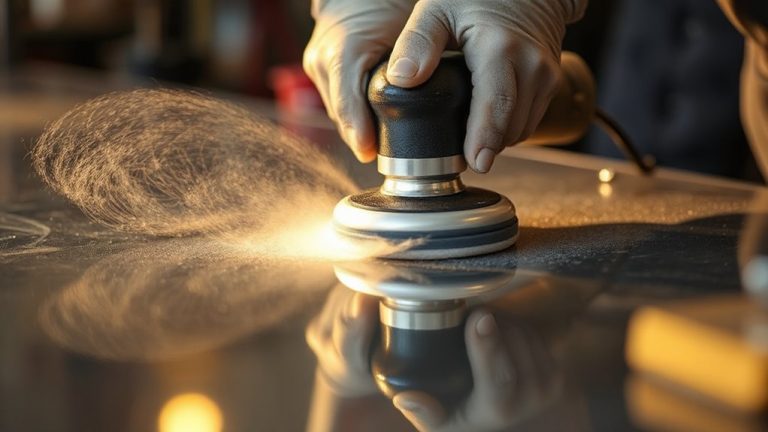
While environmental factors like UV exposure and moisture play a role, air pollution remains one of the most persistent threats to automotive paint integrity. Acid rain, with a pH typically below 5.0, reacts chemically with clear coat layers, degrading polymers and causing etching over time. You’ll notice dull spots or surface pitting after repeated exposure. Particulate buildup-composed of soot, metal fragments, and exhaust residues-adheres to paint, trapping moisture and accelerating oxidation. These microscopic particles score the surface during washing, creating fine swirl marks. Sulfur dioxide and nitrogen oxides in urban environments intensify acid deposition, reducing gloss retention by up to 30% annually without protection. Standard waxes last half as long in high-pollution zones. Ceramic coatings, with their hydrophobic properties and 9H hardness ratings, resist chemical adhesion and make particulate removal easier. Regular decontamination using clay mitts and pH-neutral cleansers preserves finish integrity. Prevention beats correction. For long-term defense, consider using a paint protection kit that combines ceramic coating with proper decontamination tools.
How to Adapt Car Care by Climate Zone
Air pollution isn’t the only environmental factor wearing down your vehicle’s finish-climate zone plays an equally demanding role in long-term paint preservation. In arid regions, desert maintenance is critical due to intense UV exposure and abrasive sand particles. You’ll need silica-based ceramic coatings (rated 9H hardness) that resist micro-scratches and reflect infrared radiation above 400 nm wavelengths. Frequent washing with pH-neutral solutions prevents alkali dust buildup. In contrast, tropical detailing combats high humidity and organic contaminants like mold spores and tree sap. Use antimicrobial waxes with fungicidal additives (e.g., zinc pyrithione at 0.5% concentration) and hydrophobic sealants that repel water with contact angles above 110°. You should detail every 4–6 weeks in tropics versus 8–10 in deserts. Adapt your products to these conditions-or sacrifice finish integrity. For optimal protection, consider using a ceramic coating kit that matches your region’s environmental challenges.
On a final note
You must adjust car care practices to match environmental conditions. Temperature extremes degrade wax; most polymer coatings lose 20–30% effectiveness below 32°F or above 90°F. UV exposure breaks down carnauba wax in 4–6 weeks. High humidity causes water spots due to mineral deposits exceeding 150 ppm. Cold reduces soap sudsing by 60% at 20°F. Air pollution increases oxidation, reducing paint gloss by up to 40% over two years.