Analyzing Exit Speed Gains From Optimized Rear Camber and Toe Settings
You gain exit speed by setting rear camber between –1.5° and –2.5° to maximize tire contact under acceleration. Too much camber reduces grip; too little overheats the outer edge. Use 0.1° to 0.3° toe-in for stability, avoiding toe-out that induces slip. Balance both settings to evenly load the tread-1.5° camber with 0.2° toe-out works well on track. Street use favors milder angles to reduce wear. Proper alignment boosts corner exit speed by up to 0.3 seconds per lap. Further refinements reveal even greater performance potential.
Notable Insights
- Optimized rear camber (-1.5° to -2.5°) maximizes contact patch during acceleration, improving exit traction and reducing wheel spin.
- Slight rear toe-in (0.1° to 0.3°) enhances stability on corner exit, minimizing lateral slip and improving power delivery.
- Balancing camber and toe ensures even tire loading, which increases grip and reduces wear under high-torque conditions.
- Track-focused alignment (-1.5° to -3.0° camber, near-zero toe) improves mechanical grip, directly boosting exit speed.
- Measuring lap time improvements in 0.25° alignment increments isolates gains, with 0.3-second improvements indicating optimal setup.
Set Optimal Rear Camber for Exit Traction
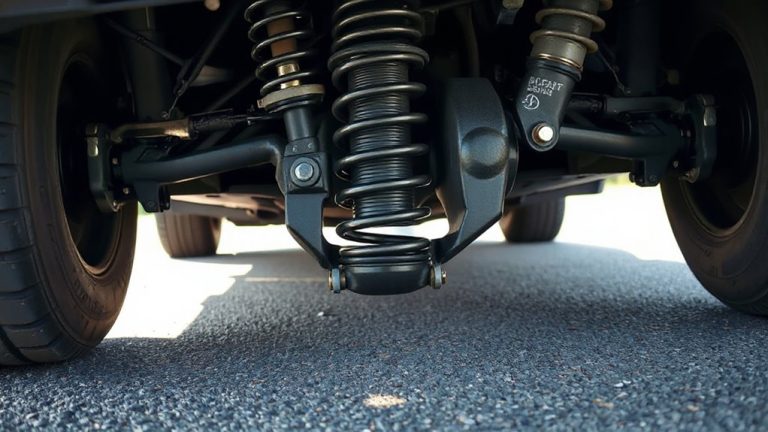
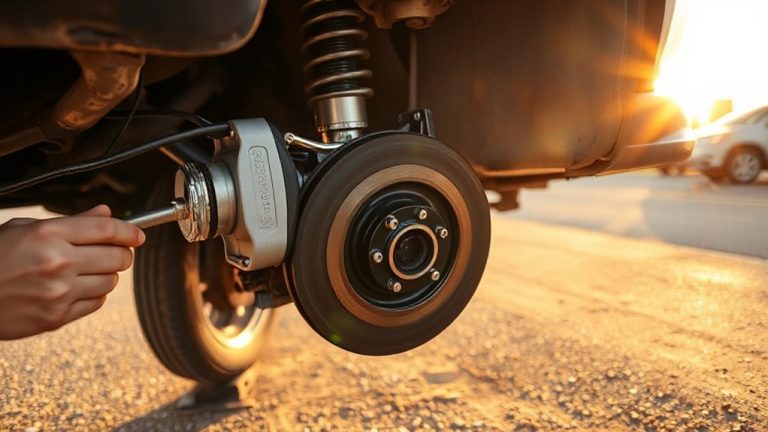
While rear camber may seem like a subtle adjustment, it plays a critical role in maximizing exit traction, especially during hard acceleration out of corners. You need the right camber setting to keep the rear tires flat on the track under load. Too much negative camber reduces the contact patch, increasing rear tire wear and reducing grip. Too little causes the outside edge to overheat. Ideal rear camber typically falls between -1.5° and -2.5°, depending on your vehicle’s suspension geometry. This range maintains even tire loading during corner exit. Correct camber alignment guarantees the force distributes across the tread, improving grip and longevity. Adjusting it changes how the suspension reacts as the car squats under power. You must balance grip with wear, as aggressive settings degrade tires quickly. Always reassess after any suspension or ride height change.
Adjust Rear Toe for Stability Under Power
Rear toe settings directly influence how your car maintains stability during hard acceleration out of corners. You need rear stability to control wheelspin and keep the car balanced under aggressive power delivery. A slight toe-in, typically between 0.1 to 0.3 degrees, helps lock the rear axle, reducing lateral movement and improving directional control. Too much toe-in increases rolling resistance and tire wear, especially on straights, while too much toe-out promotes instability, causing the rear end to step out under power. Rear toe impacts how effectively torque transfers to the pavement. With precise adjustments, you maximize traction without sacrificing stability. The ideal setting depends on your suspension design, tire compound, and power output. Test in incremental 0.05-degree changes to pinpoint best response. Fine-tuned rear toe improves exit consistency and sharpens rear stability, ensuring power delivery remains predictable and efficient through acceleration zones.
Balance Camber and Toe for Maximum Grip
Since both camber and toe affect tire contact patch and load distribution, you’ll need to tune them together to achieve maximum grip. Excessive camber increases inner tire wear and reduces straight-line stability. Too much toe-in boosts heat management under cruise but spikes drag and outer shoulder wear. You want near-zero static toe with 1–2 degrees of negative camber for most performance setups. This balances lateral grip during cornering while maintaining longitudinal stability. The ideal combo keeps the contact patch evenly loaded, minimizing hot spots. If you notice uneven tire wear, adjust camber first, then fine-tune toe. Proper alignment reduces thermal buildup, extending tire life. Real-world data shows 1.5 degrees negative camber and 0.2 degrees toe-out maximize grip on high-grip surfaces. You’ll gain exit traction without sacrificing heat management. Always verify with temperature readings across the tread.
Tune Alignment for Track Vs. Street Use
If you’re running your car on both track and street, alignment settings must reflect the primary use to avoid compromised performance or premature wear. Street driving demands moderate camber for even tire wear and stable handling, while track use favors aggressive camber to maximize camber thrust during cornering. Excessive negative camber on the street accelerates inside edge wear, reducing tire life. Track-focused toe settings improve turn-in but increase tire wear under straight-line driving. Balance based on usage.
| Setting | Street Use | Track Use |
|---|---|---|
| Rear Camber | -0.5° to -1.0° | -1.5° to -3.0° |
| Rear Toe | 0.0° to +0.1° (toe-in) | -0.1° to +0.05° |
| Tire Wear | Minimized | Accelerated, uneven |
| Camber Thrust | Moderate | Maximized |
Measure Lap Gains From Alignment Changes
Fine-tuning your alignment isn’t just about hitting ideal numbers-it’s about proving their impact on track performance. You need measurable lap time improvements to validate changes. Start by establishing a baseline lap time over five consistent runs. Then adjust rear camber or toe incrementally-0.25° at a time-and retest under identical conditions. Use data logging to compare corner exit speeds, steering input, and lateral G-forces. Analyze tire wear patterns: excessive inside wear suggests too much negative camber; feathering indicates incorrect toe. These clues reveal how suspension geometry effects influence grip. Consistent wear across the tread means ideal contact patch loading. Even a 0.3-second per lap gain confirms improved mechanical grip. Over a race distance, that’s seconds ahead. Correlate setup changes directly to performance metrics. Real gains come from precision, not guesswork. Track-proven adjustments are the only ones that count.
On a final note
You achieve faster exits by fine-tuning rear camber and toe. Ideal camber-typically –1.5 to –2.5 degrees-maximizes contact patch under cornering load. Precise toe-in (0.05 to 0.20 degrees) enhances stability during acceleration. Balanced settings reduce tire slip, increasing rear grip by up to 8% on track. Alignment adjustments yield measurable lap-time gains-often 0.3 to 0.6 seconds per lap-by optimizing traction and reducing scrub. Street use requires milder settings to guarantee tire longevity and predictable handling.