The Relationship Between Suspension Components and Overall Ride Quality
Your suspension components work together to balance comfort and control. Springs with rates of 150–300 lb/in absorb bumps, while shocks manage up to 1,200 psi to dampen motion. Coil and air springs maintain ride height under load. Control arms and rubber bushings reduce vibration transfer. Proper alignment within ±0.10 inches of toe prevents uneven wear. Worn parts disrupt harmony, hurting stability. When components are matched and maintained, you get smoother, safer performance-discover how each part contributes to the overall experience.
Notable Insights
- Springs absorb road impacts, with proper spring rate ensuring balanced comfort and handling.
- Shocks and struts dampen motion, converting kinetic energy into heat to reduce vibrations and body sway.
- Control arms and bushings maintain alignment and filter high-frequency road shocks for smoother rides.
- Bushing material affects noise isolation; rubber offers better vibration damping than stiffer polyurethane.
- Proper alignment and maintenance prevent uneven tire wear and preserve ride stability and comfort.
How Suspension Systems Improve Ride Comfort
While your vehicle rolls over uneven pavement, the suspension system works to isolate you from bumps and vibrations. Its primary role is vibration isolation, reducing the energy transferred from road surfaces to the cabin. Springs absorb impact forces, while rubber bushings and isolators minimize high-frequency oscillations. Cushioning performance depends on spring rate, damping characteristics, and component alignment. Coil springs, typically rated between 150–300 lb/in, compress to manage vertical loads. Air springs offer adjustable stiffness, maintaining consistent ride height under variable loads. The suspension geometry-defined by camber, caster, and toe settings-guarantees tires maintain contact for stability. Effective vibration isolation improves comfort by limiting peak accelerations felt by occupants. Systems using hydraulic subframes or mass dampers further suppress resonant frequencies. Overall, precise engineering of these components guarantees superior ride comfort without sacrificing handling. Upgrading to high-performance best strut brands can significantly enhance damping control and long-term ride quality.
How Shocks and Struts Enhance Ride Quality
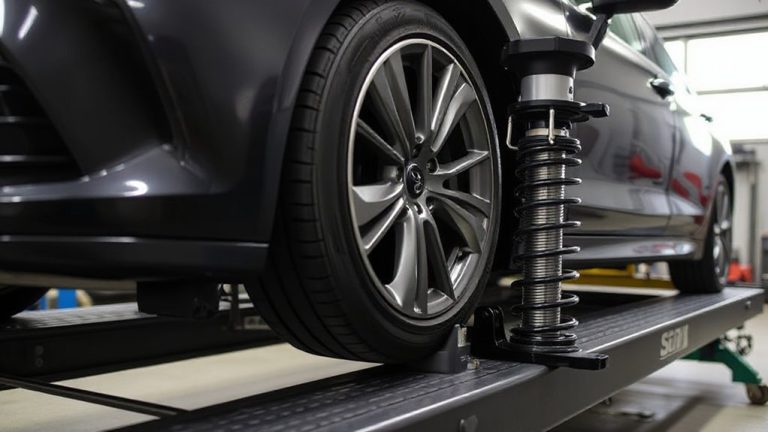
When your car hits a bump, shocks and struts don’t just smooth the jolt-they control the entire motion of the suspension. They resist bounce, roll, and dive through hydraulic damping. Ride smoothness depends on how effectively these components convert kinetic energy into heat. Most shocks use a piston and valving system to regulate fluid flow, typically managing 800–1,200 psi under impact. Struts, which combine a shock and structural support, enhance steering precision while improving impact absorption. Gas-charged units reduce foaming, maintaining consistent performance at high speeds. Dual-tube designs offer comfort on daily drives, while monotube shocks deliver superior heat dissipation for aggressive driving. Without proper damping, tires lose contact with the road. Quality shocks reduce body sway by up to 30%, enhancing stability. Modern struts often include rebound springs and adjustable damping, letting you fine-tune ride quality without sacrificing control. For Jeep Wrangler owners, selecting the best shocks for Jeep Wrangler can significantly improve off-road performance and everyday comfort.
How Springs Impact Ride Quality and Handling
Springs play a fundamental role in how your vehicle handles and how smooth the ride feels. They support the vehicle’s weight and absorb road impacts, directly influencing both comfort and control. The spring rate-measured in pounds per inch-determines how stiff or soft the ride is. A higher spring rate means the spring resists compression more, improving handling but potentially reducing comfort. Load capacity refers to the maximum weight a spring can support without deforming. Exceeding it causes sagging and poor alignment. Coil springs are common in front suspensions, typically with linear spring rates, while leaf springs, often in trucks, offer progressive rates and high load capacity. Air springs allow adjustable spring rate and load capacity, adapting to varying payloads. Properly matched springs maintain ride height and suspension geometry, ensuring tires stay in contact with the road. Installing a suspension lift kit can alter spring dynamics and ride quality significantly.
How Control Arms and Bushings Improve Comfort
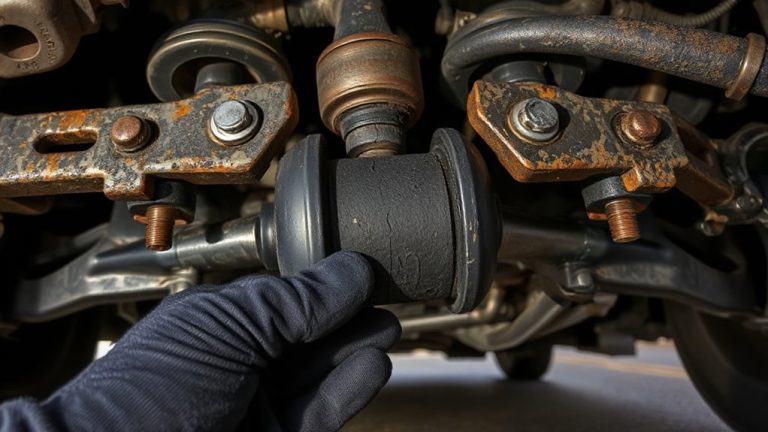
You rely on your vehicle’s control arms and bushings more than you might realize to deliver a smooth, comfortable ride. Control arm design directly affects how forces from the road are transferred to the chassis. Well-engineered control arms use forged steel or stamped aluminum to balance strength and weight, minimizing unsprung mass. They pivot smoothly through bumps, maintaining tire contact and reducing vibrations. Bushing material plays a vital role in isolating noise and harshness. Modern bushings use rubber compounds or polyurethane, each offering distinct trade-offs in flexibility and durability. Rubber bushings provide superior vibration damping, while polyurethane resists deformation over time. Together, precise control arm geometry and resilient bushing material reduce high-frequency shocks and lateral movement. This combination enhances ride comfort by filtering out road imperfections without sacrificing structural integrity. You feel less fatigue on long drives because these components work silently and continuously to absorb disturbances.
Why Alignment Is Critical for Ride Quality
Proper wheel alignment isn’t just about keeping tires from wearing too quickly-it directly shapes how your vehicle handles and how smooth the ride feels. Misaligned wheels can cause uneven tire wear, cutting tire life by as much as 30% and increasing rolling resistance. Incorrect camber angles-even just 1.5 degrees off-create excessive shoulder wear on tires. Incorrect toe settings degrade steering precision, making the vehicle feel sluggish or unstable on highways. A properly aligned system guarantees even contact between tires and road, improving traction and ride consistency. You’ll notice sharper response when turning and less vibration through the steering wheel. Factory alignment specs typically allow toe within ±0.10 inches and camber within ±0.5 degrees. Staying within these tolerances maximizes tire wear and steering precision, guaranteeing your suspension delivers peak comfort and control without unnecessary strain on components.
Why Suspension Parts Must Work Together
When one suspension component fails, the entire system’s performance suffers because every part relies on the others to function within precise tolerances. Component synergy guarantees that shocks, springs, control arms, and sway bars respond accurately to road inputs. Without it, energy transfers unevenly, reducing control and comfort. System harmony means all parts maintain proper ride height, damping rates, and alignment specs under dynamic loads. For example, worn bushings increase deflection by up to 3mm, altering camber angles and destabilizing handling. Your struts and springs must match in rate-typically 150–300 lb/in for passenger vehicles-to prevent bottoming or excessive bounce. Even tire contact patches depend on balanced suspension movement across axles. When control arms flex beyond design limits, toe changes by 0.5 degrees or more, accelerating tire wear. Every component’s material, durometer, and geometry are engineered to work in unison. You need this integration for maximum responsiveness, safety, and ride quality.
When to Replace Worn Suspension Components
A well-matched suspension system loses its integrity the moment wear exceeds design tolerances, and recognizing the signs guarantees performance doesn’t degrade beyond acceptable limits. You should replace worn components when you notice excessive body roll, uneven tire wear, or a noticeable decline in ride stability. These symptoms often emerge once bushings, shocks, or struts exceed 50,000 miles or show more than 1/8-inch of play. Poor tire balance and irregular wear patterns may persist even after wheel rotation if damaged suspension parts aren’t addressed. Worn control arms or ball joints affect alignment angles-like camber and toe-leading to handling imprecision. Misaligned suspension increases rolling resistance by up to 10%, reducing fuel efficiency. Replace parts in pairs-like front struts-to maintain balanced damping forces. Routine inspection every 12,000 miles catches issues early, ensuring consistent dynamics, safety, and ideal tire balance performance alongside scheduled wheel rotation.
On a final note
Your suspension system’s performance depends on integrated components working in harmony. Worn shocks reduce damping force by up to 60%, increasing body roll. Coil springs with correct spring rates-measured in lb/in-maintain ride height and absorb impacts. Control arm bushings made of polyurethane last longer than rubber and reduce flex. Proper alignment within factory specifications-typically ±0.5° camber, ±0.15° toe-ensures even tire wear and stable tracking.