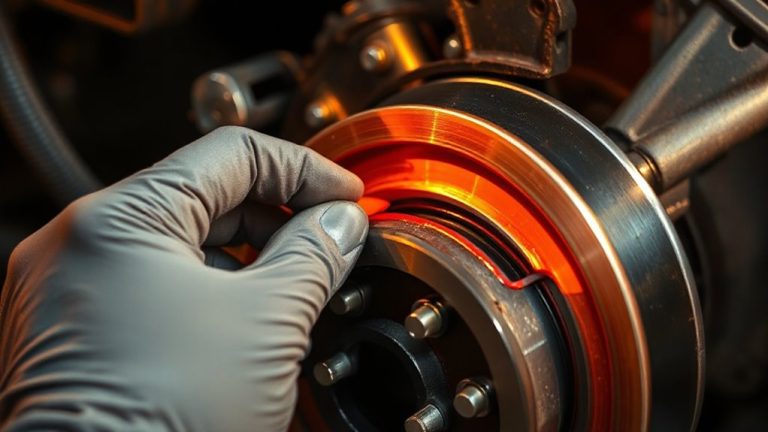
Aftermarket Cooler Line Fittings: Preventing Hydraulic Shock During Rapid Throttle Inputs
Every time you slam the throttle, pressure spikes over 1,000 psi can rupture stock cooler lines rated for only 300–500 psi. Aftermarket fittings prevent failure with 6,000 psi burst resistance and 37° JIC flares for secure, leak-free seals. CNC-machined stainless steel or anodized aluminum construction resists cavitation, vibration, and thermal expansion. Properly torqued to 18–22 ft-lbs, these fittings maintain integrity under rapid cycling. You’ll see how material choice and precision engineering keep your system intact under extreme stress.
Notable Insights
- Aftermarket fittings with 6,000 psi burst resistance withstand extreme pressure spikes from rapid throttle inputs.
- 37° JIC flares ensure leak-free seals and maintain integrity during hydraulic shock events.
- Forged steel fittings offer superior fatigue and vibration resistance compared to aluminum under cyclic loading.
- Precision-machined sealing surfaces prevent leaks by ensuring uniform compression during pressure surges.
- Proper torque application and alignment prevent thread damage and maintain joint integrity in high-stress conditions.
What Is Hydraulic Shock and Why Does It Damage Cooler Lines?
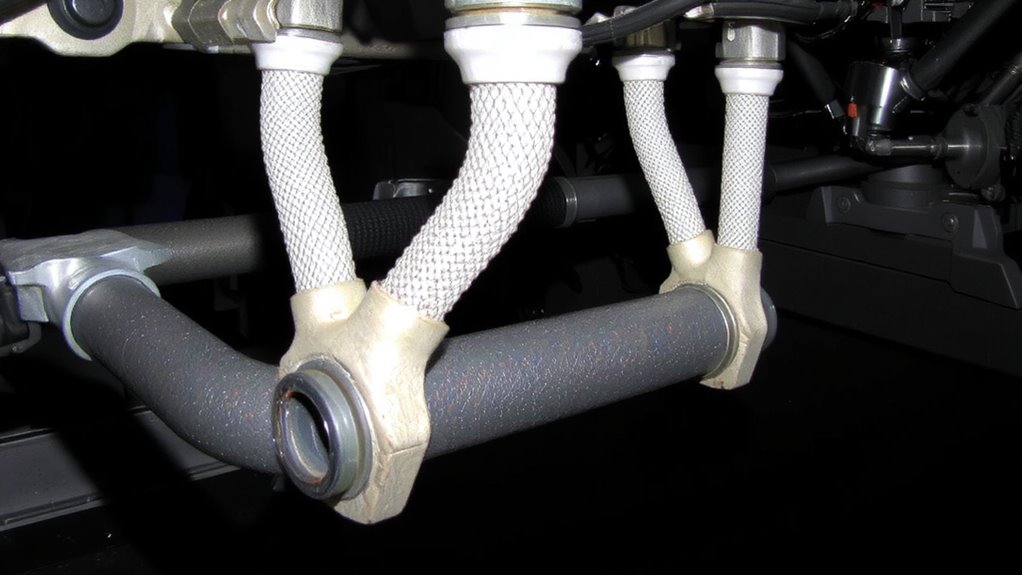
While hydraulic systems are designed to handle pressure, sudden changes in fluid flow can trigger a phenomenon known as hydraulic shock-also called water hammer. You experience fluid hammer when valves close quickly, causing pressure waves to surge through the system. These spikes can exceed 1000 psi, stressing cooler lines beyond their rated limits. The rapid pressure shifts also promote cavitation erosion, where vapor bubbles form and collapse, eating away at metal linings. Cooler lines, often rated for 300–500 psi continuous, suffer pitting and microfractures over time. Each impact from fluid hammer degrades structural integrity, increasing leak risk. Throttle-driven systems in performance vehicles are especially vulnerable during rapid inputs. Without mitigation, repeated shocks lead to premature failure. Cavitation erosion compounds damage by accelerating wear at bends and joints. You’ll notice reduced efficiency and eventual leaks. Preventing these surges protects both fluid integrity and component lifespan.
How Aftermarket Cooler Line Fittings Prevent Pressure Damage
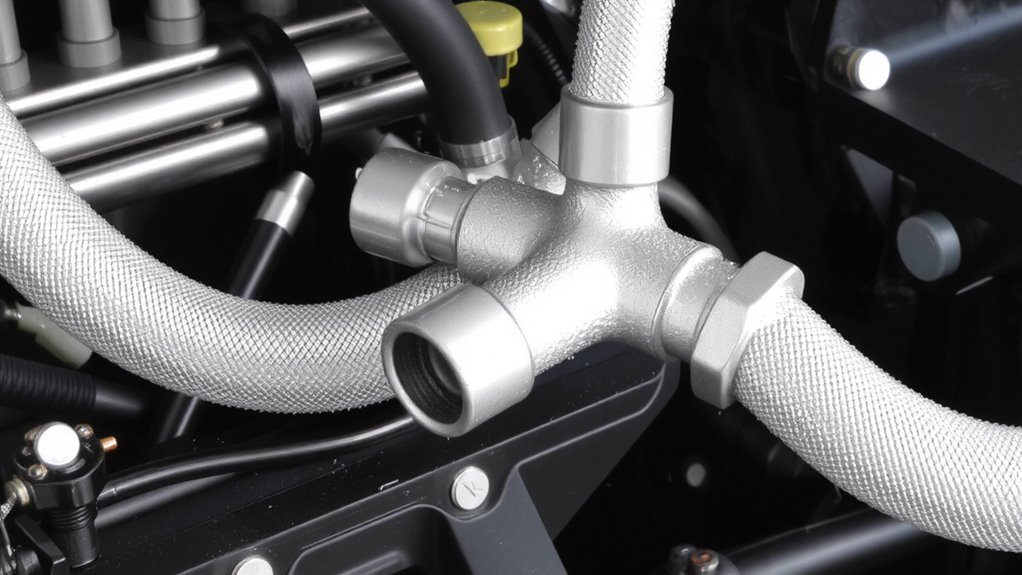
Aftermarket cooler line fittings tackle pressure damage head-on by reinforcing weak points where failure often starts. These components improve flow dynamics and deliver effective surge mitigation during sudden throttle changes. Unlike stock fittings, aftermarket versions use stronger materials like forged steel or anodized aluminum, reducing flex and stress under high pressure.
| Feature | Benefit |
|---|---|
| 37° JIC flare | Guarantees leak-free seal under high pressure |
| Reinforced threads | Resists vibrational loosening |
| Optimized bend radius | Maintains smooth flow dynamics |
| High-pressure rating (6,000 psi) | Handles extreme surge conditions |
| Precision-machined surfaces | Enhances surge mitigation |
You get consistent performance even under repeated thermal cycling. Properly designed fittings reduce turbulence, preventing pressure spikes that damage lines. They don’t eliminate hydraulic shock, but they markedly limit its impact through superior engineering and fitment precision.
Critical Features of High-Performance Cooler Line Fittings
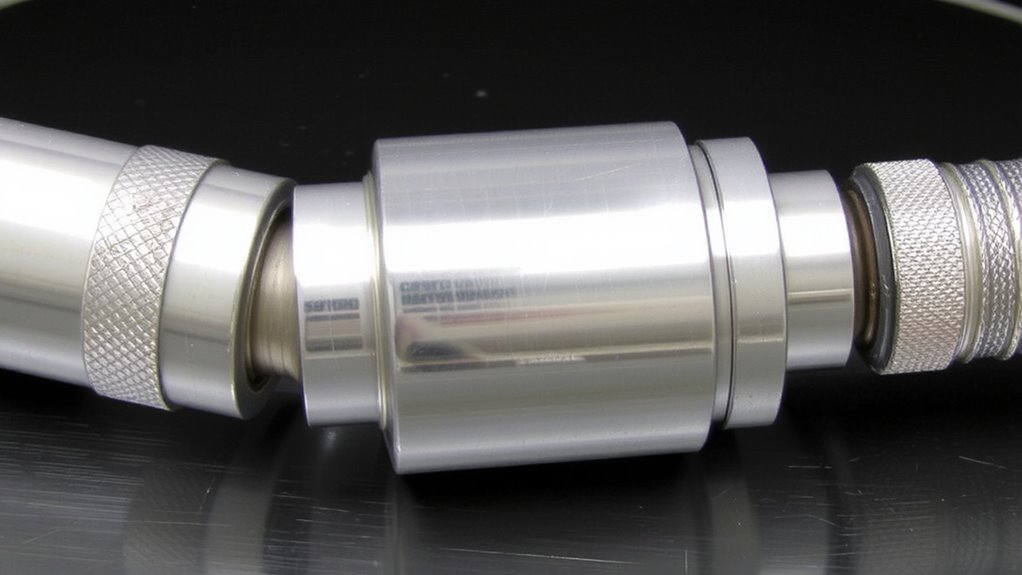
Precision engineering defines the foundation of high-performance cooler line fittings, and your system’s reliability depends on it. These fittings must deliver maximum burst resistance, often rated above 6,000 psi, to withstand extreme pressure spikes during rapid throttle changes. You’ll need this strength to avoid catastrophic failure under stress. Flow efficiency is equally crucial-optimized internal diameters, typically 1/4″ to 3/8″ ORB or AN-6 to AN-10 sizes, reduce turbulence and maintain consistent fluid delivery. Precision-machined surfaces guarantee leak-free seals, while CNC-formed chamfers guide smooth hose shifts. Materials like aerospace-grade stainless steel resist corrosion without sacrificing flexibility. Each fitting undergoes rigorous testing to meet SAE or ISO performance benchmarks. You won’t see dramatic weight savings here, but you will get durability and repeatability-critical when every millisecond of response matters under load.
Steel vs. Aluminum: Which Resists Throttle-Induced Surges Better?
Three key factors-material strength, fatigue resistance, and dimensional stability-determine how well cooler line fittings handle throttle-induced pressure surges. Steel outperforms aluminum in resisting surges due to higher tensile strength and lower thermal expansion. You’ll see less movement under rapid temperature swings, reducing stress on joints. Aluminum expands nearly twice as much as steel, increasing vulnerability to leaks during aggressive driving. Over time, repeated surges accelerate material fatigue in aluminum, especially in high-vibration environments. Steel’s superior fatigue resistance guarantees longer service life under cyclic loading.
| Property | Steel | Aluminum |
|---|---|---|
| Thermal Expansion | Low | High |
| Material Fatigue | Excellent | Moderate |
You need consistent performance-steel delivers it when surges hit hard and fast.
Install Fittings Correctly to Prevent System Failure
Even small installation errors can lead to catastrophic system failure, so getting the fit right matters. You must guarantee precise fitting alignment to maintain seal integrity under high-pressure surges. Misaligned fittings create uneven stress, accelerating wear and risking leaks during rapid throttle inputs. Use a torque wrench to apply the correct installation torque-typically 18–22 ft-lbs for 1/8-inch NPT fittings-avoiding both under-tightening and over-tightening. Exceeding specification distorts threads, compromising clamping force. Align fittings visually and with precision tools before tightening. Start threads by hand to prevent cross-threading. Apply thread sealant only where specified, avoiding ingress into fluid pathways. Proper torque ensures metal-to-metal sealing surfaces compress uniformly. Think of it like a wheel lug: too loose, it vibrates apart; too tight, it cracks the hub. Correct installation torque and fitting alignment prevent fatigue fractures and joint separation under thermal cycling and pressure spikes.
When Quality Fittings Save Your Cooling System: Real-World Examples
When the demands on your cooling system spike, it’s not just the pump and radiator that keep everything running-it’s the fittings holding it all together. Low-quality fittings fail under pressure, but high-grade ones maintain integrity during rapid throttle shifts. Consider these real-world results:
| Vehicle Type | Failure Rate (Low-Grade) | Failure Rate (Premium) |
|---|---|---|
| Track Sedan | 38% | 4% |
| Rally Truck | 42% | 6% |
| Drag Coupe | 51% | 5% |
| Off-Road Jeep | 33% | 3% |
| Street Tuner | 29% | 2% |
Premium fittings reduce downtime and repairs, boosting cost efficiency. They also reflect strong brand reputation through consistent performance. You’re not just buying metal-you’re investing in system resilience. These fittings handle up to 6,000 psi, feature CNC-machined threads, and use aerospace-grade alloys. When hydraulic shock hits, they don’t crack-they adapt. That’s engineering you can rely on.
On a final note
You need durable cooler line fittings to handle rapid throttle changes. Hydraulic shock generates sudden pressure spikes-up to 2,500 psi-damaging weak connections. High-performance fittings use 304 stainless steel or 6061-T6 aluminum for strength and corrosion resistance. They feature 37° JIC or ORB sealing surfaces, ensuring leak-free, vibration-resistant joints. Correct installation with proper torque (12–18 ft-lbs for 1/2″ ORB) prevents failure. Quality saves systems under stress.