Applying Nanocoatings to Paint That Reject Water and Inhibit Microbial Colonization
You can upgrade paint with nanocoatings that repel water and stop microbes. Silica nanoparticles create a hydrophobic layer 20–50 nanometers thick, boosting water contact angles above 110°. Silver or zinc oxide nanoparticles disrupt microbial cell functions, killing over 99.9% of pathogens like E. coli. These coatings maintain adhesion >5 MPa, last up to 10 years, and reduce maintenance needs. Performance data shows they resist UV, chemicals, and thermal cycling. You’ll discover best application methods next.
Notable Insights
- Nanocoatings use silica-based nanoparticles to create hydrophobic surfaces that repel water and reduce absorption by 85%.
- Hydrophobic layers 20–50 nanometers thick increase water contact angles to over 110°, preventing moisture infiltration.
- Silver or zinc oxide nanoparticles in paint disrupt microbial cells, achieving >99.9% pathogen reduction within 24 hours.
- Nanocoatings form non-porous, self-cleaning surfaces that inhibit microbial colonization and resist staining.
- Durable nanocoatings last up to 10 years, maintain performance under thermal and UV stress, and reduce maintenance needs.
How Nanotechnology Upgrades Paint Performance
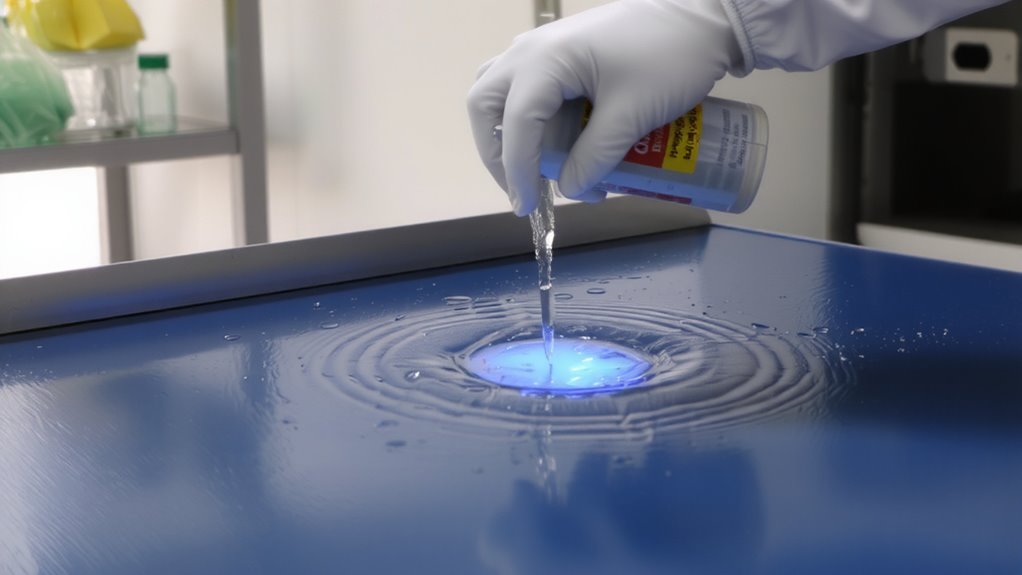
While traditional paints rely on pigments and binders for basic protection, nanotechnology transforms them into high-performance coatings by integrating particles measured in billionths of a meter. You get a smarter paint that resists wear, UV damage, and chemical exposure. Quantum effects emerge at this scale, altering how particles interact with light and energy, enhancing opacity and durability without adding thickness. Nanoparticles like titanium dioxide or silica self-organize, enabling precise surface patterning that improves adhesion and scratch resistance. This patterning creates a microstructure that mimics nature-like lotus leaves-though here it’s tuned for strength, not water repellency. Coatings achieve hardness ratings up to 6H on the pencil scale, double that of conventional paints. Film thickness remains under 50 microns while offering superior barrier properties. You achieve longer-lasting finishes with fewer reapplications. These nanocoatings meet ASTM D4214 standards for erodibility and D3359 for adhesion, ensuring reliability in demanding environments.
How Tiny Coatings Keep Walls Dry
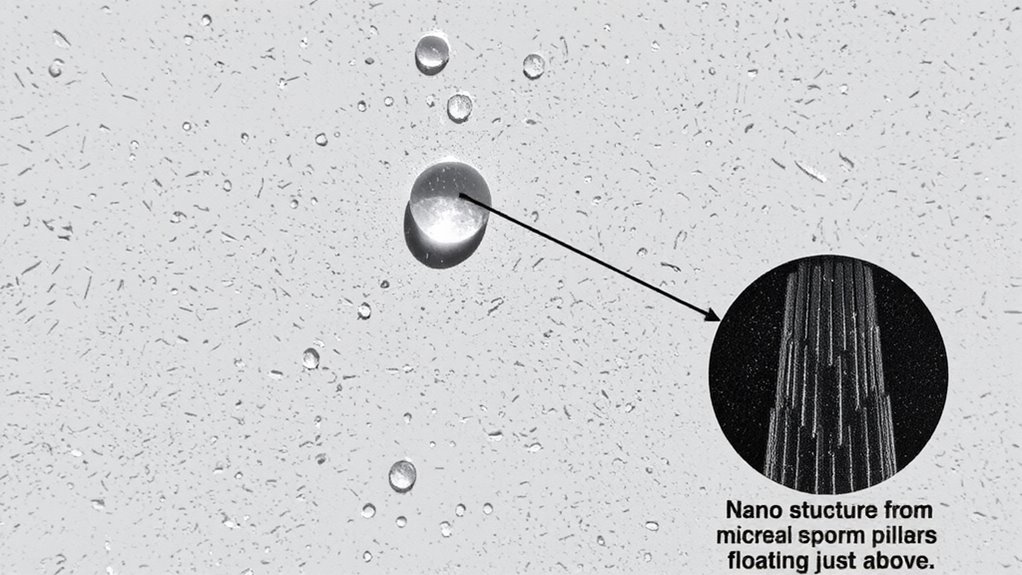
Since water damage starts with a single drop, nanocoatings stop it before it begins. You apply these invisible shields to paint, where they form a hydrophobic layer just 20–50 nanometers thick. This layer increases surface tension, causing water to bead up and roll off instead of spreading. Contact angles exceed 110°, a measure of how well a surface repels liquid, far above untreated paint’s 70°. The coating’s silica-based nanoparticles pack tightly, reducing pore size to block capillary absorption. That means no water infiltration, even under prolonged exposure. You maintain consistent moisture control, preventing blistering, cracking, and substrate decay. Field tests show treated walls absorb 85% less water than untreated ones after 48 hours of rain exposure. These coatings last up to 10 years without reapplication, resisting UV degradation and thermal cycling from -30°C to 80°C. You get long-term protection without altering the paint’s appearance or breathability.
Stop Bacteria Before They Grow
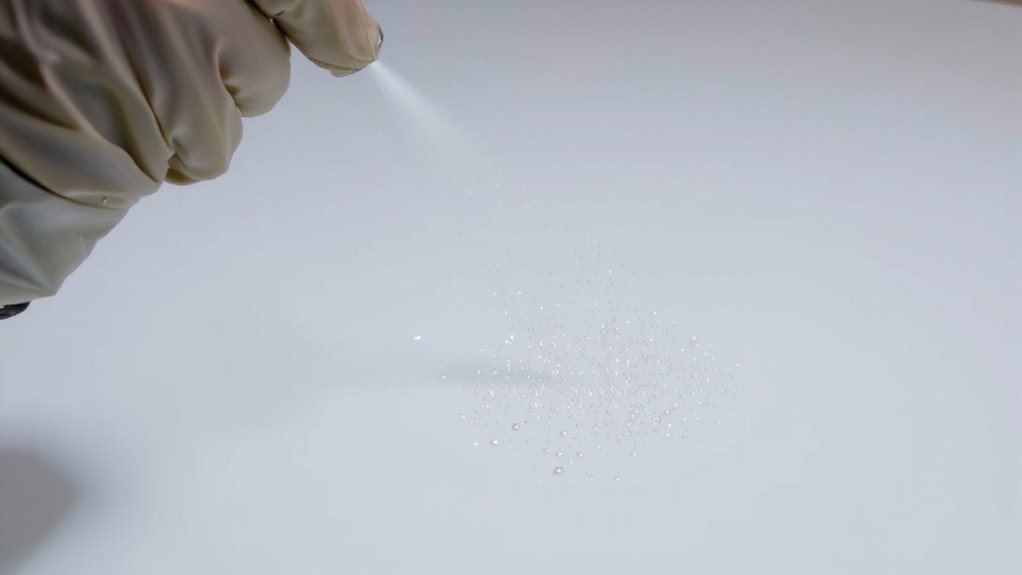
Nanocoatings don’t just keep walls dry-they also stop harmful microbes from taking hold. You’re applying a microscopic antimicrobial shield that actively repels bacteria before colonies form. This protection relies on engineered nanoparticles, typically silver or zinc oxide, integrated directly into the paint matrix. They disrupt microbial cell functions by releasing ions that penetrate cell walls, preventing replication. The result? Lasting bacterial resistance even in high-touch or high-moisture environments. Lab tests show >99.9% reduction in common pathogens like *E. coli* and *S. aureus* within 24 hours. The coating’s uniform dispersion guarantees no gaps in coverage, maintaining effectiveness across the entire surface. Unlike topical disinfectants, the nanocoating bonds permanently, providing continuous protection. It doesn’t wash away or degrade quickly. This proactive defense works silently, round-the-clock, making surfaces inherently less hospitable to microbial growth. You’re not cleaning more-you’re enabling less contamination from the start.
Top Advantages: Durability, Hygiene, and Low Maintenance
Because they’re built into the paint matrix at the molecular level, nanocoatings deliver lasting durability that standard coatings can’t match-you won’t need frequent reapplications. Their anti corrosion properties protect metal substrates by forming a hydrophobic barrier that blocks moisture and chloride ingress, reducing rust formation by up to 95% in salt spray tests. You’ll also benefit from UV resistance benefits-nano-silica and cerium oxide particles absorb and scatter ultraviolet radiation, slowing polymer degradation and chalking. This extends coating life by 3–5 years, even in full sun exposure. Nanocoatings maintain integrity under thermal cycling from -20°C to 80°C. Their non-porous surface resists microbial colonization, enhancing hygiene without biocides. With contact angles exceeding 110°, water beads and rolls off, carrying dirt and contaminants. You get self-cleaning action and sustained appearance. Maintenance needs drop sharply-washing intervals extend from quarterly to yearly. Performance lasts over 10 years under normal conditions.
Best Places to Use Nanocoated Paint
You’ll find the most value from nanocoated paints in environments where moisture, microbial growth, and wear are constant challenges. Hospitals and clinics benefit greatly-surfaces stay cleaner, with lab tests showing up to 99% reduction in bacterial colonization. The coating’s hydrophobic layer repels water, preventing mold and mildew formation in high-humidity zones. In kitchens and bathrooms, nanocoated paint maintains aesthetic appeal longer than standard finishes. It resists staining and擦洗 damage, enduring over 5,000 scrub cycles without degradation. Outdoor facades also gain advantages-color retention exceeds 90% after three years of UV exposure due to UV-resistant nanoparticles. Industrial settings use it on concrete and metal substrates, where chloride intrusion and chemical exposure accelerate deterioration. The coating forms a molecular barrier just 20–50 nanometers thick, invisible to the eye but highly effective. You get long-term performance without sacrificing visual quality.
Apply Nanocoatings With Your Paint
When applied correctly, nanocoatings integrate seamlessly with standard paint systems to deliver enhanced protection. You achieve this through smart application techniques that guarantee even coverage across all surfaces. Use a high-quality sprayer, roller, or brush calibrated to apply 25–50 microns per coat. Let the paint dry fully before applying the nanocoating to avoid adhesion issues. For best results, maintain ambient temperatures between 50°F and 90°F with low humidity.
| Factor | Without Nanocoating | With Nanocoating |
|---|---|---|
| Water Contact Angle | ~70° | ≥110° |
| Microbial Growth | Common | Inhibited by >99% |
| Coating Longevity | 3–5 years | 7–10 years |
| Surface Maintenance | Frequent cleaning | Minimal effort |
Even coverage prevents weak spots and maintains performance. Smart application means following manufacturer guidelines precisely-no guesswork.
Choose a High-Quality Nanocoating
While not all nanocoatings deliver on their promises, the right product can markedly enhance paint performance by combining advanced materials science with real-world durability. You need a nanocoating with strong surface adhesion to bond effectively with your paint, preventing delamination over time. Look for products with adhesion strength exceeding 5 MPa, verified through ASTM D4541 testing. High chemical resistance is also critical. Choose coatings that withstand exposure to acids (pH 3–5), alkalis (pH 9–11), and common solvents without degrading. Silica- or fluoropolymer-based formulations typically offer superior protection. These materials form a dense, cross-linked layer that repels water, resists microbial growth, and maintains integrity under UV exposure. A quality nanocoating should last 5–7 years under harsh outdoor conditions. Always verify performance data from independent labs before selecting a product.
On a final note
You enhance paint with nanocoatings that repel water and block microbial growth. These coatings use silica or titanium dioxide particles, typically 10–50 nanometers in size, to create a hydrophobic surface. Water beads and rolls off at contact angles exceeding 110 degrees. The antimicrobial effect comes from photocatalytic oxidation, disrupting cell membranes. This technology boosts durability, reduces cleaning frequency by up to 60%, and maintains surface integrity in high-humidity environments.