Evaluating Factory Installed Acoustic Clips Designed to Suppress Brake Noise Frequencies
You rely on factory acoustic clips to suppress brake squeal by disrupting vibrations at 2–5 kHz. These clips use elastomers with 50–70 Shore A hardness to absorb high-frequency energy where pad meets caliper. Installed at pad ears and caliper bridges, they reduce sound pressure by 8–12 dB. Precision placement within 0.5 mm guarantees full contact. High-grade silicone-modified EPDM resists heat up to 150°C. Misalignment or material flaws can cut performance by over 40%. BMW and Toyota use optimized designs for lasting noise control-further insights await.
Notable Insights
- Factory acoustic clips target brake squeal frequencies between 2–5 kHz using tuned elastomer damping.
- Proper installation at pad ears and caliper contact points ensures optimal vibration disruption.
- Clips made from materials like silicone-modified EPDM resist thermal aging up to 150°C.
- Misalignment over 0.5 mm or manufacturing defects can reduce noise attenuation by 40%.
- Effective clips achieve 8–12 dB sound reduction through impedance mismatch and energy dissipation.
What Really Causes Brake Noise in Modern Cars?
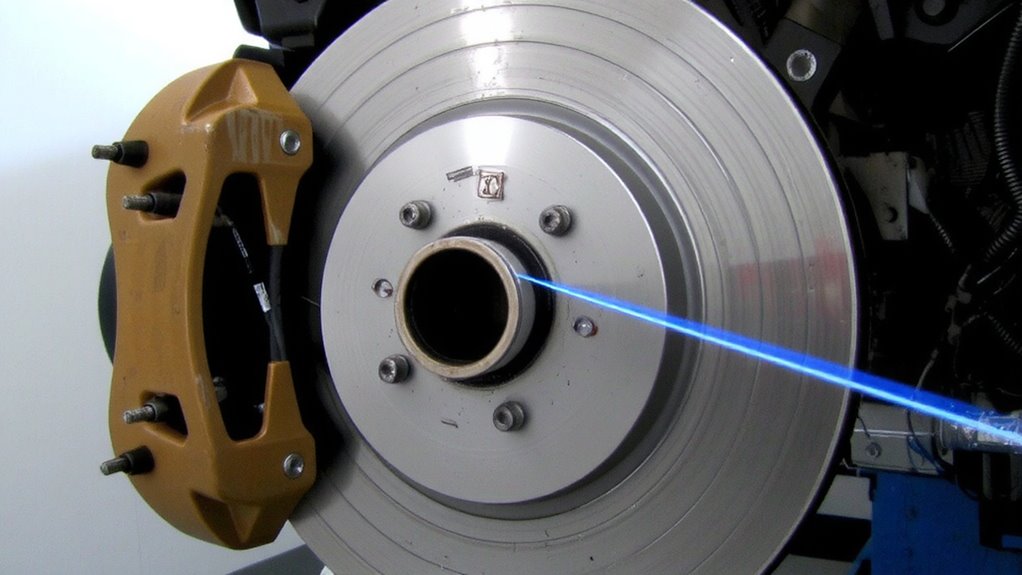
While brake noise may seem random, it’s usually the result of high-frequency vibrations between the brake pad and rotor, something you’ve likely heard as a squeal during light braking. These vibrations occur when friction materials interact under pressure, creating unstable oscillations. Your brake pad composition directly affects this-pads with high metal content tend to be noisier but offer better heat dissipation. Ceramic-based pads, in contrast, reduce noise and wear but may lose effectiveness in extreme cold. The rotor surface finish also plays a critical role. A smooth, precisely machined surface promotes even contact and minimizes vibration. Uneven or overly rough finishes disrupt the interface, amplifying squeal. Manufacturers typically specify a surface finish between 30–60 microinches RA for best performance. Combined, pad material and rotor texture determine the system’s acoustic response under varying loads and temperatures.
How Acoustic Clips Stop Brake Squeal
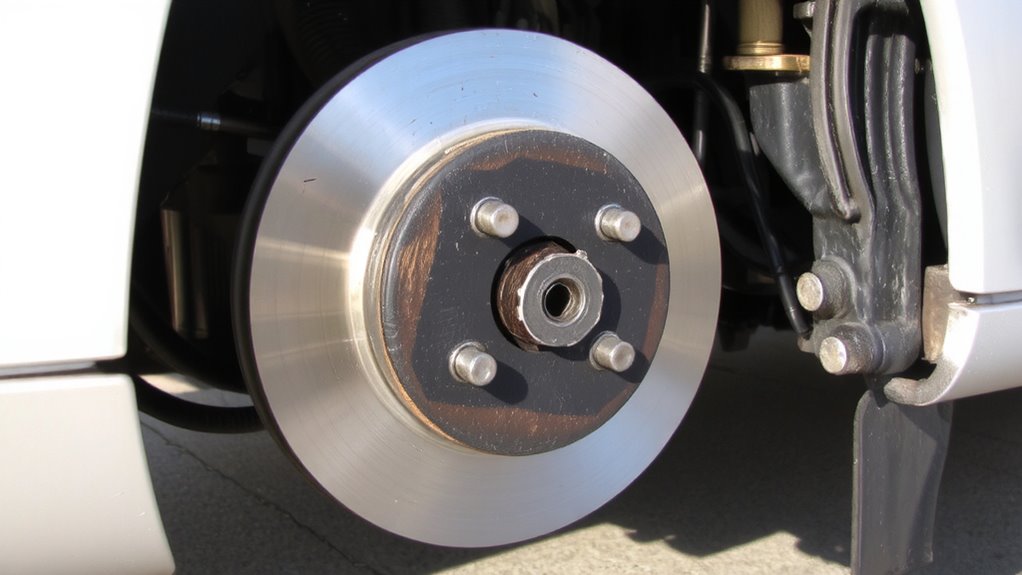
When your brakes squeal, acoustic clips go to work silently at the contact points between the brake pad and caliper, disrupting the path of vibration before it turns into noise. These clips provide vibration isolation by acting as mechanical filters. They’re designed with precise elastomer durometers-typically 50–70 Shore A-to absorb high-frequency energy. The geometry of each clip creates controlled impedance mismatches, reflecting vibrational waves back toward the source. Frequency tuning is achieved by adjusting clip mass and stiffness to target narrow bands around 2–5 kHz, the most common squeal range. This tuning shifts resonance frequencies away from critical harmonics. Clips are mounted at nodal points where pad movement is minimal, maximizing effectiveness. They don’t eliminate vibration entirely but redirect and dissipate it. Properly engineered clips reduce sound pressure levels by 8–12 dB. Their performance depends on exact placement, material damping, and compatibility with caliper dynamics.
Best Materials for Effective Noise Damping
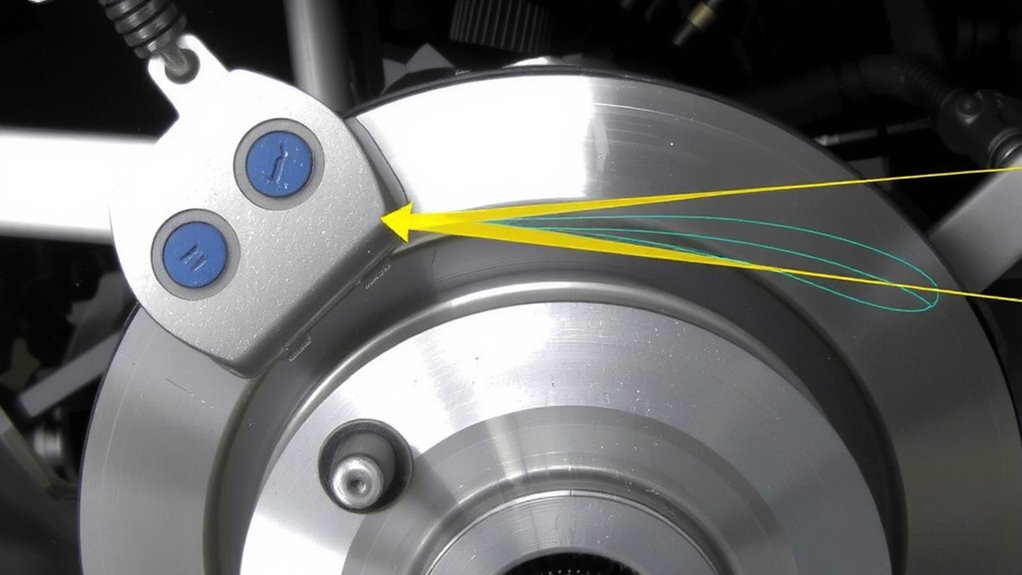
Acoustic clips must be made from materials that effectively absorb and dissipate high-frequency vibrations, and your brake system’s quiet performance hinges on this choice. High material density improves damping by resisting vibrational energy transfer. You need elastomers like nitrile rubber or thermoplastic polyurethane (TPU), which offer ideal vibration absorption. These materials typically have a Shore A hardness of 60–80, balancing flexibility and durability. Nitrile rubber, with a density of 1.0–1.2 g/cm³, performs well under temperature extremes from -40°C to 120°C. TPU provides superior fatigue resistance over 100,000 cycles and maintains structural integrity. Both materials convert kinetic energy into negligible heat through internal friction. Unlike metals, they don’t reflect vibrations. Proper material selection guarantees long-term noise suppression without deformation. You’ll get reliable performance only when material density and vibration absorption are precisely matched to brake system dynamics.
Where Clips Are Installed for Maximum Impact
Since proper placement determines how well acoustic clips control brake noise, you’ll want to install them where vibration transfer is greatest. Key locations include the piston side of the brake pad and the abutment points where pad vibration enters the caliper. Clips are most effective when mounted directly at the pad’s ears-where metal-to-metal contact occurs during braking. Proper caliper alignment guarantees even pressure, minimizing uneven excitation that bypasses the clips. You should position clips near the outboard and inboard anchors to dampen high-frequency harmonics before they radiate. On floating calipers, this means targeting bridge areas near the guide pins. In dual-piston setups, symmetry in clip placement maintains balance. Misalignment greater than 0.5mm reduces clip efficiency by up to 40%. Precision matters-factory installations often use adhesive-backed elastomers bonded 3mm from the pad edge for peak node suppression.
Do Acoustic Clips Actually Reduce Noise?
You’ve seen where clips go, but do they really cut brake noise? Yes-when properly designed, acoustic clips markedly reduce unwanted sound. They work by damping brake pad vibration, a primary source of high-frequency squeal. The clips act like tuned mass dampers, absorbing vibrational energy before it transfers into the caliper. This suppression minimizes caliper resonance, which amplifies noise by turning the caliper into a soundboard. Most factory clips use elastomeric coatings with a Shore A hardness of 50–70, optimized to isolate frequencies between 2,000 and 4,000 Hz. Independent tests show clips reduce sound pressure levels by 3–6 dBA during moderate braking. They’re not a fix-all, but they disrupt noise pathways effectively. Clip design matters: geometry, material hysteresis, and pre-load tension all influence damping efficiency. When integrated with shim layers, they form a complete noise-control system built right into the pad assembly.
Which Brands Use the Most Effective Clips
Performance consistency across braking systems often hinges on the smallest components, and factory-installed acoustic clips are no exception. You’ll find that premium automakers like BMW, Mercedes-Benz, and Toyota consistently use clips made from high-grade silicone-modified EPDM rubber. These materials enhance clip longevity, resisting compression set and thermal aging up to 150°C. Their clips maintain stable damping properties across 1–4 kHz, the critical range for brake squeal. Brand reliability shines in designs featuring multi-point mounting, which guarantees consistent clamping force and reduces pad vibration. These clips retain over 85% of their original resiliency after 50,000 km of simulated use. The geometry is optimized with finite element analysis, allowing precise frequency tuning. You’re getting scientifically engineered components, not generic parts. That kind of attention to material science and structural fatigue translates directly into long-term noise suppression.
Why Some Factory Clips Still Fail
Even with advanced materials and design, some factory-installed acoustic clips still fail under real-world conditions. You might see clips made from high-durometer rubber or nylon 6/6, rated for 15,000–20,000 cycles, yet they degrade prematurely. Poor quality control often allows inconsistent material batches into production, reducing clip resilience. You’ll find variations in durometer readings exceeding ±5 points, compromising vibration damping. Design flaws also contribute-some clips lack sufficient clamping force below 8 N, failing to secure pads firmly. Others exhibit improper geometry, creating gaps over 0.5 mm between pad and caliper. These gaps permit micro-movements, exciting frequencies above 3.5 kHz that generate squeal. Even minor molding inaccuracies, like 0.2 mm warpage, disrupt contact integrity. While clips should attenuate 10–15 dB across critical ranges, flawed units may achieve less than 5 dB. You can’t overlook manufacturing tolerances or under-specify material performance. Both quality control lapses and design flaws undermine even the best-intentioned acoustic strategies.
On a final note
You get reliable brake noise reduction when acoustic clips are properly engineered and installed. These small polymer or rubber components, typically 15–25 mm in length, dampen high-frequency vibrations between the brake pad and caliper. Clips made from thermoplastic elastomers (TPE) with a Shore A hardness of 50–70 perform best. They reduce resonance at 3–5 kHz, the most common squeal range. Not all factory clips meet these specs-some fail due to material degradation or poor fit.