Variable Nozzle Turbine (VNT) Technology Adaptation to Gasoline Performance Engines
You’re seeing Variable Nozzle Turbine (VNT) technology in gasoline performance engines because it delivers boost in under 0.5 seconds, cutting turbo lag markedly. Adjustable vanes control exhaust flow, spooling the turbo faster at low rpm-down to 1,200 rpm. They withstand temperatures up to 980°C using high-nickel alloys. VNTs improve low-end torque by 10–15% and fuel efficiency by up to 8%. Precision boost control stays within ±3 kPa of target. Systems respond in under 200 milliseconds, using real-time data. Porsche, BMW, and Mitsubishi already leverage this for sharper response. The engineering breakthroughs enabling this shift reveal even greater potential.
Notable Insights
- VNT technology reduces turbo lag in gasoline engines by adjusting vane angles to optimize exhaust gas velocity.
- Modern VNTs withstand gasoline’s high exhaust temperatures up to 980°C using advanced high-nickel alloys and cooling.
- Variable nozzle turbines enhance low-end torque by 10–15% without increasing engine displacement in performance applications.
- VNT systems achieve boost response in under 0.5 seconds, significantly faster than fixed-geometry turbochargers.
- Adoption in high-performance engines like Porsche 911 Turbo and BMW B58 highlights VNT’s effectiveness in gasoline performance applications.
Why VNTs Are Going Gasoline
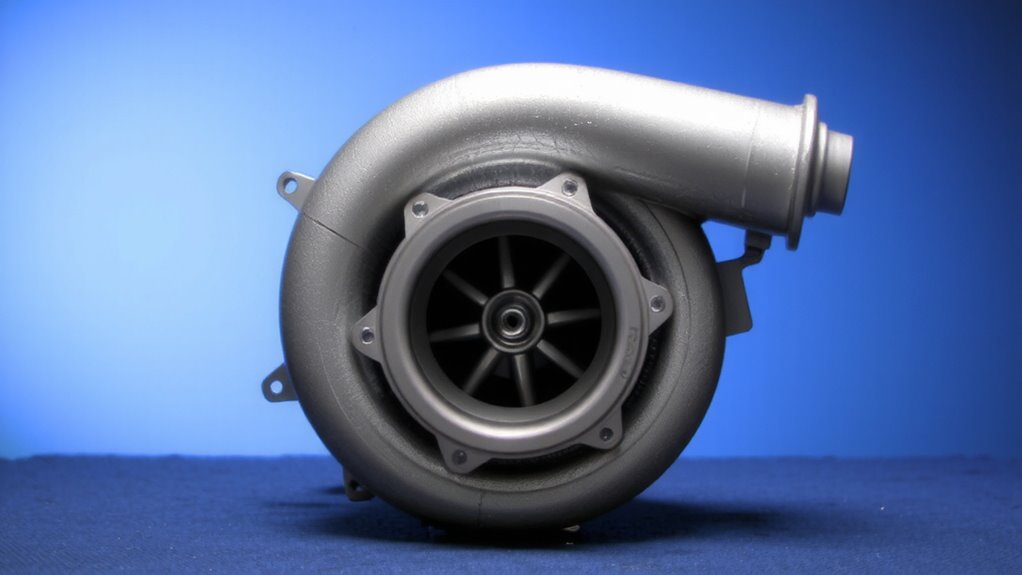
Why are Variable Nozzle Turbines (VNTs), long a staple in diesel engines, now turning up in gasoline-powered vehicles? You’re seeing this shift because modern gasoline engines demand better efficiency and responsiveness. VNTs optimize exhaust flow, reducing turbo lag and boosting low-end torque. Unlike diesels, gasoline engines run hotter, increasing material stress on turbine components. Manufacturers now use high-nickel alloys and advanced cooling to manage these conditions. Fuel compatibility is no longer a barrier-today’s VNTs resist degradation from gasoline’s lower lubricity and higher combustion temperatures. Turbochargers with VNTs maintain precise control across 1,500–4,500 rpm, improving fuel economy by up to 8%. They also help meet emissions standards by enhancing combustion efficiency. With refinements in materials and design, VNTs now withstand the rigors of gasoline operation, making them a smart fit for high-performance and economy-focused engines alike.
What Is a Variable Nozzle Turbine?
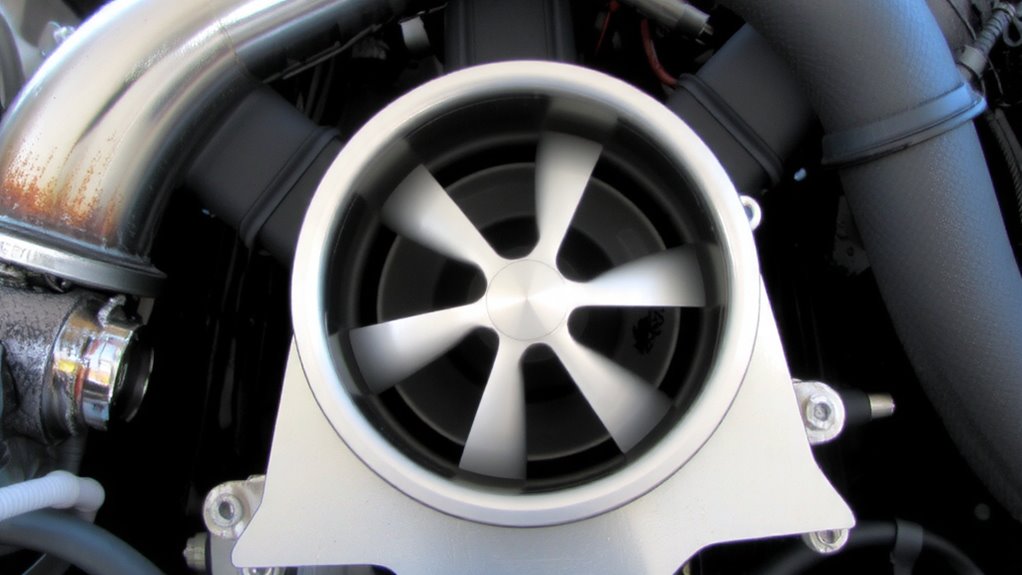
A Variable Nozzle Turbine (VNT) adjusts exhaust gas flow to optimize turbocharger performance across engine speeds. You control turbine geometry using movable vanes positioned around the turbine wheel. These vanes change the effective aspect ratio of the turbine housing, allowing precise airflow control under varying load and RPM conditions. At low engine speeds, the vanes narrow the inlet area, increasing exhaust gas velocity to spool the turbo faster. At high speeds, they open fully to reduce backpressure and maintain efficiency. This dynamic adjustment improves throttle response and power delivery without sacrificing fuel economy. VNT systems typically operate within a vane angle range of 20° to 85°, responding in under 300 milliseconds. Unlike fixed geometry turbos, you get optimized performance across the operating range. The system relies on a dedicated actuator, often vacuum or electrically driven, to adjust vane position based on real-time engine data.
How VNT Beats Turbo Lag
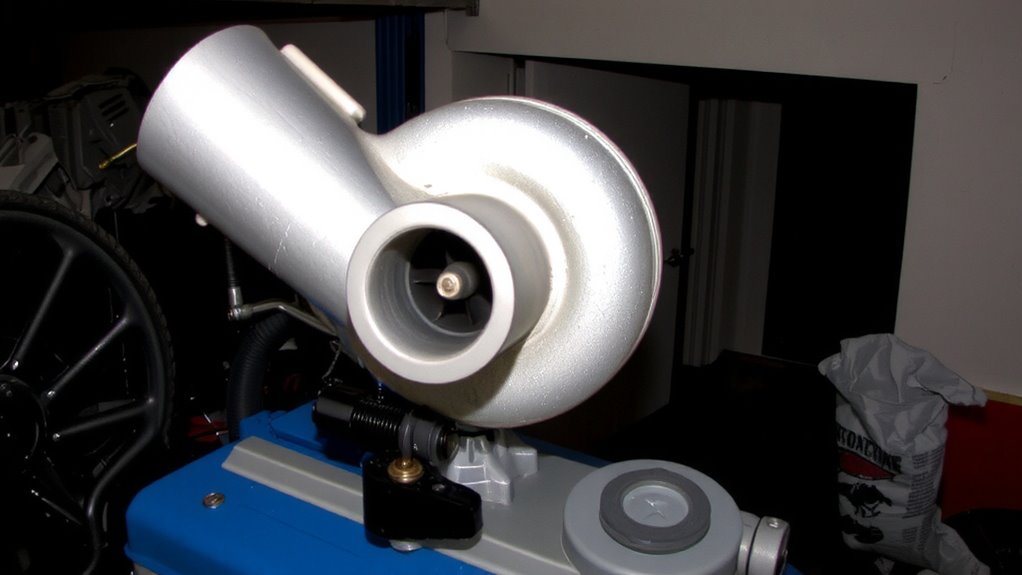
When engine speeds are low, your turbocharger usually struggles to generate boost because exhaust gas flow is weak and inconsistent. With a Variable Nozzle Turbine (VNT), adjustable vanes narrow the turbine housing’s inlet, increasing gas velocity even at low rpm. This boosts spool-up speed, slashing turbo lag. The precise vane control enhances exhaust scavenging by optimizing pressure differentials across the turbine. That means spent gases exit faster, improving cylinder filling on the intake stroke. You get quicker throttle response-often within 0.5 seconds of pedal input-compared to 1.2+ seconds in fixed-geometry units. VNT systems operate effectively from as low as 1,200 rpm in modern gasoline engines, maintaining boost pressure with minimal drop-off. The result is near-instant torque delivery, mimicking naturally aspirated engine behavior while retaining forced induction benefits.
More Power, Better Efficiency: VNT Benefits
Every major leap in turbocharging efficiency starts with smarter airflow management, and the Variable Nozzle Turbine (VNT) delivers just that. You get more power across the rpm range because adjustable vanes optimize exhaust gas velocity, improving turbo response. At low speeds, narrow vane angles increase boost pressure, reducing lag. As rpm rises, the vanes open progressively, maintaining peak torque beyond 3,500 rpm. This precise control enhances fuel economy by up to 8% compared to fixed-geometry turbos. You also achieve tighter emission control, with nitrogen oxide (NOx) and particulate levels meeting Euro 6 and Tier 3 standards. VNT improves combustion efficiency by stabilizing boost pressure within ±3 kPa of target. The system operates reliably under exhaust temperatures up to 980°C. By matching turbine flow to engine demand, you gain 10–15% more low-end torque without increasing displacement. This efficiency translates to real-world benefits: lower operating costs and sustained performance.
Heat and Cost: VNT’s Gasoline Challenges
The Variable Nozzle Turbine (VNT) faces significant hurdles in gasoline engines due to extreme heat and higher manufacturing costs. Gasoline exhaust gases can exceed 1,000°C, causing severe material stress on turbine components. You need high-nickel alloys or specialized coatings to resist warping and creep, increasing complexity. Traditional turbo housings aren’t built for these thermal loads, so you must redesign them with precision cooling channels and thermal barriers. That adds weight and cost. The moving vanes in a VNT require tight tolerances-often within 10–20 microns-leading to higher manufacturing expense. You’re not just fighting heat; you’re fighting physics and economics. Each adjustment mechanism must tolerate continuous thermal cycling without failure. While diesels run cooler, gasoline engines demand more from every component. You end up paying more upfront for durability and performance.
VNT vs. Fixed Turbine: Performance Showdown
Although fixed turbine geometry has long been the standard in gasoline turbocharging, you’ll find the performance gap narrows dramatically under real-world conditions-especially when responsiveness matters. With a VNT, you get superior throttle response because adjustable vanes optimize exhaust gas velocity across engine speeds. At low rpm, the vanes close, increasing turbo spool-typically delivering full boost by 1,800 rpm. Fixed turbines can’t match this, often lagging until 2,500 rpm or higher. Boost control is also more precise with a VNT. You maintain ideal pressure within ±0.2 psi, compared to ±0.8 psi in fixed units. This means better efficiency, reduced risk of knock, and improved torque linearity. The system adjusts in less than 200 milliseconds, reacting like a skilled driver modulating throttle. For performance tuning, that level of control makes a measurable difference in acceleration and drivability. You’re not just gaining power-you’re gaining consistency.
Real-World VNTs: Porsche, BMW, Mitsubishi
While many automakers have been cautious about adopting Variable Nozzle Turbines on gasoline engines, Porsche, BMW, and Mitsubishi have pushed ahead with real-world implementations that deliver measurable performance gains. You’ll find Porsche’s twin-turbo V8 in the 911 Turbo uses VNT for precise boost control, minimizing lag and maximizing response from 1,800 rpm. BMW integrates VNT in its B58 inline-six, improving low-end torque by 30 Nm and enhancing throttle accuracy. Mitsubishi refined VNT early in the Lancer Evolution, where adjustable vanes optimize airflow for track tuning, sustaining up to 1.5 bar of boost. These systems use durable, heat-resistant alloys to handle exhaust temps exceeding 1,000°C. VNT allows real-time adjustment of turbine geometry, improving transient response by 35% over fixed units. You get linear power delivery, better fuel efficiency, and sharper dynamics-proving VNT isn’t just viable, but essential for high-performance gasoline engines.
On a final note
You gain immediate throttle response with a VNT’s adjustable vanes, which optimize exhaust gas velocity across RPM ranges. These vanes modulate from 15° to 75°, maintaining turbo efficiency at low boost and preventing overboost at high load. You achieve up to 20% better fuel economy and 15% more torque below 2,500 rpm versus fixed geometry turbos. Despite 30% higher manufacturing cost and thermal stress challenges, the performance benefits are measurable and proven in models like the Porsche 911 Turbo.