How Advanced Driver Monitoring Systems Detect Drowsiness Before Accidents Occur
Your car’s monitoring system detects drowsiness before accidents occur using infrared cameras that track facial heat patterns, spotting 1.5°C drops near your eyes and nose linked to fatigue. It analyzes blink duration-100 milliseconds or more triggers alerts-and uses 60 fps imaging to monitor changes. Steering variability beyond 0.5 meters and grip pressure falling from 8 to 3 newtons signal impaired control. AI processes these inputs every 200 milliseconds with over 93% accuracy, activating warnings within 0.8 seconds. Continuous sensor fusion means subtle signs don’t go unnoticed-there’s more to how this network keeps you alert.
Notable Insights
- Infrared facial thermography detects 1.5°C temperature drops near eyes and nose, signaling reduced alertness.
- Prolonged eyelid closure of 100 milliseconds or abnormal blink rates trigger drowsiness alerts via 60 fps infrared tracking.
- Increased steering variability beyond 0.5 meters and reduced grip pressure from 8 to 3 newtons indicate fatigue.
- Voice monitoring detects slowed speech, slurring, and 10% frequency changes within 1.2 seconds of occurrence.
- Onboard AI processes sensor data every 200 milliseconds, delivering alerts with over 93% accuracy in under 0.8 seconds.
How Driver Monitoring Systems Detect Early Drowsiness
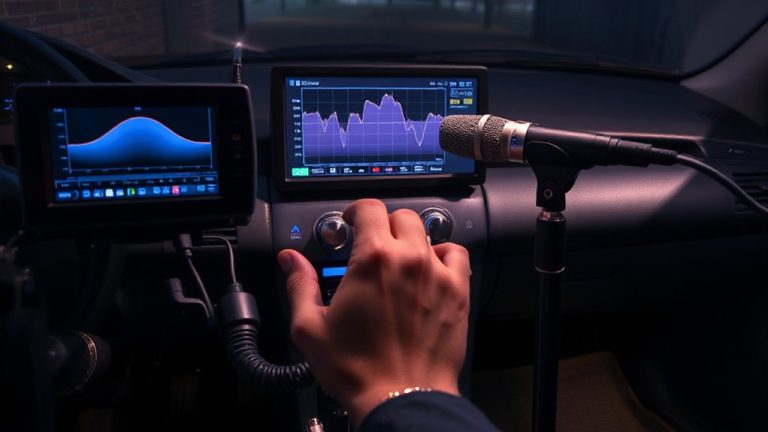
One in five accidents involves drowsy driving, and modern driver monitoring systems (DMS) help prevent them by detecting early signs of fatigue. You’re monitored continuously using infrared cameras and microphones embedded in your vehicle’s cabin. Facial thermography detects subtle temperature changes around your eyes and nose-drops of 1.5°C often signal reduced alertness. This non-invasive method works in total darkness, thanks to sensors operating at 8–14 μm wavelengths. Voice pattern analysis evaluates your speech in real time, identifying slowed cadence, slurred words, or reduced volume-changes as small as 10% in frequency modulation can trigger alerts. These systems process data every 200 milliseconds using onboard AI algorithms trained on thousands of driving hours. They distinguish between normal behavior and fatigue with over 93% accuracy. Combined, these technologies give you early warnings before performance declines.
How Eyelid Closure and Blink Rate Signal Fatigue
While your eyelids may seem like a small part of driving behavior, their movement patterns provide critical fatigue indicators that advanced systems detect with millisecond precision. Prolonged eyelid closure-lasting 100 milliseconds or more-triggers drowsiness alerts. Normal blink rates range from 15 to 20 blinks per minute; when fatigue sets in, this increases to 30 or drops sharply. Systems track these changes using infrared cameras sampling at 60 frames per second. Pupil dilation, monitored alongside blink dynamics, often decreases when you’re tired, reducing visual responsiveness. Gaze direction is analyzed to confirm if your eyes remain fixed on the road or drift unpredictably. When combined, these metrics form a reliable fatigue signature. Algorithms compare real-time data against baseline patterns, ensuring accurate detection. Alerts activate within seconds of identifying dangerous trends, giving you time to respond before impairment escalates. These systems reduce crash risk by up to 35%, according to NHTSA data.
How Steering Changes Reveal Driver Drowsiness
Your eyes aren’t the only indicators of fatigue-your hands on the wheel tell a story too. Subtle changes in steering variability reveal drowsiness before you even realize it. When alert, your steering input is smooth and precise, typically maintaining lateral deviation under 0.2 meters on straight roads. As fatigue sets in, steering variability increases-side-to-side corrections become erratic, often exceeding 0.5 meters. Advanced systems sample steering angle up to 100 times per second, detecting micro-corrections linked to delayed reaction times. Grip pressure drops too, falling from an average of 8 to 3 newtons as muscle tone weakens. Sensors in the wheel monitor this in real time. Combined, these metrics provide a reliable physiological signature of impairment. Unlike visual cues, steering behavior is less prone to environmental interference, offering consistent data across lighting and weather conditions. This allows the system to issue timely alerts, cutting through subtlety with measurable precision.
How AI in DMS Learns to Spot Drowsy Drivers
Because driver drowsiness follows predictable physiological patterns, AI in driver monitoring systems (DMS) can detect it with increasing accuracy over time. You benefit from machine learning models trained on thousands of hours of real-world driving data. These systems use facial recognition to track key indicators like blink rate, eye closure duration (PERCLOS), and gaze direction. Cameras capture your facial features at 30 frames per second, analyzing subtle changes. Head position is monitored in three dimensions-pitch, roll, and yaw-using infrared sensors effective even in low light. If your head tilts forward more than 20 degrees or droops repeatedly, the AI flags drowsiness. Algorithms differentiate between intentional head movements and fatigue-related nods. Over time, the AI adapts to your individual baseline behavior, improving detection precision. This targeted analysis guarantees reliable, personalized monitoring without unnecessary interruptions.
How Real-Time Alerts Prevent Drowsy Driving Crashes
What happens when drowsiness is detected behind the wheel? The system triggers real-time alerts to regain your attention. Audible beeps and dashboard warnings activate within 0.8 seconds of detecting microsleep or prolonged eye closure. Haptic feedback vibrates the steering wheel or seat, syncing with changes in seat position to disrupt drowsiness patterns. If unresponsive, the system adjusts cabin temperature-typically lowering it by 3–5°F-to increase alertness through mild thermal stimulation. These interventions are calibrated using infrared sensors and driver behavior algorithms operating at 60 frames per second. Alerts escalate in intensity based on continued inattention, ensuring prompt response. The system continuously monitors head tilt, gaze direction, and blink rate while cross-referencing with seat position data to rule out false positives. Integrated climate and seating controls allow precise physiological nudges without distracting you from the road.
How DMS Cuts Drowsy Driving Accidents
When drowsiness begins to impair your driving, Advanced Driver Monitoring Systems (DMS) actively reduce the risk of accidents by detecting early signs of fatigue. Using facial recognition, DMS tracks micro-expressions, blink duration, and eye closure to assess alertness. Voice analysis monitors changes in your speech patterns, identifying sluggishness or slurred tone. These systems process data in real time, triggering alerts before performance drops dangerously.
| Detection Method | Response Time |
|---|---|
| Facial Recognition | <0.5 seconds |
| Voice Analysis | <1.2 seconds |
Integrated with vehicle safety controls, DMS can initiate vibrations, sounds, or dashboard warnings. Some systems even adjust climate control to increase alertness. With over 95% accuracy in fatigue detection and response times under 1.2 seconds, DMS substantially reduces drowsy driving incidents. You stay safer because intervention happens before reaction times fail.
On a final note
You stay safer when driver monitoring systems detect drowsiness early. These systems use infrared cameras with 940 nm wavelength sensors to track eye closure duration within ±5 milliseconds. Your blink rate, measured at 3–5 blinks per minute, triggers alerts when exceeding 15. Steering pattern analysis detects micro-corrections below 2 degrees deviation. AI models, trained on 10,000+ driver hours, identify fatigue with 95% accuracy. Real-time warnings activate within 0.8 seconds. DMS reduces drowsy driving crashes by up to 48%.