Control Arms: How They Connect Wheel Hub to Chassis (Specs)
You rely on control arms to link your wheel hub to the chassis through ball joints and bushings, forming a critical suspension pivot point. They’re made from stamped steel or forged aluminum, weighing 5–15 lbs, and handle loads over 5,000 lbs. Ball joints allow 20–30 degrees of steering swing, while bushings permit 10–15 degrees of vertical travel. Precise sleeve alignment maintains camber within ±0.5 degrees. Misalignment or wear beyond 0.05 inches signals service need. There’s more to how they endure stress and sustain precision over time.
Notable Insights
- Control arms link the wheel hub to the chassis via ball joints, allowing controlled movement during steering and suspension travel.
- They attach to the chassis through durable rubber or polyurethane bushings that absorb vibration and maintain alignment.
- In strut suspensions, the lower control arm connects the hub to the chassis while supporting the strut assembly.
- Upper and lower control arms work together in dual wishbone systems to precisely guide wheel motion and positioning.
- Robust construction from steel or aluminum ensures the arm withstands dynamic loads while maintaining structural integrity.
What Control Arms Do (And Why They Matter)
While your vehicle navigates bumps and turns, the control arms quietly handle a critical job-connecting the wheel hub to the chassis and managing suspension movement. They guarantee proper load distribution across the front or rear axle, maintaining stability under varying driving conditions. Typically made from stamped steel or forged aluminum, control arms weigh between 5–15 pounds, depending on design and material. Their bushings and ball joints allow limited pivoting, enabling effective force absorption from road impacts. This protects other suspension components and enhances ride comfort. Control arms maintain alignment geometry, preventing excessive tire wear. On most passenger vehicles, they endure up to 100,000 miles before replacement. Upgraded polyurethane bushings improve responsiveness. In performance applications, adjustable control arms let you fine-tune camber and caster angles. They’re essential for balancing durability, handling, and safety-without them, your suspension system simply wouldn’t function as intended.
How Control Arms Enable Steering and Suspension Movement
Because your vehicle must respond accurately to both road irregularities and steering inputs, control arms are engineered to pivot through defined ranges using ball joints and bushings. These pivot points allow precise control over steering geometry, guaranteeing your wheels maintain ideal alignment during maneuvers. As the suspension compresses or extends, control arms guide the wheel’s path, preserving tire contact and stability. This movement enables effective suspension articulation, letting each wheel move independently over bumps. Proper articulation improves ride comfort and handling by minimizing body roll and maintaining traction. Control arms operate within tight tolerances-typically allowing 10–15 degrees of vertical travel and 20–30 degrees of steering swing-depending on design. Their rigid construction, often from stamped steel or forged aluminum, resists deformation under load. By balancing strength and flexibility, control arms guarantee responsive steering and consistent ride quality without compromising safety or performance.
Which Suspension Types Rely on Control Arms
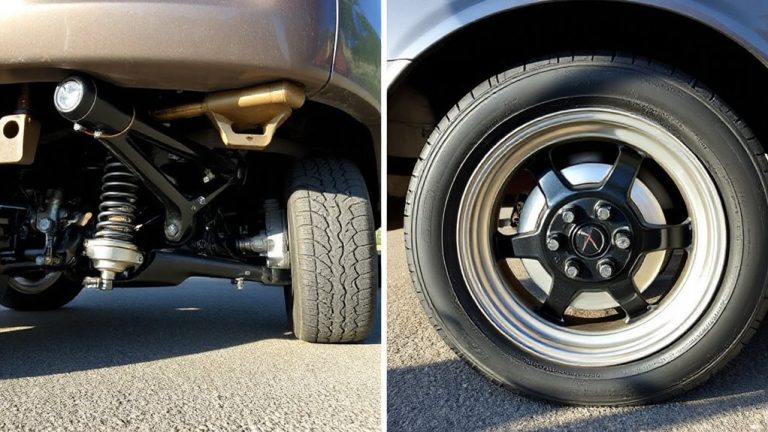
Control arms are fundamental to several modern suspension systems, particularly those designed for independent wheel movement. You’ll find them in most independent suspension setups, where each wheel moves without affecting the opposite side. This design improves ride quality and handling over uneven surfaces. In a strut suspension system, the control arm works alongside the MacPherson strut, which combines the shock absorber and spring in one unit. The lower control arm connects the wheel hub to the chassis, allowing controlled fore-aft and vertical movement. Upper control arms, when present, help maintain alignment and geometry. These systems commonly use ball joints rated for 75,000 to 100,000 miles. Control arms must withstand lateral and longitudinal forces-often exceeding 5,000 pounds during cornering or braking. They’re made from stamped steel or cast aluminum, balancing strength and weight. Proper material selection guarantees durability without sacrificing performance.
What’s Inside a Control Arm?
A control arm’s strength starts with its internal structure. You’ll typically find stamped steel or cast aluminum as the primary material composition, chosen for durability and weight savings. Stamped steel arms use high-tensile sheets shaped under extreme pressure, while aluminum versions rely on precision casting. The manufacturing process directly impacts performance-robotic welding guarantees consistent joints, and heat treatments enhance fatigue resistance. Internal ribbing adds rigidity without extra mass, much like support beams in a bridge. Bushing sleeves are precisely aligned during assembly to maintain geometry under load. Each control arm undergoes rigorous load testing, simulating years of road stress. Whether forged or stamped, the final design balances stiffness, weight, and flexibility. You depend on this engineered structure to maintain alignment and handle dynamic forces. Material composition and manufacturing process together define the control arm’s lifespan and performance.
Warning Signs of Failing Control Arms
That clunking noise you hear when driving over bumps might be your control arms warning you something’s wrong. Worn bushings or ball joints cause excessive play, creating metal-on-metal impacts under suspension movement. You’ll notice loose steering, where the vehicle responds sluggishly or drifts laterally on uneven pavement. This occurs because degraded control arms fail to maintain precise wheel alignment. Uneven tire wear often follows, especially on inner or outer tread edges, due to altered camber angles exceeding ±0.5 degrees tolerance. Tire wear patterns become noticeably asymmetrical within 3,000 miles if left uncorrected. Visible corrosion or cracked rubber bushings-typically made from polyurethane or rubber compound-confirm deterioration. Inspect for vertical play exceeding 1/8 inch at the ball joint. Ignoring these signs risks suspension failure and compromises ABS and stability control systems reliant on consistent wheel positioning.
Schedule Inspections to Extend Control Arm Life
Hearing clunks over bumps or spotting uneven tire wear means you’ve likely already encountered issues tied to worn control arm components. You can prevent this by sticking to a regular inspection frequency-every 15,000 to 20,000 miles is ideal. Early detection of wear patterns like uneven bushing deformation or ball joint play helps maintain alignment and handling. Technicians check for 0.05 inches or more of lateral movement, which signals failure. Visual and physical inspections include examining rubber bushings for cracking, swelling, or separation from metal sleeves. Ball joints are tested for axial play using dial indicators. Catching these wear patterns early guarantees suspension geometry stays within OEM specs. Ignoring scheduled checks risks damage to tie rods, struts, and tires. Proper inspection frequency not only extends control arm life but also sustains vehicle safety and ride stability over time.
On a final note
You rely on control arms for precise wheel alignment and suspension stability. Each control arm connects the wheel hub to the chassis via rubber-bushed pivot points, allowing controlled vertical movement. Upper and lower arms in a double-wishbone setup maintain camber angles within ±1.5 degrees under load. They handle forces up to 2,000 pounds during cornering. Worn bushings or ball joints degrade handling and tire wear. Regular inspection prevents failure.