How MacPherson Strut Assemblies Integrate Shocks and Springs for Compact Efficiency
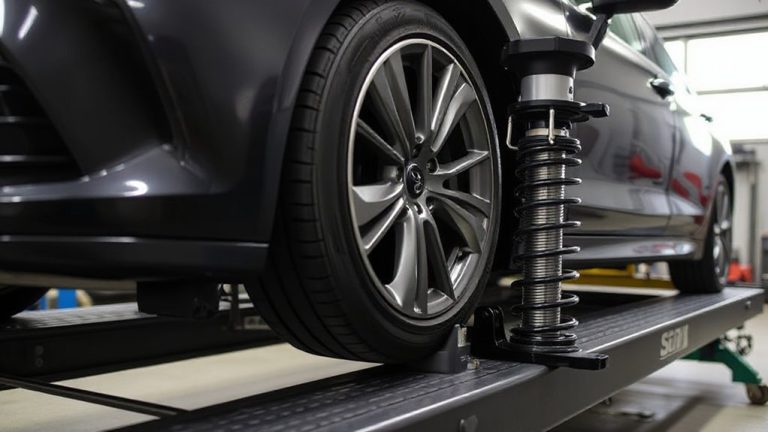
Your MacPherson strut combines a shock absorber and coil spring into one compact, load-bearing unit. The coil spring handles vehicle weight-typically compressing under loads that maintain 90–120 lb/in spring rates. Inside, a monotube or twin-tube shock uses hydraulic pressure up to 360 psi to dampen motion. This integration reduces part count by up to 30%, aligning components on a single axis. You gain precise handling, reliable damping, and more engine bay space. There’s more to discover about how this design shapes modern front-wheel-drive performance.
Notable Insights
- MacPherson struts combine a shock absorber and coil spring into a single vertical unit for space-efficient suspension design.
- The coil spring handles vehicle load and ride height while the shock absorber dampens wheel motion via hydraulic resistance.
- Integration on a single axis reduces lateral space, allowing more room in the engine bay and cabin.
- High-strength steel and precision construction enable durability while minimizing part count and assembly complexity.
- Monotube or twin-tube dampers provide efficient heat dissipation and consistent performance within a compact housing.
What Is a MacPherson Strut and Why It’s Essential
A MacPherson strut is more than just a shock absorber-it’s a critical load-bearing component of your vehicle’s front suspension system. It directly supports the vehicle’s weight, affecting alignment, handling, and safety. Proper load distribution is maintained through its rigid housing, which transfers forces from the wheel assembly to the chassis efficiently. This design reduces body roll and enhances ride stability, especially during cornering or sudden maneuvers. The strut integrates with the steering knuckle and attaches at the hub and the upper mount, allowing precise control over wheel motion. Engineers rely on it in compact vehicles because it saves space without compromising durability. It operates under high stress, typically enduring 100,000-mile service life under ideal conditions. Replacing worn struts restores factory ride stability and guarantees even tire wear.
How a MacPherson Strut Combines Shock and Spring
You know it supports the vehicle’s weight and keeps your ride stable, but what really sets the MacPherson strut apart is how it merges two key suspension functions into one compact unit. The coil spring handles load distribution by compressing under weight, maintaining ride height and evenly transferring forces to the chassis. Inside, the shock absorber provides damping efficiency by controlling spring oscillations through hydraulic resistance. A piston moves within a fluid-filled tube, with valving calibrated to resist bounce and stabilize wheel contact. This integration reduces part count, improves responsiveness, and guarantees consistent performance. Typical spring rates range from 150 to 300 lb/in, depending on vehicle mass and design intent. The monotube or twin-tube damper operates at pressures up to 360 psi, optimizing damping efficiency across varied road conditions. Together, they deliver precise control without excess bulk.
The Smart Engineering Behind Space-Saving Design
Because space is at a premium in modern vehicle design, the MacPherson strut’s compact layout delivers maximum functionality without wasting room. You get both shock absorption and spring support in a single, streamlined unit. This integration improves load distribution by aligning the strut, spring, and steering knuckle on one vertical axis, reducing lateral forces during cornering. Material efficiency is maximized-the strut tube, piston rod, and coil spring are engineered to handle compression and rebound with minimal mass. High-strength steel and precision welding reduce weight while maintaining durability. The assembly occupies less wheel well space than separate shock-and-spring systems, freeing up room for engines, brakes, and suspension geometry. Its simplified design cuts part count by up to 30% versus double-wishbone setups. You gain serviceability and structural rigidity without compromise. This isn’t just clever packaging-it’s optimized engineering for tighter, smarter chassis layouts.
Why Small Cars Love Integrated Strut Systems
Space efficiency isn’t just a bonus in small car design-it’s a requirement. You need every inch, and integrated MacPherson struts deliver. By combining the shock absorber and coil spring into a single vertical unit, they free up critical space in the engine bay and suspension layout. This compact design allows automakers to minimize the front track and increase cabin room. You also benefit from cost efficiency-fewer components mean lower manufacturing and assembly expenses. The simplified construction reduces maintenance needs and part count. Despite their size, these struts provide reliable ride comfort by effectively damping road vibrations. Tuned spring rates-typically 90–120 lb/in-balance responsiveness with smoothness. The monotube shock design inside handles heat dissipation well, maintaining performance. You get predictable handling and improved steering response, essential in tight urban environments.
Warning Signs Your MacPherson Strut Is Failing
What if the ride that once felt smooth now delivers jolts over every bump? That’s your first clue. Worn MacPherson struts lose damping efficiency, reducing control and comfort. You’ll notice unusual noises-clunks or knocks over dips-caused by loose components or collapsed internal valves. These sounds often originate from dried-out bushings or damaged strut mounts rated for 50,000–100,000 miles. Uneven wear on your tires is another red flag. A failing strut can’t maintain consistent contact, leading to cupping or scalloping, especially on the front tires. Misalignment from strut play accelerates tread wear by up to 30%. Vibration through the steering wheel during braking suggests strut instability. Your vehicle may also nose-dive more than 2 inches under hard stops-beyond OEM specs. Ignoring these signs risks handling precision and safety. Early diagnosis saves suspension components and extends tire life. Upgrading to premium best strut brands can significantly improve ride quality and longevity.
Replacing a Strut vs. Conventional Suspension
A strut assembly isn’t just a shock absorber-it’s a structural part of your suspension system. Replacing it demands more precision than swapping out standard shocks. You’ll face strut removal challenges, like compressed coil springs that require a spring compressor for safe disassembly. The entire assembly supports steering, braking, and alignment angles. Without proper tools, dismounting a strut can be dangerous. Once installed, you must perform an alignment after replacement. Even minor deviations in camber or toe can cause uneven tire wear and poor handling. A MacPherson strut replaces multiple components found in conventional suspensions-control arms, ball joints, and separate shocks. This integration saves space but increases complexity during service. Typical torque specs range from 80–120 ft-lbs for mount bolts. Always inspect steering components while the strut is out. Mistakes lead to premature failure.
Why Front-Wheel-Drive Cars Rely on MacPherson Struts
You’ve seen how replacing a MacPherson strut differs from servicing conventional suspension systems, especially with its integrated role in steering and alignment. That’s why front-wheel-drive cars rely on them. Their compact design suits tight engine bays, especially with transverse engine packaging, where space is limited. The strut mounts directly to the steering knuckle, reducing parts and saving width. This layout enhances steering precision and simplifies geometry. Plus, it aids torque steer management by minimizing suspension compliance during acceleration. Uneven force transfer is reduced thanks to rigid mounting points and aligned force vectors. MacPherson struts handle lateral and vertical loads efficiently, with coil springs managing bumps while monotube shocks dampen oscillations. Typical spring rates range from 150 to 220 lb/in, tuned for ride comfort and control. Overall, their structural efficiency makes them ideal for front-drive platforms where packaging and cost matter.
On a final note
You rely on MacPherson struts for precise handling and compact suspension integration. Each assembly combines a shock absorber and coil spring into a single vertical unit, saving space and reducing weight. It connects the wheel hub to the chassis, handling lateral and vertical forces. Typical spring rates range from 150 to 300 lb/in, damping forces adjust accordingly. This design suits front-wheel-drive layouts, streamlining engine bay packaging without sacrificing ride control.