Protect Exhaust Manifolds From Thermal Cycling & Rust
You can protect your exhaust manifold from thermal cycling and rust by choosing stainless steel headers, which handle up to 1,500°F and resist corrosion better than cast iron. Apply a ceramic coating up to 15 mils thick to resist heat up to 1,600°F and block moisture. Wrap the manifold with ceramic fiber sleeves rated to 2,000°F for added insulation. Use vapor seals at flanges to prevent condensation. Inspect every 15,000 miles for cracks or rust-knowing what comes next could save your engine.
Notable Insights
- Use stainless steel manifolds to resist thermal stress and corrosion in high-heat, high-output engines.
- Apply ceramic coating to create a thermal barrier that withstands up to 1,600°F and prevents oxidation.
- Wrap manifolds with ceramic fiber sleeves to retain heat and reduce underhood temperatures by up to 50%.
- Inspect every 15,000 miles for cracks, rust, and coating damage to catch fatigue early.
- Install vapor seals at flanges to block moisture and prevent condensation-induced rust during cooldown.
Recognize How Heat Cycles Damage Manifolds
While the engine runs, your exhaust manifold heats up quickly, reaching temperatures as high as 1,300°F during peak operation. Each time you drive, the manifold expands under extreme heat and contracts as it cools-this repeated expansion and contraction create thermal stress. Thermal stress accumulates over cycles, pushing the metal past its elastic limit. Over time, this leads to material fatigue, a progressive weakening of the manifold’s structure. Microscopic cracks form at stress points, especially near bends and welds, where heat distribution is uneven. These cracks grow with each heat cycle, eventually causing cracks or complete failure. Cast materials are especially prone due to lower ductility. You won’t always see damage immediately, but internal degradation occurs long before visible symptoms appear. Preventing excessive thermal cycling reduces wear. Letting the engine idle for 30–60 seconds before shutdown helps dissipate heat gradually, minimizing stress.
Choose Stainless Steel or Cast Iron Manifolds
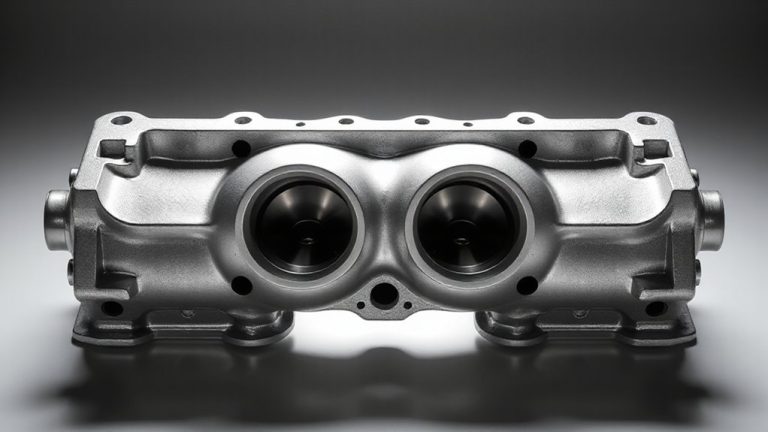
You can reduce the risk of thermal fatigue by selecting the right manifold material. Material selection plays a critical role in exhaust system longevity. Stainless steel manifolds, typically made from 409 or 304 alloys, resist rust and handle temperatures up to 1,500°F. They’re lighter than cast iron and less prone to cracking under thermal cycling. Cast iron manifolds, while heavier, offer excellent heat retention and cost efficiency. A durability comparison shows stainless steel outperforms cast iron in corrosion resistance and thermal shock tolerance. Cast iron, however, dampens vibration better and suits moderate-performance applications. Stainless steel weighs 30–40% less, improving engine responsiveness. For high-output or turbocharged engines, stainless steel is often the better choice. Both materials endure repeated heating and cooling, but stainless steel maintains structural integrity longer. Proper material selection guarantees longer service life and reduced maintenance.
Apply Ceramic Coatings to Resist Heat and Rust
A ceramic coating acts like a thermal barrier, shielding your exhaust manifold from extreme heat and corrosion. You get ceramic bonding that adheres tightly to metal surfaces, preventing oxidation and rust. This coating withstands temperatures up to 1,600°F, reducing thermal cycling stress. The process involves precision thermal sealing, which locks out moisture and contaminants. Applied at 10–15 mils thick, the layer guarantees uniform protection across complex geometries. Ceramic coatings also reduce underhood temperatures by up to 30%, improving engine efficiency. Unlike paint, it won’t crack or peel under repeated heating and cooling. Proper surface prep-media blasting and degreasing-guarantees strong ceramic bonding. Once cured, the coating resists salt, road debris, and chemicals. Thermal sealing enhances durability, making it ideal for high-performance or daily-driven vehicles. You gain longer manifold life, lower maintenance, and consistent performance.
Wrap Your Exhaust Manifold for Heat Protection
When properly applied, exhaust manifold wraps can greatly reduce radiant heat in the engine bay by trapping heat within the exhaust system. You gain improved heat retention, which boosts exhaust gas velocity and engine efficiency. These wraps provide effective thermal insulation, typically lowering under-hood temperatures by 30% to 50%. Most quality wraps are made from silica or ceramic fibers, capable of withstanding continuous temperatures up to 1,200°F and peaks near 2,000°F. A standard wrap is 1 to 2 inches wide and 50 to 100 feet long, depending on manifold size. Proper installation requires tight, overlapping layers without gaps. The material resists vibration and expansion fatigue, maintaining integrity over time. Unlike coatings, wraps offer immediate, measurable thermal insulation without curing. You’ll see gains in both performance and component longevity. Wrap maintenance is minimal, but inspection every 15,000 miles guarantees effectiveness.
Stop Rust by Blocking Moisture
Your exhaust manifold’s vulnerability to rust begins the moment moisture infiltrates its surface. Moisture reacts with iron in the cast metal, accelerating oxidation, especially during engine cooldown. You can prevent this by applying durable moisture barriers. These coatings bond chemically to the manifold, forming a protective layer impermeable to water and salts. For best results, use ceramic-based moisture barriers rated for temperatures up to 1,200°F. They remain stable through repeated thermal cycling. Vapor seals are equally critical. Applied at flange joints and mounting points, they block humid air from entering micro-gaps where condensation forms. A high-temp silicone vapor seal with a 50-year durability rating guarantees long-term protection. Together, these defenses stop rust at the source. Regular inspection maintains their integrity. Immediate reapplication after removal or damage preserves effectiveness.
Use Longtube Headers for Better Heat Dissipation
Though they’re often overlooked, longtube headers play a critical role in managing exhaust heat. They distribute thermal loads more evenly than stock manifolds, reducing stress from thermal cycling. Their longer, equal-length tubes promote scavenging, where exiting exhaust pulses create low-pressure zones that pull subsequent gases out. This leads to improved airflow and increased efficiency. Walls stay cooler due to consistent gas velocity, which minimizes hot spots. Most longtube headers are made from 16-gauge stainless steel or chromoly, materials chosen for durability and heat resistance. Primary tubes typically measure 1.75 to 2 inches in diameter, optimized for mid-to-high RPM performance. Unlike cast iron manifolds, these headers radiate heat away faster, lowering underhood temperatures by up to 150°F. You’ll see gains in both power and longevity.
Inspect Your Manifold Often to Catch Cracks Early
Regularly inspecting your exhaust manifold can save you from costly engine damage and performance loss. Cracks often start small but expand due to thermal cycling and manifold vibration. Check for hairline fractures near ports and mounting flanges, especially in cast iron manifolds prone to brittleness. Use a bright flashlight and a mirror to examine tight spaces. Look for soot stains or discoloration-signs of exhaust leaks. These leaks reduce backpressure, disrupting scavenging and lowering efficiency. Stainless steel manifolds resist cracking but still fatigue over time. Listen for ticking noises during warm-up; they often indicate leaks. Address cracks early through welding or replacement. Ignoring them increases stress on the turbocharger or catalytic converter. Inspect every 15,000 miles or annually. Early detection maintains engine integrity and prevents cascading failures linked to prolonged exhaust leaks.
On a final note
You protect exhaust manifolds by managing thermal stress and moisture. Use 304 or 321 stainless steel-it resists cracking up to 1,500°F. Ceramic coatings reduce surface temps by 300–400°F and block rust. Exhaust wraps lower radiant heat but trap moisture if not sealed. Longtube headers improve scavenging, reducing heat soak. Inspect for hairline cracks during oil changes. Keep undercarriage dry. These steps extend manifold life beyond 100,000 miles.