Hypoid vs EP Gear Oil: GL-5 Guide for Truck Differentials
Choose hypoid gear oil for heavy-duty trucks with non-intersecting axle gears requiring high film strength under continuous load. It uses synthetic or high-VI mineral oils with controlled sulfur-phosphorus additives to prevent scuffing at up to 121°C. EP oils work best for shock loads, forming a sacrificial layer under pressures over 300,000 psi. Match your oil to differential type and OEM specs-GL-5 isn’t always the answer. Your next decision depends on actual operating demands.
Notable Insights
- Hypoid gear oils use controlled sulfur-phosphorus additives to protect yellow metals under high sliding and rolling loads.
- EP gear oils contain aggressive sulfur-based additives ideal for shock loads in heavy-duty applications like dump trucks.
- Heavy hypoid differentials require high-EP GL-5 oil rated for 8,000–12,000 lbs of operating load.
- Matching oil to OEM specifications ensures correct API class, viscosity grade, and viscosity index for your differential.
- Synthetic GL-5 oils offer superior film strength and thermal stability for locking and limited slip differentials under high torque.
How Hypoid and EP Gear Oils Differ in Design and Additives
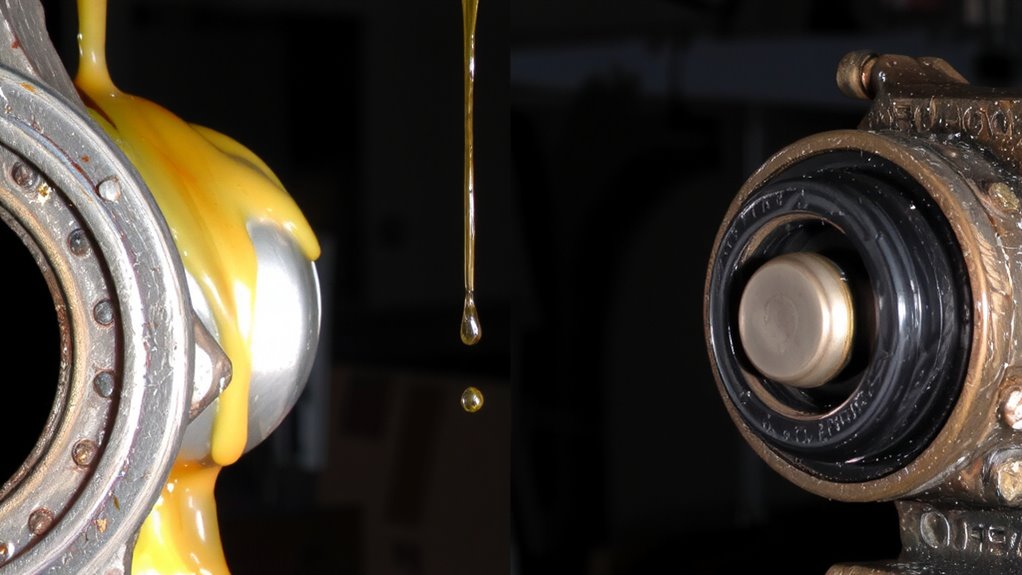
Hypoid and EP gear oils aren’t interchangeable, even though both protect gear systems-they’re engineered for different stress conditions. You need to understand their design differences. Hypoid gear oils use a carefully balanced base oil composition with high-viscosity index minerals or synthetics to handle sliding and rolling contact. Their additive synergy includes extreme pressure (EP) agents like sulfur-phosphorus compounds, but in controlled levels to protect yellow metals. EP gear oils, meanwhile, rely on aggressive sulfur-based additives for high-impact protection under shock loads. Their base oil composition often lacks the refinement needed for hypoid gears’ complex motion. Additive synergy in EP oils prioritizes film strength over material compatibility. Using the wrong type risks accelerated wear or chemical damage. You must match chemistry to gear design-function dictates formulation. Performance hinges on precision in both base stock and additive interaction.
Match Your Gear Oil to Differential Type and Operating Load
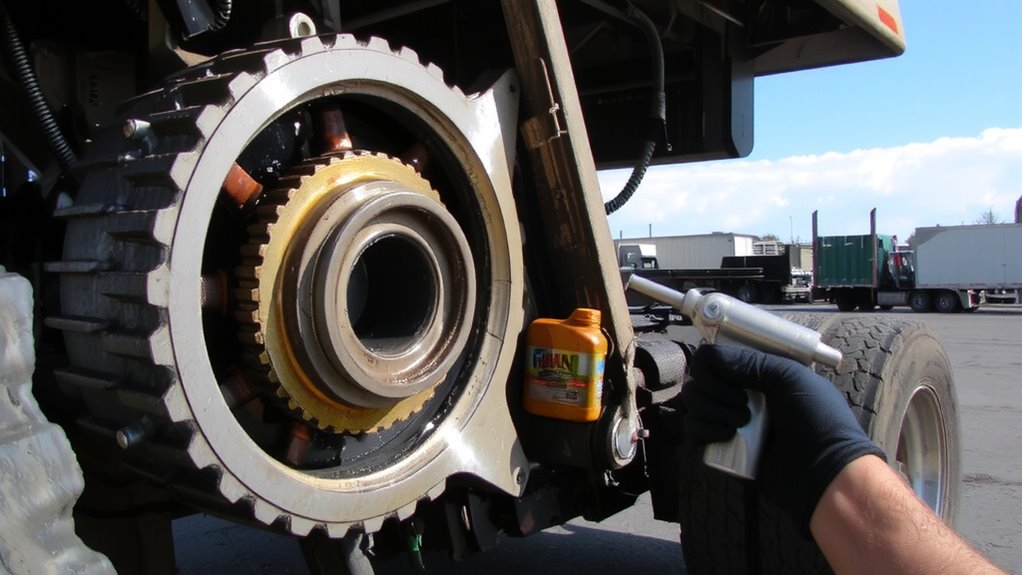
When you’re choosing gear oil, the type of differential and the demands of your workload determine the right formulation-there’s no one-size-fits-all solution. Gear compatibility and load capacity are critical factors. Mismatches can lead to premature wear or failure. Use the right oil to protect your investment and maintain performance under stress.
| Differential Type | Recommended Oil | Load Capacity (Lbs) |
|---|---|---|
| Spiral Bevel | GL-4 | Up to 5,000 |
| Hypoid (Light) | GL-5 EP | 5,000–8,000 |
| Hypoid (Heavy) | High-EP GL-5 | 8,000–12,000 |
| Locking | Synthetic GL-5 | Up to 10,000 |
| Limited Slip | LS-Modified | 6,000–9,000 |
Always verify gear compatibility with OEM specs. High load capacity oils contain more extreme pressure (EP) additives to prevent metal-to-metal contact.
Best Uses for Hypoid Gear Oil in High-Torque Applications
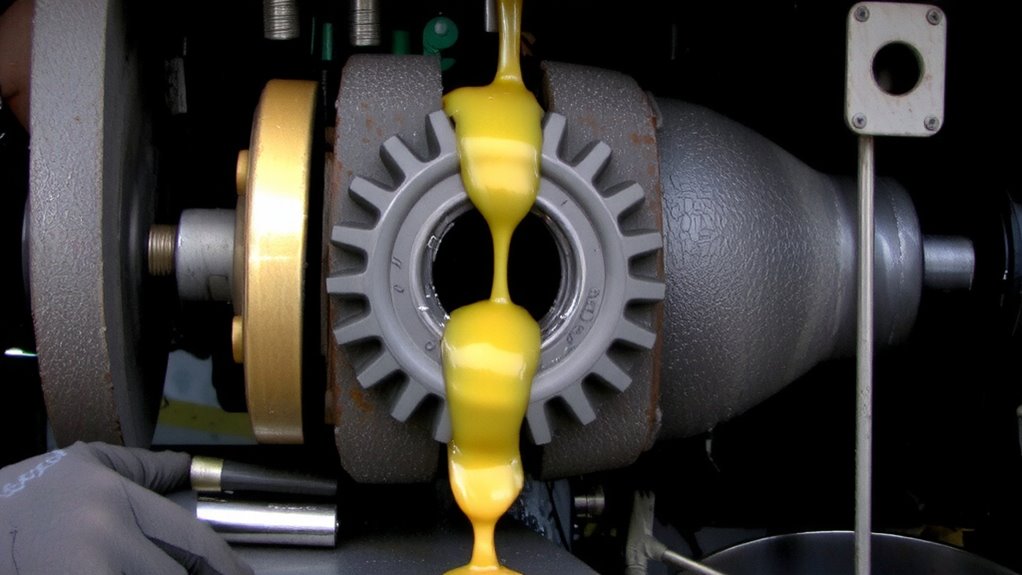
You’ll want to choose hypoid gear oil when facing heavy loads and high-torque conditions, especially in commercial trucks and off-road vehicles. Hypoid gear oil is formulated specifically for the unique sliding and rolling motion in hypoid differentials. It guarantees smooth torque distribution across non-intersecting axis gears, reducing friction and wear under sustained load. The oil’s extreme pressure (EP) additives work alongside high viscosity indices-typically 140 to 250-to maintain film strength at operating temperatures up to 121°C (250°F). Proper gear alignment is preserved because the lubricant resists micro-welding between gear teeth, even under constant high torque. Unlike standard oils, hypoid formulations contain sulfur-phosphorus compounds that protect against scuffing. These oils meet API GL-5 standards and are backward compatible with most older differential designs. Using the right hypoid gear oil maximizes efficiency, extends component life, and supports reliable performance in demanding service cycles.
When EP Gear Oils Excel Under Shock Load and Extreme Pressure
Don’t mistake all high-performance gear oils as interchangeable-while hypoid oils handle sustained torque well, they’re not always the best choice for sudden, intense stress. EP gear oils shine when shock absorption is critical. Their extreme pressure additives, like sulfur-phosphorus compounds, activate under sudden load dynamics to prevent metal-to-metal contact. You’ll see their advantage in applications with rapid torque reversals or heavy impacts-think dump trucks, off-road haulers, or construction equipment. These oils maintain film strength even at momentary pressure spikes exceeding 300,000 psi. That protection reduces pitting and extends gear life. Unlike hypoid formulations, EP oils react chemically under heat and pressure to form a protective barrier. This sacrificial layer absorbs shock and disperses energy. You get reliable performance when load dynamics shift unpredictably.
Use OEM Specifications to Finalize Your Gear Oil Choice
While gear performance under stress is critical, the most reliable guide for selecting the right oil lies in following your manufacturer’s specifications. OEMs design differentials to operate with precise lubricant properties. Ignoring their recommendations risks premature wear or failure. Always check your owner’s manual or equipment label for required API service classification and viscosity grade. Oil color isn’t a performance indicator-it’s often dye-based and varies by brand. What matters is the viscosity index (VI), which measures how much the oil’s thickness changes with temperature. A high VI guarantees stable performance in fluctuating conditions. Below is a comparison of common gear oil specs:
| Specification | Viscosity Index |
|---|---|
| SAE 75W-90 | ≥130 |
| SAE 80W-140 | ≥90 |
| API GL-5 | Standard for most hypoid gears |
| API GL-4 | Lower EP, for synchronized units |
| OEM-approved | Matches factory oil color & VI |
On a final note
You must match gear oil to your differential’s design and load demands. Hypoid oils contain additives for high-torque spiral-bevel gears, providing smooth operation under sustained stress. EP (extreme pressure) oils use sulfur-phosphorus compounds that protect under sudden shock loads. API GL-5 rated oils work for most differentials. Always follow OEM specs-using the wrong oil risks wear or failure. Viscosity grades like 75W-90 guarantee proper flow and film strength.