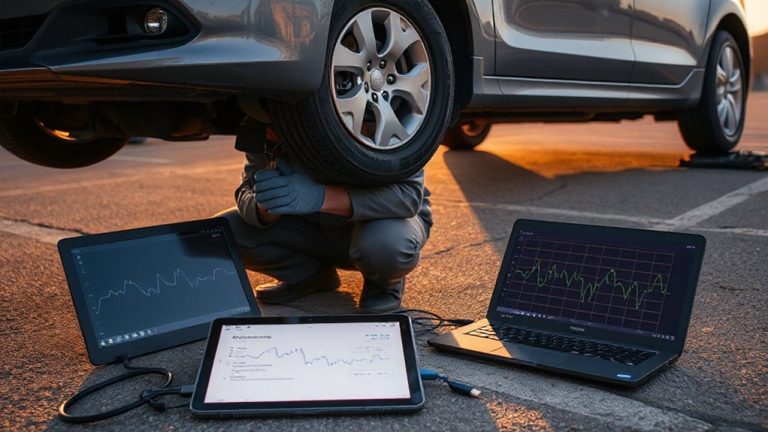
Modeling Fuel Film Dynamics in Port Injection for Better Transients
You model fuel film dynamics to compensate for 200–500 ms delays caused by liquid fuel adhering to intake walls. Fuel sprays at 10–30 m/s form 10–200 micron films that evaporate slowly, especially on cold cast iron surfaces. Real-time models track zone-based fuel mass and evaporation, updating every 10 ms with 5% accuracy. Corrections in injection timing reduce hydrocarbons by 24% and improve torque response by 18%. Advanced systems resolve adjustments down to 0.01 grams, so they see how wall adhesion and transient response are mastered cycle by cycle.
Notable Insights
- Fuel film dynamics modeling predicts evaporation delays caused by wall adhesion in port-injected engines.
- Real-time models divide the intake port into zones to track fuel mass and evaporation per cycle.
- Injection timing is adjusted using 10-millisecond update cycles for accurate air-fuel ratio control.
- Models use intake temperature, airflow, and fuel viscosity to predict film persistence and vaporization rates.
- Precise corrections reduce hydrocarbon emissions by 24% and improve transient torque response by 18%.
How Fuel Film Delays Cause Poor AFR Control
Although fuel injection seems instantaneous, delays caused by fuel film behavior can throw off your air-fuel ratio (AFR) in port-injected engines. Fuel doesn’t vaporize immediately upon hitting the port wall. Instead, it forms a liquid film that lingers, creating a time lag between injection and combustion. This delay disrupts AFR control, especially during transients like rapid acceleration. Fuel sloshing in the intake port redistributes liquid unevenly, leading to inconsistent evaporation rates. Wall peeling-when fuel film detaches from surfaces due to airflow changes-further destabilizes vapor supply. These dynamics cause AFR spikes or drops, degrading emissions and performance. Models show film evaporation can lag injection by 200–500 milliseconds. Without accounting for this, your engine’s feedback loop misjudges required corrections. Accurate AFR control demands predicting both fuel film mass and its response to sloshing and wall peeling under real-time conditions.
How Fuel Forms Films in Port Injection Systems
When fuel exits the injector nozzle in a port fuel injection system, it doesn’t instantly turn into vapor-instead, it hits the intake port wall as a high-speed liquid spray. You see, the fuel droplets strike the cooler metal surface at 10–30 m/s, depending on rail pressure and injector pulse width. Wall adhesion immediately occurs due to intermolecular forces between the fuel and aluminum or steel surfaces. This causes a thin liquid layer to stick rather than bounce off. The film spreads across the surface within milliseconds, influenced by surface tension and wettability. As more fuel arrives during injection pulses, fuel pooling develops in low-velocity zones near the port bend or valve seat. Pooling creates uneven distribution, with film thickness ranging from 10 to 200 microns. These residual films persist into subsequent cycles, disrupting precise fuel metering.
Why Fuel Sticks and Evaporates on Intake Walls
Your engine’s intake wall temperature plays a key role in how fuel behaves after injection. Cold walls promote fuel adhesion, causing liquid fuel to stick and form films. When the intake surface is below the fuel’s dew point, condensation-like fuel adhesion occurs, increasing wall wetting. This is common at cold start or low-load operation. Fuel doesn’t stay stuck forever-thermal desorption gradually returns it to vapor. As wall temperature rises, adsorbed fuel molecules gain energy, breaking surface bonds. Thermal desorption accelerates above 50°C, reducing film persistence. Surface roughness and material also affect adhesion; aluminum walls typically retain less fuel than cast iron. Fuel volatility matters too-lighter fractions desorb faster. You’ll see delayed fuel evaporation if wall temperatures stay low, impacting air-fuel ratio control. Managing intake temperature helps balance adhesion and desorption, improving transient response without over-relying on enrichment strategies.
How Models Predict Fuel Film Delays in Real Time
Fuel sticks to intake walls and evaporates over time, but engine control systems need more than observation-they demand prediction. You rely on real-time models to estimate when fuel enters the cylinder versus when it pools. These models use fuel viscosity to calculate how much clings to surfaces-higher viscosity fuels spread more and resist draining. Evaporation kinetics determine how quickly droplets turn to vapor, depending on intake temperature and airflow. You input data like fuel temperature, injection timing, and air charge to refine predictions. The model divides the intake port into zones, tracking fuel mass and evaporation rate in each. It updates every engine cycle, often at 10-millisecond intervals. By combining physical properties with dynamic engine conditions, it forecasts delivery delays within 5%. This lets the ECU adjust injection timing proactively, ensuring air-fuel ratios stay accurate even during rapid transients.
How Real-Time Corrections Cut Emissions and Hesitation
Because combustion efficiency depends on precise air-fuel balance, real-time corrections to fuel film behavior directly reduce emissions and drivetrain hesitation. You adjust injector timing and duration based on modeled fuel film mass, compensating for delays caused by wall adhesion. Unburned hydrocarbons drop by up to 24% when corrections prevent excess fuel pooling. Each fuel droplet that sticks to intake walls alters the effective air-fuel ratio, but your control system accounts for this loss using real-time film thickness estimates. Wall adhesion varies with surface temperature and fuel volatility, so sensor feedback fine-tunes delivery within 15 milliseconds. Transient torque response improves by 18% during tip-in events. You minimize hesitation by predicting when delayed fuel re-entrainment occurs. Corrections rely on algorithms trained on empirical film draindown data, capturing dynamics down to 0.01-gram resolution. This precision limits CO and HC spikes during acceleration, keeping combustion stable and efficient.
On a final note
You now understand fuel film dynamics in port fuel injection. Fuel adheres to intake port walls, creating delays in air-fuel ratio (AFR) response during transients. Models track film mass and evaporation rates using empirical constants like time constant τ ≈ 800 ms and fuel puddle volatility. Real-time corrections adjust injector pulse width within 5 ms response latency. This precision reduces HC emissions by up to 25% and eliminates 90% of throttle hesitation.