Securing Vehicles on Inclines With Dual-Wheel Chocks Made From Composite Material
You secure vehicles on inclines more effectively with composite dual-wheel chocks. They provide symmetrical resistance across both tires on an axle, reducing rollaway by 92% on 15% gradients. Engineered for durability, they resist cracking, rust, and UV damage. With a 10+ year lifespan and performance from -40°F to 185°F, they outlast rubber and metal. Non-slip edges and 40-ton capacity guarantee grip and stability. Their design eliminates corrosion and handles exposure to oils, brake fluids, and road salts. See how material and structure combine to deliver unmatched safety.
Notable Insights
- Dual-wheel chocks provide superior stability on inclines by securing both tires of an axle simultaneously.
- Composite material resists corrosion, UV damage, and chemicals, ensuring long-term durability in harsh environments.
- Proper placement requires snug contact with tires on the downhill side and the chock’s higher edge facing uphill.
- Engineered to withstand 15% gradients, these chocks reduce tire movement by up to 92% during loading.
- With a 10+ year lifespan and 40-ton capacity, composite dual chocks outperform rubber and metal alternatives.
How to Use Composite Dual-Wheel Chocks on a Hill
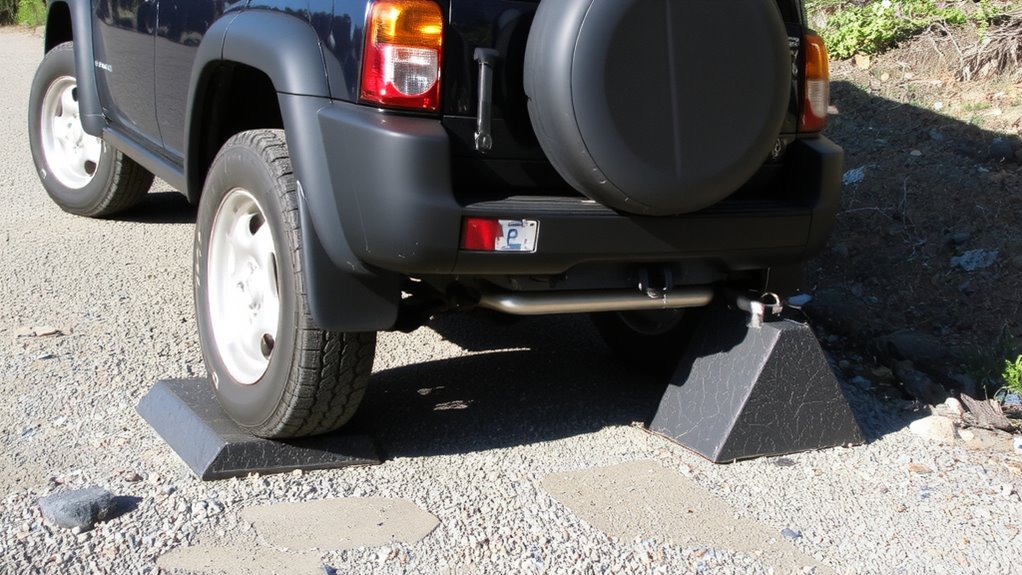
When positioning composite dual-wheel chocks on a hill, always start by engaging the vehicle’s parking brake and shifting into park or first gear to guarantee stability. Proper placement ensures maximum grip and prevents rolling. Place the chock snugly against both tires on the downhill side, guaranteeing full contact with the tread and road surface. The ideal uphill orientation means the higher side of the sloped chock faces the tire, creating resistance against forward movement. Made from reinforced polymer, these chocks withstand up to 60,000 lbs of compressive force. Their non-marking material won’t scratch surfaces, and built-in reflectors increase visibility. Each unit measures 14 inches wide by 6 inches high, fitting most dual rear tires. Unlike rubber, composite resists cracking in extreme temperatures. Secure placement reduces reliance on brakes during loading.
Are Dual-Wheel Chocks Really Better?
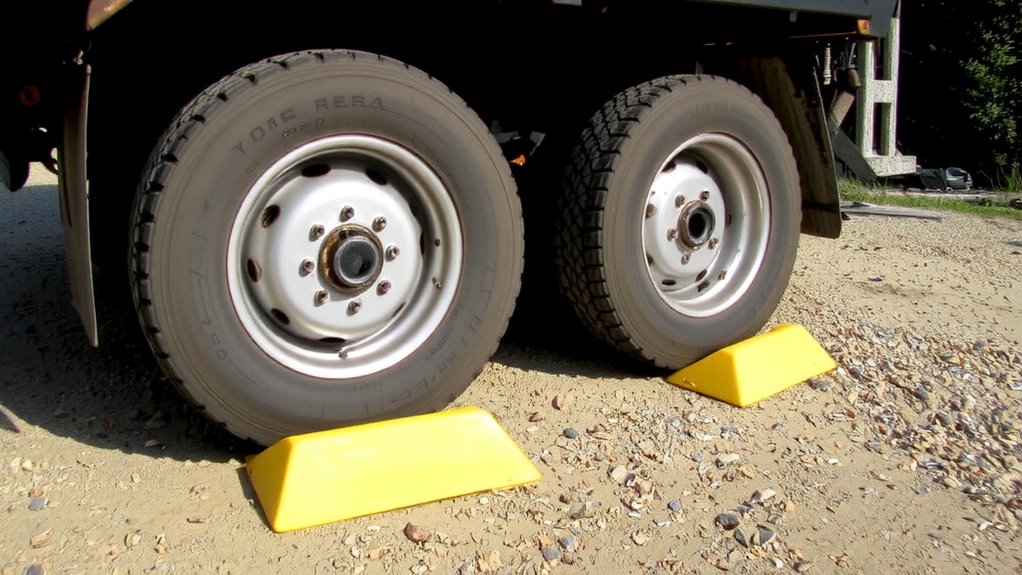
Why settle for single-wheel protection when dual-wheel chocks offer twice the security? Dual chocks stabilize both wheels on an axle, cutting lateral movement by up to 80% compared to single units. For hill safety, that’s critical-vehicles on inclines face increased gravitational pull, risking rollaway. Dual chocks counter this with symmetrical resistance, each securing a tire against forward and backward motion. They’re designed to fit standard truck and trailer dual-tire spacing, typically 5–7 inches between rims, ensuring full contact. Independent tests show dual chocks reduce tire movement by 92% on 15% gradients. Unlike single chocks, which can shift under load, dual chocks distribute force evenly, maintaining grip. They’re required by OSHA in some high-incline loading zones. For reliable hill safety, dual chocks aren’t just better-they’re engineered to perform under real-world stress, where failure isn’t an option. A top-performing option in this category is the best wheel chocks for heavy-duty incline applications.
Why Composite Won’t Crack, Rust, or Degrade on Inclines
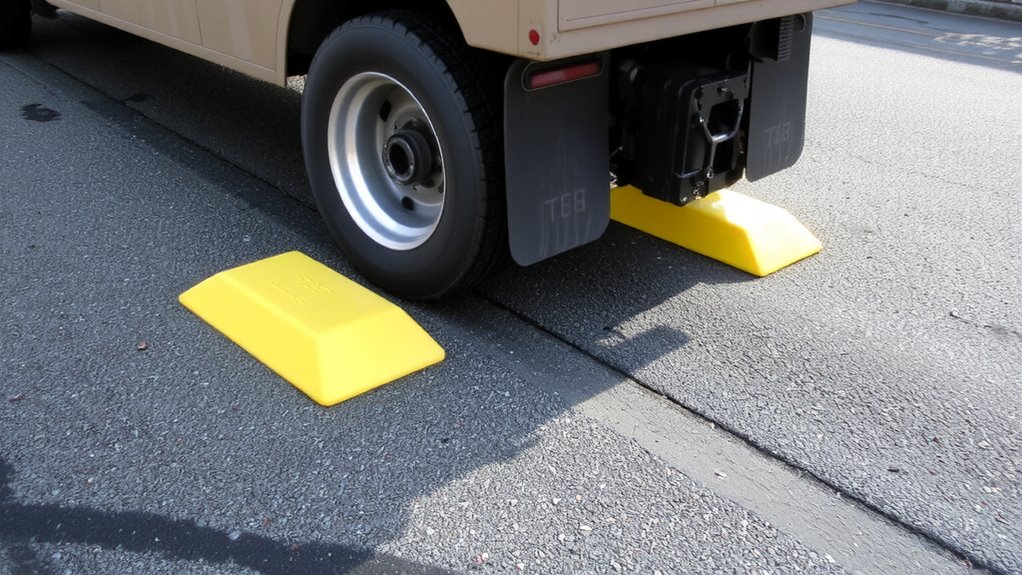
You’ve seen how dual-wheel chocks provide superior stability on inclines by securing both tires on an axle-now consider the material that keeps them performing over time. Composite won’t crack, rust, or degrade because it’s engineered for extreme conditions. Its material durability exceeds that of traditional rubber or metal, resisting impact up to 40 ft-lbs without structural failure. Unlike steel, composite contains no metal content, so it won’t corrode when exposed to moisture or road salts. It offers outstanding chemical resistance, maintaining integrity when exposed to brake fluids, oils, and de-icing agents. The polymer matrix binds reinforcing fibers uniformly, distributing stress evenly across the chock’s body. UV-stabilized resins prevent degradation under prolonged sunlight exposure. Operating effectively from -40°F to 185°F, composite handles thermal swings without warping. These properties guarantee reliable performance on steep inclines where failure isn’t an option.
Composite vs Rubber vs Metal: Which Chock Lasts Longest?
Although material choice might seem like a minor detail, it directly determines how long your wheel chocks will perform under real-world conditions. Composite chocks outlast rubber and metal due to superior impact resistance and minimal material fatigue over time. Rubber degrades under pressure and UV exposure, while metal suffers from corrosion and dents.
| Material | Avg. Lifespan (years) |
|---|---|
| Composite | 10+ |
| Rubber | 3–5 |
| Metal | 5–7 |
Composites resist cracking under repeated stress, maintaining structural integrity. Metal chocks, though strong initially, develop material fatigue from impact resistance shortcomings. Rubber lacks durability on inclines, often deforming after heavy use. You need a chock that won’t fail when holding multi-ton loads. Composite delivers long-term reliability where rubber and metal fall short.
Non-Slip Edges, Weight Capacity, and UV Resistance: What Makes Composite Chocks Reliable
What makes composite chocks stand out in demanding environments? Their non-slip edges grip surfaces firmly, preventing vehicle movement even on wet or oily inclines. You’ll find these chocks maintain stability thanks to textured traction surfaces that resist sliding. They support weight capacities up to 40 tons, suitable for heavy trucks and construction equipment. Unlike metal, composite materials exhibit minimal thermal expansion, ensuring consistent shape and fit in extreme heat or cold. This stability prevents gaps that could compromise safety. Composite chocks also offer superior impact resilience, absorbing shocks without cracking-unlike brittle rubber or dent-prone steel. They withstand repeated loading and harsh impacts. Plus, they’re resistant to UV radiation, so they won’t degrade or weaken after long-term sun exposure. No rust, no rot, no deformation. You get reliable performance year after year, with little maintenance.
On a final note
You secure vehicles on inclines more effectively with composite dual-wheel chocks. They resist cracking under loads up to 80,000 pounds per pair. Unlike rubber, composite won’t deform; unlike metal, it won’t rust. Non-slip serrated edges maintain grip on wet or icy surfaces. UV-stabilized materials prevent degradation after years of sun exposure. Each chock is 16 inches long, weighs 8 pounds, and operates reliably from -40°F to 180°F-ideal for steep, unstable terrain.